Prices as of September 10, 2026, 7:23 p.m. ET. Record compiled from 31 sourced items across 25 dated sources; see the sourced record file for every citation.
This is the strongest honest case for Jack Reed. The companion piece argues the other side: Why Raymond McKay (R) Will Win the Rhode Island Senate Race.
On Sunday, June 14, 2026, Jack Reed went on Fox News Sunday and told Shannon Bream that walking away from the Obama-era Iran agreement "was a bad mistake by the president," and that Trump's tentative Iran deal, which Reed would later call "a deal to make a deal," left the country in a "much worse position" than the one it had torn up. "I think the precipitating issue today is the president wants to give himself a birthday present," he said. "And we have paid for it with hundreds of billions of dollars." The war he was describing began on February 28, 2026. Reed is the senior Democrat on the Senate Armed Services Committee, had called it "this irresponsible war" in April, and by its sixth month, on August 28, his office was counting 18 servicemembers killed and more than 700 wounded. At 4:22 that afternoon, the president answered on Truth Social, in a post WPRI's Ted Nesi transcribed the next day:
"Senator Jack Reed, a Dumocrat from R.I., lied when stating the the Deal we just made is not as good as the Obama disaster known as the JCPOA...Impeach Jack Reed!"
The same post, Mediaite reported, called him "either an outright fraud, or incompetent."
Reed's shortest reply to the calls to impeach him, reported by the Boston Globe on June 16, ran four words: "The truth hurts sometimes." His longer one, on Monday, June 15: "The president does not like to be questioned in any way, shape or form, which is bad for an executive." The man who is now his Republican opponent took the other side of it. "The real problem is that Rhode Island's Reed is part of a party that never wants President Trump to succeed," Ray McKay said, and by June 17 WPRI was reporting that McKay backed the president's call to impeach him. A sitting senator cannot be impeached; the Senate can expel one only with a two-thirds vote.
Eighty-seven days after that Sunday, Rhode Island answered too. On September 9, 2026, Reed took the Democratic nomination for a sixth term with about 77 percent of the vote. The two challengers, both progressives, had run at him from the left on Gaza and, in Connor Burbridge's case, on his age. On Kalshi, where a price in cents is a probability, the contract that pays if a Democrat is sworn into this seat asks 99 cents. The interesting number is the margin, not that one, where the same exchange prices a real argument, and I make the case for it below.
Stay ahead of the markets.
Daily insights and expert picks on Kalshi, Polymarket, and what's moving markets.
Free forever. Unsubscribe anytime.
The Board
As of September 10, 2026, 7:23 p.m. ET (Kalshi, cents = probability; the bid is what a buyer will pay, the ask is what a seller wants):
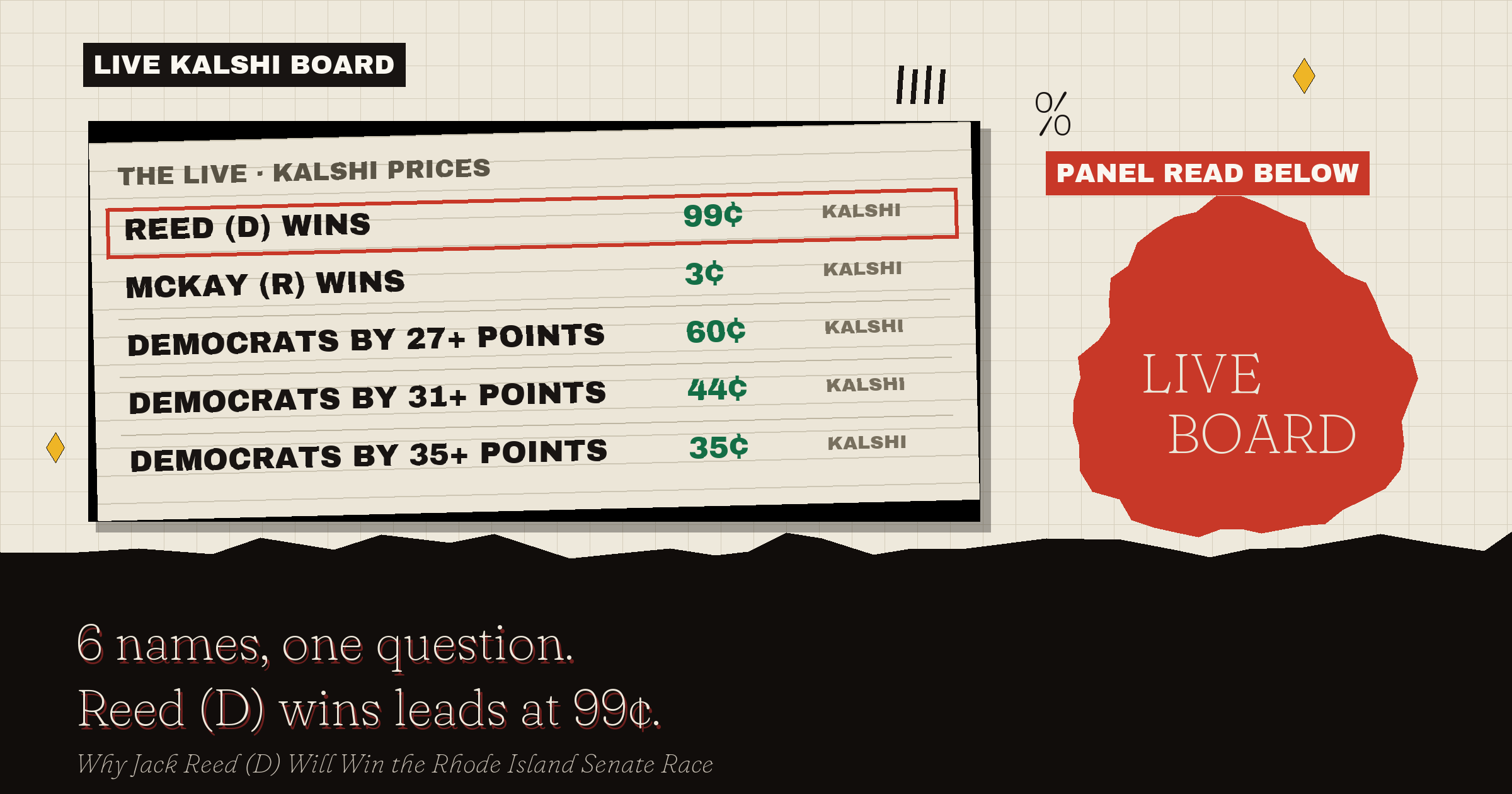
| Outcome | Yes price (buyers bid / sellers ask) | Reads as |
|---|---|---|
| Reed (D) wins | 98/99¢ | about 99% |
| McKay (R) wins | 1/3¢ | about 2% |
| Democrats by 27+ points | 59/60¢ | about 60% |
| Democrats by 31+ points | 36/44¢ | about 40% |
| Democrats by 35+ points | 26/35¢ | about 30% |
| Turnout above 400K votes | 26/35¢ | about 30% |
The price is saying the seat is all but decided and the open question is the score. The winner contract has traded about 11,200 contracts on Reed's side over its life, with 590 changing hands on September 8 and 356 on September 10, and the ask moved from 98 cents to 99.5 before settling at 99.3. The margin ladder is where the money still disagrees with itself: Democrats by 27 or more points sits at 60 cents, by 31 or more at about 40, by 35 or more at about 30. Those rungs are thin, 219 lifetime contracts on the by-27 rung and about 1,000 on the by-31 rung, and the turnout rung above 400,000 votes shows a quote with zero contracts traded. The winner contract resolves Yes if a Democrat is sworn in for the term beginning in 2027.
What the Models Think
We also asked a panel of AI models the same question without showing them the price, only the sourced record this article is built on. Six of the panel's eight seats ran this board, and their middle answer put Reed at 98 percent, about a point under the 99-cent ask. The spread was two points, from 97 to 99. Every seat cited the polls, three this year with Reed ahead by 17 to 20 points; five of the six cited the eleven independent raters with the race at Solid or Safe Democratic, and most added the state Kamala Harris carried by nearly 14 points in 2024 or the cash gap. As one model put it, a "five-term incumbent in a deep-blue state with a 20-point polling lead, 1,000-to-1 cash advantage, and unanimous Safe/Solid D ratings from all eleven forecasters."
When a price-blind panel and real money land about a point apart, there is no case to make about the winner. The case worth making is about the margin, and it starts with what the primary just measured.
More live boards from the same panel: New Hampshire Senate: Pappas vs Sununu · Michigan Senate: El-Sayed vs Rogers · every 2026 Senate race we track · the 2026 Senate election odds board. Prices fetched September 10, 2026.
Six Democratic Ballots For Every Republican One
Start with the two turnout numbers from September 9, because they are the whole general election in miniature. The Democratic primary counted 125,629 votes. The Republican primary, in which McKay was the only name on the ballot, counted 20,203. The Democratic primary drew about six ballots for every one in the Republican primary on a night when the Republican contest was uncontested and the Democratic side had two Senate challengers and a governor's race that removed an incumbent. That ratio measures where the contests were as much as where the voters are, so read it as a turnout signal rather than a floor. It is still a signal the Republican side has no answer to.
The second mechanism is the one the panel kept reaching for, and it is Reed's own record. He has won this seat five times and has never finished below 63 percent. His margins run 28 points in 1996 over Nancy Mayer, 57 in 2002, 42 in 2014 over Mark Zaccaria, and 33 in 2020 over Allen Waters, with 73 percent of the vote in 2008. Rhode Island in 2024 gave Harris 55.5 percent to Trump's 41.8, and gave Sheldon Whitehouse a 20-point win over Patricia Morgan the same day. Morgan is the Republican who beat McKay in the 2024 Senate primary, 64 percent to 36. The man Reed faces in November lost his own party's primary two years ago by 29 points to a candidate who then lost the general by 20.
The third mechanism is the money, and the gap is more than a thousand to one. The Federal Election Commission filings through June 30, 2026 had Reed with $3,642,761 in cash and McKay with $2,745. Fox News reported about $3.1 million on hand for Reed as of August 20; the Rhode Island Current put his account above $3.7 million the same week. McKay, 65, an Army veteran who ran the network for the City of Warwick for 26 years and led the Rhode Island Republican Assembly from 2005 to 2014, had raised $163,438 through June 30 and spent almost all of it. The University of New Hampshire Survey Center's August release called him "largely unknown in the state." That is the reason the polls look the way they do.
| Poll | Field dates | Sample | Reed (D) | McKay (R) | Bahry (I) | Undecided |
|---|---|---|---|---|---|---|
| UNH Survey Center | Aug. 20-24, 2026 | 750 LV, ±3.6 | 51% | 31% | 4% | 13% |
| UNH Survey Center | June 18-23, 2026 | 664 LV, ±3.9 | 52% | 35% | not named (other 1%) | 12% |
| UNH Survey Center | Apr. 16-20, 2026 | 556 LV, ±4.0 | 52% | 34% | not named (other 2%) | 12% |
The row worth a second look is the August one, because it is the only poll that named Michael Bahry. Bahry, 58, a theology lecturer at Salve Regina University and former construction executive who calls himself "Rhode Island's wildcard," took 4 percent, and McKay's number fell from 35 in June to 31. One poll, within the polls' margins of error, is not proof, but it is consistent with the independent drawing from the challenger rather than the incumbent. The full 2026 Senate map and the balance-of-power board both carry this seat as part of the Democratic floor, the 13 seats the party is defending against 22 for the Republicans, and the president's party has lost an average of 3.3 Senate seats across the 20 midterms since 1946. Reed is not in the president's party.
The Age File, The Gaza Vote And The Twenty-Point Question
The case has a file to beat, and this format does not let it hide. Reed was born on November 12, 1949; he turns 77 nine days after the election. GoLocalProv put the argument in an editorial on May 27, 2025 under the headline "It Is Time, Senator Reed": "The mandatory retirement age for generals in the U.S. Army is 64 years old. That can be extended to 66 by the Secretary of Defense or 68 by the President of the United States, but no further. Reed has already passed that extended age by seven years." The same outlet had written in September 2023 that "to date, Reed has shown no decline," and the UNH August release found a majority of Rhode Islanders believe he is "mentally and physically capable of serving another term at the current age of seventy-six." His campaign spokesperson, Benjamin Craig, told the Rhode Island Current he works "7 a.m. to late at night" on some days.
Then there is the primary itself. Burbridge, the 31-year-old elder care worker who took 13.4 percent, and Luis Daniel Muñoz, a medical school graduate who has worked as a technology consultant and took 9.7, both ran on cutting military aid to Israel; Reed's answer on the trail was "We can't forget Oct. 7." Burbridge's line was generational: "I have a lot of respect for Sen. Reed. But it's time for a new generation of leaders to step up," and "Jack Reed has been hesitant to do what he can to try and gum up the works of this administration." Reed had not answered his debate challenge as of Ocean State Media's August 24 report, and 23 percent of Democratic primary voters picked one of the two challengers. Burbridge had raised a little over $25,000; Muñoz listed no FEC totals. That is the protest share the general-election margin has to absorb. McKay had no primary to absorb anything in; he ran unopposed, and his primary page covers how he got the line.
The weakest link is the number the ladder is arguing about, and it is the one I keep coming back to. The August poll gave Reed a 20-point lead with 13 percent undecided. Split those undecideds the way the decided vote split, 51 to 31, and the margin lands near 23 points, under the by-27 rung that asks 60 cents. To clear 27, Reed needs about ten of those thirteen points, roughly three of every four undecided voters, and undecideds do not have to break like the decided vote; that split is a starting point, not a forecast. Here is the math I trust more than the poll. In 2020 he ran 12 points ahead of Joe Biden's 20.8-point margin in the state; in 2024 Sheldon Whitehouse ran six points ahead of Harris's 13.8. Add Reed's 2020 overperformance to Harris's margin and you get about 26. So the margin is the fight, not the seat: by my math the by-27 rung at 60 cents is priced a little rich, and the case for the upper half of it is the environment, an impeachment call, a six-month Iran war, and a president who took 41.8 percent here in 2024. The winner contract at 99 cents is priced as a fact; the Reed primary page already made the case that the nomination would be.
A Worked Example of the Trade
One Yes contract on the Democratic side at the 99-cent ask pays $1.00 if a Democrat is sworn into this seat: risk 99 cents to profit one cent, before fees, which is why the argument on this page lives on the ladder instead. The rung worth understanding is the pair at 25 and 27: Democrats by 25 or more asks 67 cents, and Democrats by 27 or more asks 60. A wider margin can never be more likely than a narrower one, so those two asks cannot both be right; that inversion, on 125 and 219 lifetime contracts, is what a thin ladder looks like, and it is the reason to read every rung here as an opinion rather than a depth-tested price.
The Bottom Line
Rhode Island is priced as a 99-cent Democratic hold, and a price-blind panel put it at 98, so the case for Jack Reed is not an argument with the market. It is the record: five wins never below 63 percent, a primary electorate six times the size of the Republican one, a challenger who lost his own party's primary by 29 points in 2024 and reported $2,745 in the bank in June, and eleven raters who agree. The real question lives on the margin ladder, where Democrats by 27 or more sits at 60 cents against a 20-point August poll with 13 percent undecided, and my own math above lands at about 26. The seat is not the argument; the score is. The counterweight is that Reed is 76 with an editorial page telling him to go, that 23 percent of his own primary voted for challengers who ran on Gaza and his age, and that the state's presidential margin narrowed by seven points between 2020 and 2024. The 60-cent question, not the 99-cent one, is whether an impeachment call and a six-month war turn a 20-point lead back into the 33-point win he posted last time.
More on this: 2026 Senate Races: Every Kalshi Board We Track · Why N'Kiyla Thomas (D) Will Win the Oklahoma Senate Race · Why Alani Bankhead (D) Will Win the Montana Senate Race · Why Andy Barr (R) Will Win the Kentucky Senate Race · Why Cory Booker (D) Will Win the New Jersey Senate Race
What Moves The Price From Here
- The first post-primary poll. UNH has polled this race in April, June and August; its next survey, with McKay and Bahry both named, sets the margin argument. Reed above 55 with the undecideds shrinking pushes the by-27 rung up from 60; a repeat of 51-31 is a 20-point race and pushes it down. Bahry is the tell inside that poll: the independent only matters to the ladder if McKay's number drops below 31 while Bahry's rises.
- A debate. Reed had not answered Burbridge's challenge as of late August. Whether he takes a general-election stage against McKay and Bahry in October 2026, and how the age question plays on it, moves the ladder, not the winner contract.
- The turnout market. The state cast 514,562 votes for president in 2024; the exchange quotes a midterm Senate vote above 400,000 at about 30 cents, on a rung with zero contracts traded. The first actual trades there will say whether anyone expects a presidential-scale electorate, and all of it is decided by the vote on November 3, 2026.
Follow Dave on X: @Loughy.
Hero illustration: OddsShopper, in the house collage style. Jack Reed photo by United States Senate, licensed Public domain; photos cropped, toned, and composited.
Prices quoted are live Kalshi market prices as of September 10, 2026, 7:23 p.m. ET, and will keep moving until this market settles after the November 3, 2026 vote.). OddsShopper covers prediction markets as an independent analyst: any model or panel figures referenced are model estimates, not predictions of fact and not financial advice. This article does not advocate for or against any candidate or party. Trading involves risk; contracts can go to zero. The panel's graded record lives on the public Model Verdict Scoreboard.