Most bettors who want an edge on NBA player props hit the same wall: they know a number on the board looks soft, but they have no way to prove it. Learning how to make your own NBA projections is how you turn that hunch into a real, priced-up read, and you do not need a spreadsheet or a stats degree to do it. OddsShopper hands you the same projection model we bet off of, lets you adjust the inputs you have an opinion on, and then shows you exactly which player props that produces are priced in your favor. This guide walks the full custom NBA projections workflow for a night of games, from editing a starter's minutes to firing the bet at the book with the best number.
TL;DR: Building Custom NBA Projections In OddsShopper
- Start From A Real Model. The tool loads the Stokastic origination projections we use for our own NBA betting, then lets you overwrite only the inputs you have a read on.
- Lead With Injuries. Minutes drive usage, and usage drives every counting stat, so reassigning the minutes a questionable starter frees up is the single most valuable edit you can make.
- Edit Minutes And Rates. Bump a player's projected minutes or per-minute scoring rate and every one of his props re-prices; cutting a player's minutes surfaces his unders as +EV.
- Blend With The Market. Slide between 100% your model and a model/market blend to keep one strong opinion honest.
- Shop And Fire. The tool surfaces every +EV prop across the sportsbooks you select, flags the book paying the best number, and pre-loads the bet slip in one click.
Watch: How To Build Your Own NBA Projections
This walkthrough runs through the whole flow on a live NBA board, from editing a player's minutes to firing the bet at the book with the best number.
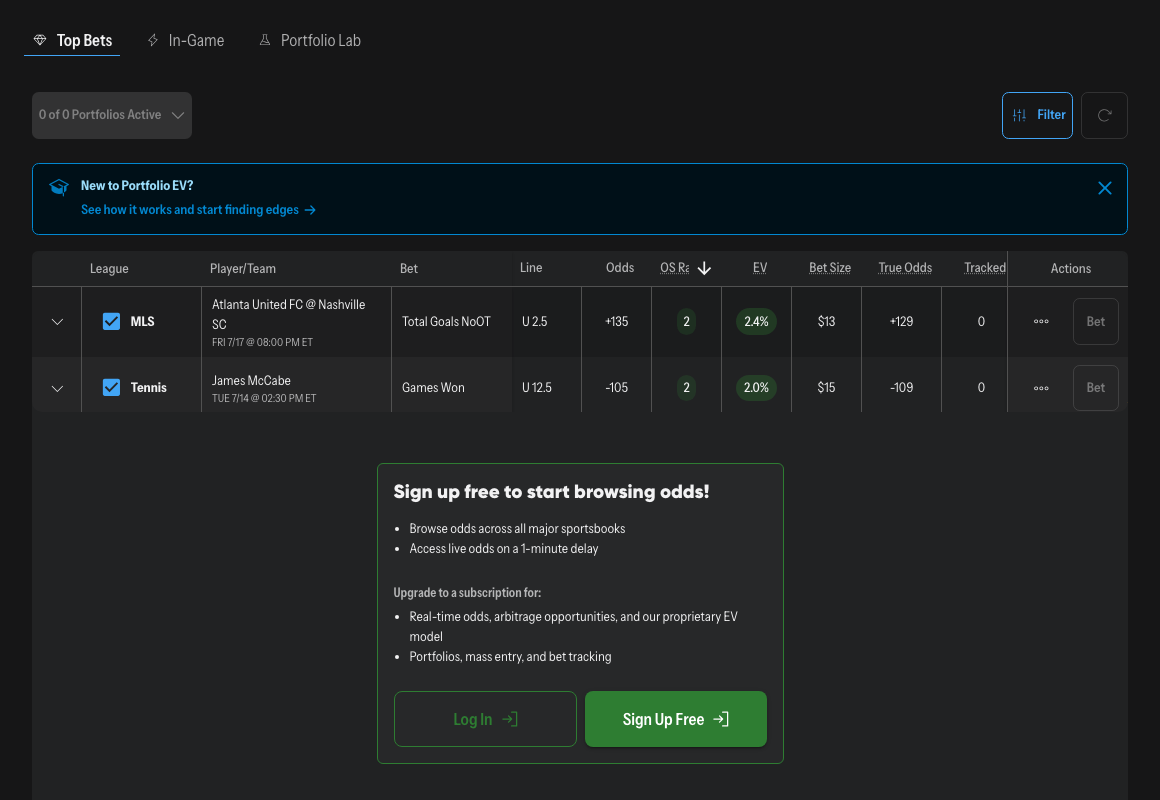
The OddsShopper +EV Screen.
Start From A Real Model, Then Make It Yours
You can bet straight off the projections the tool loads in if you want — the same Stokastic model we use for our own betting and DFS, loaded in as what the tool calls the origination projections. But the point of building your own is that you usually know one thing the model is still catching up to: a rotation change, a coach's tendency, or a questionable starter you are confident is sitting. Everything is built so you can keep what the model gives you and overwrite only the pieces you have a real opinion on.
Pick any game on the board, click the team, and every player's projection becomes editable. Nothing you change is permanent, so this is a sandbox: adjust an input, watch the projection move, and see which player props flip to +EV as a result.
Lead With The Injury Report, Because Usage Is Everything
In the NBA, opportunity comes before talent. Minutes and usage drive every counting stat a prop is built on, so the single most valuable thing you can do to a projection is reassign the minutes an injury frees up. This is why OddsShopper surfaces an injury report for the games on the slate, flagging the high-impact situations and writing up which players are questionable and what they are dealing with. It is the same usage-first logic behind the whole OddsShopper NBA betting tool: find the vacated minutes first, and the mispriced prop follows.
Put it to work like this: if a starter is tagged questionable and you are confident he sits, project him for zero minutes. Those minutes and his scoring rate do not vanish; you reallocate them to the teammates who absorb them. The model re-prices every prop for the players who just inherited that usage, and the bets that appear are the ones built on the edge nobody has fully accounted for yet. A confirmed late scratch is the most actionable thing in basketball, and this is how you put a number on it the moment you see it.
A Worked Example: Editing Minutes Into A +EV Bet
Take the Philadelphia 76ers example the video walks through. In that demo the model has Andre Drummond at 22.9 minutes and Adem Bona at 24.7, and it plays out a simple read: you think Philadelphia leans on Bona for a couple more minutes of center rotation. Bump Bona up two minutes, trim Drummond by a couple, and open the projection menu to see what it did. Your slate will put different names and matchups in front of you every night, but the mechanic never changes.
Bona's projected production rises with the minutes. His rebound line is the clean one to read: it sat at 5.5, and after the bump the model projects him for 6.6 boards, so the over on rebounds is now +EV. If boards are the market you keep landing on, our guide to betting NBA rebounds props breaks down the matchup reads behind them. You can shop that exact market on the NBA player props board the moment you find it.
The points line shows you something subtler about how projections actually work. One of Bona's alternate lines is over 9.5 points at +220. Even with the extra minutes, the model only projects him for 8.1 points, so a beginner would skip it. But a projection is a distribution, not a single number, and the model has him clearing 9.5 points in 35% of outcomes. A +220 price only needs the bet to hit just over 31% of the time to break even, so 35% to win is a +EV play even though the average projection sits below the line. That gap between what the model says will happen and what the book is paying is the whole game.
New to OddsShopper?It scans every major sportsbook and flags the player props the books have mispriced, doing automatically what you just did by hand. Try it free for 7 days, and code NBAPROJ20 takes 20% off OS Pro if you subscribe: Start your free trial.
Edit The Rates, Not Just The Minutes
Minutes are the blunt lever; scoring rates are the fine one. If you think a player is more efficient than the model has him, open his rate editor and nudge his scoring rate up, apply the change, and every points-based prop re-prices off the higher number. The two levers stack: when you cut a player's minutes, the flip side is that a wave of his unders tends to surface as +EV, things like under 0.5 made threes or under 8.5 rebounds plus assists for a player you just downgraded. Customizing in one direction almost always opens bets in the other.
Here is what each input controls and how it moves a projection:
| What You Edit | What It Represents | How It Moves the Projection |
|---|---|---|
| Minutes | A player's share of playing time | Scales every counting stat up or down; the biggest single lever |
| Scoring Rate | Per-minute scoring efficiency | Re-prices a player's points props off the adjusted rate |
| Project A Player To 0 Minutes | A confirmed or expected sit | Frees his usage and minutes to reallocate to teammates |
| Model Vs. Market Blend | How much you trust your read vs. the field | Averages your projection with the market line to set fair value |
Blend Your Read With The Market
Your opinion does not have to carry the whole projection. A slider moves you between your own model output and market-based projections. At 100% origination, you are betting purely off the model (and your edits). Set it to 50/50, 75/25, or anywhere in between, and the blend averages your fair lines with the market's to set a single number.
This is wisdom-of-the-crowd as a guardrail. Blending toward the market keeps one strong opinion from overwhelming the projection and pulls your edits back toward a price the whole field has weighed in on. The +EV bets that survive a blend are the ones still showing value after your read is pulled back toward the market, which gives you a steadier baseline than either number alone. The market price is the benchmark; your job is to find the gap, not to out-argue it on every line.
Shop The Number And Fire It In One Click
Finding a +EV prop is only half the job. The same edge disappears if you take it at a worse price, which is why line shopping on the OddsShopper odds screen is baked right into the projection flow. The same rebound over can be priced differently across the books you hold accounts with, whether that is DraftKings, FanDuel, BetMGM, or Caesars, and even a half-point of line or a few cents of juice is real money over a season. So once a bet surfaces, the tool shows you the line at every book you have selected, configurable in the top-left so you only see the sportsbooks you actually hold accounts with. It tells you which of your books is offering the most +EV lines, you add the bet to your slip, and placing it opens that sportsbook with the wager pre-loaded. You bet the best available number without manually checking each app, and a Clear button wipes the slip if you change your mind. To see every edge across the night's games at once, the Top Bets view lists every top bet on the board under whatever projections and blend you have set.
Trust The Timestamp Before You Bet
Every set of projections carries a last-updated timestamp, and you should read it before you fire. It tells you whether the model has accounted for the latest injury news. Say a star is ruled out at 3:10 p.m. ET but the projections last refreshed at 3:04; you know that scratch is not baked in yet, and the boost it gives his teammates is not reflected in the projections you are looking at. That is also why betting it early matters: the line movement after a confirmed scratch usually runs against you, so a +EV number now often turns into beaten closing line value later. The model updates quickly as lock approaches, but the timestamp is how you confirm it. And if you want to wipe every edit and return to the base model, the reset minutes and rates button puts you back to square one.
The Bottom Line
Making your own NBA projections comes down to the exact move you just made on Bona: read tonight's injury report first, hand a questionable starter's minutes to the teammate who absorbs them, and let the model re-price every prop off that one edit. That is the entire NBA prop betting strategy here: start from a real projection, reallocate the minutes an injury frees up, edit the rates where you have conviction, blend toward the market to stay honest, and bet the best number across your books. It is a repeatable process for finding the +EV NBA props the field has mispriced, night after night. You can pressure-test your reads against the live odds on the NBA odds screen any night there are games, or start from our free NBA and sports betting picks and reverse-engineer the projection behind each one.
Stop leaving the better number on the table.OddsShopper builds the projections, flags the +EV props, and shows you which of your sportsbooks pays the most for each one. Try it free for 7 days, then 20% off OS Pro with code NBAPROJ20: Start your free trial.
FAQ
Do I need to be a stats expert to make my own NBA projections? No. You start from OddsShopper's model and only adjust the inputs you have an opinion on, like a player's minutes or a coach's rotation. The tool handles the math and re-prices every prop for you.
Why does editing a player's minutes change so many props? Because minutes drive usage, and usage drives every counting stat a prop is built on. When you reassign the minutes an injured player leaves behind, the model re-projects points, rebounds, and assists for the teammates who absorb them.
What does blending with market-based projections do? It averages your projection with the market's to set fair value. The market price reflects where the whole field has landed, so blending toward it keeps your edits honest and gives you another baseline instead of relying on your adjusted projection alone.
How do I know which sportsbook to bet a +EV prop at? OddsShopper shows the line at every book you have selected and flags which one offers the best number. You add it to your slip, and placing the bet opens that sportsbook with the wager pre-loaded so you never take a worse price by accident.
More on this: NBA Championship 2027 Odds: Live Title Prices By Team · NBA Next Team Odds: Every Star's Landing-Spot Market, Scored · How Does Kalshi Make Money? The Charge You Can't See · Why Did My PrizePicks Projection Change? What It Tells You · How To Bet NBA Assists Props: A Strategy Guide