Every draft class arrives with a quarterback the whole league already has an opinion about, and 2026 is no different: Fernando Mendoza went first overall to the Raiders, Ty Simpson went in the top half of the first round to the Rams, and the takes were flying before either of them signed a contract. Then you look at the depth charts and the story flips. Most signs point to Mendoza opening the year behind Kirk Cousins, Simpson sits behind Matthew Stafford, and outlets from NFL.com to Bleacher Report have floated something that has not happened since 2022: a season that could kick off with no rookie quarterback starting in Week 1 at all.
That gap between the draft-night noise and the Week 1 reality is where rookie QB betting actually lives. The bet is almost never the hype. It is a durable pricing pattern that shows up every time a first-year passer finally takes the ball: the total leans one way, the spread hands his team points, and the public leans the other way on both. This guide teaches that pattern first, then walks the 2026 landing spots through it, and finishes by tying it into the one rookie market that is live right now, Offensive Rookie of the Year. The single edge I keep coming back to is the shaded home dog: a rookie start that leaves his team getting points right on top of a key number, where buying the hook onto 3 does real work. Hold that one, because the 2026 landing spots point to exactly where it sets up first.
In Summary: Betting Rookie QBs In 30 Seconds
- A Rookie's First NFL Start Bends The Total Toward The Under. Vanilla playbooks, disguised coverages the rookie has not seen, clock-control game plans, and extra turnovers all suppress scoring. The public still buys the over on the exciting new name, which is exactly the wrong side.
- The Spread Usually Hands The Rookie's Team Points. Books shade the line to fade an unproven passer, so a rookie start often means a home dog at or near a key number, and key numbers (3 and 7) are the whole game on NFL spreads.
- 2026 May Not Give You A Rookie Start For A While. Mendoza (Raiders) likely opens behind Kirk Cousins, Simpson (Rams) behind Matthew Stafford, and Carson Beck (Cardinals, third round) is a developmental add. Know the pattern now; the spots come when the veteran ahead gets benched or hurt.
- The Award Market Is The Offseason Play. A rookie QB only wins OROY if he starts early and produces, which is why the QB near the top of that board is usually the trap. Read our 2026 OROY odds guide for that market.
- The Edge On All Of It Is The Same: de-vig the price, shop every book for the best number, and be early. OddsShopper compares NFL sides, totals, and props across 100+ sportsbooks and shows the fair odds on each. New users get a free 7-day OS Pro trial, and code ROOKIEQB20 takes 20% off your first payment.
New to OddsShopper? It scans 100+ sportsbooks and flags the totals, spreads, and props priced in your favor, so you are not opening five apps by hand to find the best rookie-QB number. You can try OS Pro free for 7 days, and code ROOKIEQB20 takes 20% off your first payment of OS Pro if you decide to stay.
Why A Rookie QB Start Moves The Number
Before you bet a single rookie, understand what his first start does to a game, because the football and the market both bend the same direction and that is the entire edge. A rookie quarterback making an early NFL start is walking into the hardest version of the job: a playbook the staff has deliberately shrunk to protect him, defensive looks he has never seen disguised until the snap, and a coaching plan built around not losing the game rather than winning it in a shootout. The result, far more often than not, is a lower-scoring, more conservative game than the names on the marquee suggest.
The market knows this, and it prices it, but it prices it against a public that leans the other way. Casual money in the NFL flows overwhelmingly toward favorites and overs, and a shiny rookie starter is a magnet for exactly that money. So the books get to do the thing they love: post a number the public will buy on the wrong side. The two cleanest rookie-QB angles fall right out of that setup, a lean to the under and a lean to the points, and both of them are contrarian to the room. If any of the odds math below is new, our how to read betting odds guide has the implied-probability conversions, and how to bet on NFL covers the sides-and-totals fundamentals this piece builds on.
Hold onto that split, because it turns into two separate bets with two separate rules, and the spread one is where the sharpest, most mechanical edge lives.
The Totals Angle: Rookie Debuts And The Under
Start with the total, because it is the more intuitive of the two. An early rookie start is the definition of a suppressed-scoring environment: his own offense is playing it safe, his mistakes hand the other team short fields, and his staff is happy to grind clock and keep the game close rather than trade touchdowns. The betting-strategy layer we lean on all season starts from a structural under lean on NFL totals in the first place, since books often shade the over and the public is parked on the over side. A rookie start stacks a second reason on top of the first.
Two honest caveats keep this from being a blind rule. Game script can flip it: if the rookie's team falls behind by two scores, he is suddenly throwing on every down in catch-up mode, and garbage-time volume can push a game back over a total that was heading under. And environment overrides everything: a dome erases the weather help the under usually gets, while wind above 15 mph does the opposite and drags the passing game down, deep balls and kicks especially, which is a gift to an under you already liked.
The rookie-under rule of thumblook under first and make the over prove itself, the reverse of where the public starts. The exception is a big underdog forced to throw all game, or a dome that removes the weather help.
The point is not "always bet the rookie under." It is that a rookie start is a real, repeatable reason to flip your default and start from the under. When you want to pressure-test a specific number, the NFL win totals and totals tools walk the same season-long logic on team scoring.
The Spread Angle: Key Numbers And The Home Dog
Now the sharper half. When a rookie starts, the books shade the spread to fade him, which means his team is frequently getting points, and often getting them right around the two numbers that decide NFL games. Key numbers are the single most important concept in football spread betting: 3 first, 7 second. Historically, roughly one in seven NFL games is decided by exactly 3 points, and games landing on 3 or 7 combined account for close to one in four. Those are not trivia. They are the difference between a bet that cashes and one that pushes or loses.
Here is why that matters for a rookie's team specifically. If a rookie start pushes his team to a home underdog of +2.5, +3, or +3.5, the exact number you take is doing real work. Getting +3 instead of +2.5 means that on the most common margin in the sport, a 3-point loss, you push and get your stake back instead of losing by the hook. And the asymmetry runs the other way for the favorite: laying -2.5 instead of -3 buys you the same key number from the other side. This is the entire reason our NFL key numbers guide exists, and it is the discipline that turns "I like the rookie's team plus the points" into a bet with a defined, mechanical edge instead of a hunch.
Worked Example: Buying The Hook Across 3
Say a rookie is making an early start and his team sits at +2.5 as a home dog, and you want the points but you want to be on the right side of that 3. (Every number here is illustrative, chosen to show the method, not a live line.) At your book, the move looks like this:
| The Bet | Line | Price |
|---|---|---|
| Take The Dog As Posted | +2.5 | -110 |
| Buy The Half-Point Up | +3 | -125 |
Buying that half-point costs you 15 cents of juice, moving -110 to -125. The question is whether crossing 3 is worth it. Because roughly one in seven games lands on a 3-point margin, that specific half-point is the most valuable one on the entire spread board: it is the difference between a push (at +3, a 3-point loss ties and refunds) or an outright cover and a straight loss (at +2.5, that same 3-point game is a loser). That is why the rule is buy the hook only when it crosses 3 or 7, and only at a cheap price, roughly 10 to 15 cents. Three is worth the top of that range precisely because it is the game's most common margin; almost nothing else is. Buying a half-point that does not cross a key number, say +1.5 to +2, or +8.5 to +9, is a trap the books rake aggressively, because you are paying for a number that rarely decides anything. The rookie-QB home dog is one of the cleanest spots to actually use this, because that is precisely where the shaded line tends to leave the dog sitting.
That mechanical edge is worth more when you also start from the best raw number, which is where line shopping comes in. The same rookie dog can be +2.5 at one book and already +3 at another before you buy a thing, and OS Pro's live odds comparison lays every book's spread side by side so the tool surfaces the shop that already has you across the key number. Pull the current NFL board on the OddsShopper real-time NFL odds screen and you can see which book is posting the best number on every side.
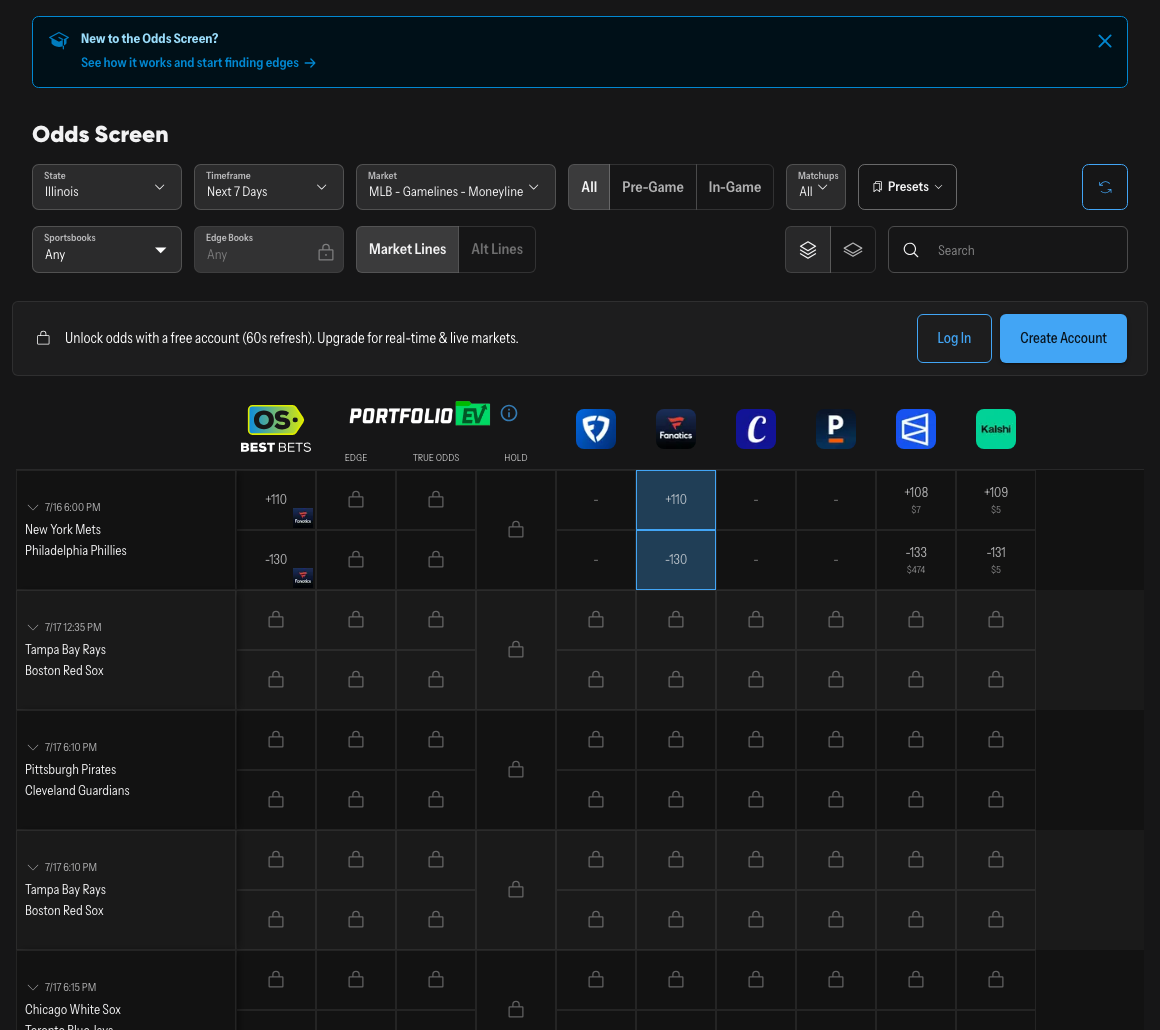 The OddsShopper live odds screen — every book's price on one board, refreshed in real time. Open the live board.
The 2026 Rookie QB Landing Spots
Now bring the pattern to this class, because the landing spots decide when you actually get to use any of it. The table below is the top of the 2026 rookie quarterback board with where each one landed and the realistic Week 1 picture as of now. Roles are still being written in camp, so treat every "likely role" as the current read, not a settled fact.
| Rookie QB | Drafted | Team | Likely Week 1 role | The betting read |
|---|---|---|---|---|
| Fernando Mendoza | No. 1 overall | Raiders | Most signs point to QB2 behind Kirk Cousins | No game angle until he takes the job; then the rookie-start pattern is live |
| Ty Simpson | No. 13 | Rams | Behind Matthew Stafford | Developmental; a mid-season injury is the only near-term path to snaps |
| Carson Beck | No. 65 (Rd 3) | Cardinals | Depth / developmental | Long-term project, not a 2026 betting factor barring attrition |
| Cade Klubnik | Round 4 (No. 110) | Jets | Depth (Day 3 project) | Off the board for betting purposes this year |
The row I keep coming back to is Mendoza. He went first overall and landed with all the spotlight that carries, and yet the reporting has been consistent that Las Vegas would rather let Kirk Cousins open the season while the rookie learns. That is not a knock on Mendoza; it is the exact situation that produces the "no rookie starts Week 1" headline several outlets floated for 2026, the first time that would be true since 2022. For a bettor it means patience: you do not have a rookie-start spot to attack in September, but the moment a veteran ahead of one of these names gets benched or banged up, the total-under and home-dog-points pattern from the last two sections goes live, and the books will still be pricing the rookie against a public that wants the over and the favorite.
Until then, the sharpest rookie-QB angle when one does start is on the passing props, not the sides. A rookie passer's yardage and attempts numbers are posted conservatively and move slowly, so the NFL player props market is often a step behind his real workload once he is starting, and you can watch those numbers on the live NFL passing-props screen the week it happens.
Get across the key number before you buy a thing.OddsShopper lays every NFL total, spread, and rookie prop across 100+ sportsbooks on one screen, highlights the book already posting the best number, and de-vigs it so you see the true probability instead of the padded one. Your first seven days on OS Pro are free, and if you stay, code ROOKIEQB20 knocks 20% off that first payment. Start your free trial →
The OROY Tie-In: The Award Is The Offseason Version Of This
You can bet the offseason version of everything above right now, and it lives in the Offensive Rookie of the Year market. The same fact that shapes the game angles shapes the award: a rookie quarterback only wins OROY if he starts early and produces. That is why the passer sitting near the top of the OROY board is usually the shaded number. If Mendoza opens behind Cousins, as most expect, his OROY ticket is paying for a coin flip on playing time, not on football, because you cannot win a counting-stats award from the bench, no matter how good he looks in December.
Circle back to that "no rookie starts Week 1" possibility, and it explains the whole shape of the 2026 OROY board: with the marquee rookie passers buried behind veterans, the value in that market tends to slide toward the skill-position rookies who walk into immediate touches. That is the exact archetype the award underpays almost every year, and we lay out the full board, the volume rule, and where the value hides in our 2026 NFL Offensive Rookie of the Year odds guide. The game bets and the award bet are two doors into the same idea: bet the workload and the game environment, never the name on the jersey.
The Traps To Avoid
The rookie-QB mistakes are predictable, which means they are avoidable. Four that show up every year:
- Betting The Narrative Instead Of The Number. "Can't-miss rookie in a primetime spot" is a story, not an edge. The primetime rookie game is one of the most over-bet totals on the board, and the public over is exactly what the books are counting on.
- Buying Points That Do Not Cross A Key Number. The half-point across 3 or 7 is worth paying for; almost every other bought half-point is the book raking you. If you would not be crossing 3 or 7, take the number as posted and shop for a better one instead.
- Projecting A Role That Is Not Confirmed. This is the live one for 2026: it is tempting to bet Mendoza's team as if he already has the job, but if Kirk Cousins opens the season in Las Vegas, there is no rookie-start spot to attack yet. A rookie who looks great in August but never takes the Week 1 job gives you nothing to bet. Treat the depth chart the way you treat an inactive report on a Sunday: it decides whether the spot is real, and no draft slot overrides it.
- Fighting The Closing Line. Rookie-QB numbers move faster and harder than veteran lines, because every camp report, depth-chart leak, and preseason snap re-prices an unknown, so the sharp money often lands before you do. If a rookie total or spread has moved hard against your read by kickoff, that closing line is telling you something. Closing-line value is the scoreboard for whether you are betting well; beat the close consistently and the edge tends to show up over a large sample, and if the number keeps running you over, respect it. Our how to find +EV bets guide walks the math behind that idea.
Frequently Asked Questions
Should you bet the over or under when a rookie QB starts? Lean under first and make the over prove itself. A rookie's early start usually means a shrunk playbook, disguised coverages he has not seen, extra turnovers, and a conservative game plan, all of which suppress scoring, while the public tends to buy the over on the new name. Always check game script (a big underdog throwing in catch-up mode can push a game back over) and weather (a dome removes the under's usual help).
Do rookie quarterbacks' teams get points on the spread? Frequently, yes. Books shade the line to fade an unproven passer, which often leaves the rookie's team as a home underdog at or near a key number. The exact number matters: getting +3 instead of +2.5, or +7 instead of +6.5, is the difference between a cover, a push, and a loss on the most common NFL margins.
Is any 2026 rookie QB a lock to start Week 1? Not clearly. As of now, Fernando Mendoza is expected to open behind Kirk Cousins in Las Vegas, Ty Simpson sits behind Matthew Stafford in Los Angeles, and Carson Beck is a developmental third-round add in Arizona. Several outlets have flagged 2026 as possibly the first season since 2022 with no rookie quarterback starting the opener. Roles can change fast on injury, so confirm the starter before betting.
Why is a rookie QB usually a bad Offensive Rookie of the Year bet? Because the award rewards counting stats, and a passer who does not start early has no path to it. Unless a rookie quarterback both wins the Week 1 job and produces, the QB near the top of the OROY board is typically an overpriced name. See our 2026 OROY odds guide for the full board.
How do you find the best number on a rookie-QB bet? De-vig the price to see the true probability, then shop every sportsbook for the best line. On a spread, that means finding the book already posting you across a key number before you ever buy a half-point. A tool like OddsShopper compares every book's total, spread, and prop side by side and flags the +EV side automatically.
The Bottom Line
Go back to draft night: the first-overall passer, the top-15 arm, the takes about who changes a franchise. Three months later the depth charts tell a quieter story, and that quiet is the opportunity. Rookie QB betting was never about the name on the marquee. It is about what actually happens when a first-year passer finally takes the ball, a lower-scoring, more conservative game that leans under, and a shaded spread that hands his team points near a key number, all priced against a public that wants the opposite. That is the edge I flagged at the top, the shaded home dog getting points on a key number with the hook bought onto 3, and the first place it is likely to set up in 2026 is Las Vegas, the moment Fernando Mendoza takes the job from Kirk Cousins. The 2026 class may make you wait for that first start, and the award market is the way to bet the idea in the meantime, but the rule does not change when it arrives: bet the workload and the environment, never the reputation.
The only thing left is to make it fast. OddsShopper lays every NFL total, spread, and rookie prop across 100+ sportsbooks on one screen, de-vigs each number so you see the true probability instead of the padded one, and flags the price that is actually in your favor, so you are across the key number before you buy a thing. The 7-day OS Pro trial is free for new users, and ROOKIEQB20 takes 20% off your first payment when you subscribe. Start your free trial and find the best rookie-QB numbers →
Betting is for adults 21+ in regulated markets where legal. Bet within your means; the goal is a long-term edge, never a sure thing.
More on this: NFL Defensive Rookie Of The Year Odds: The Safety Problem · NFL Defensive Rookie Of The Year 2026 Odds, Scored · Jordyn Tyson Injury: 2026 NFL Offensive Rookie Of The Year Odds Hit +3500, Who Fills The Vacuum · NFL 2026 on Kalshi: Every Board We Track · NFL Coach Of The Year Odds: Kalshi Fades A Two-Time Winner