Kalshi MLB betting starts with one fact that changes everything downstream: Kalshi is not a sportsbook. It is a federally regulated event-contract exchange, so when you back the Dodgers to win a Tuesday-night game you are not betting into a house that sets the price and bakes in its margin. Kalshi MLB markets price that same game, only you buy a contract from another trader on an order book. That distinction matters more in baseball than almost anywhere else, because MLB is a moneyline sport played every single day: as many as 15 games a night and 162 per team, and a favorite is rarely as dominant as a football spread can make it feel. In a grind that long, small price differences add up when your baseline is sound and the fill still beats the market after fees, and an independent price you can check every night is exactly the kind of number worth having on your screen.
This guide covers which MLB markets Kalshi lists, the one translation that lets you compare any cent price to a sportsbook moneyline, the fees that quietly eat your edge, the thin-liquidity reality that makes baseball different from football on the exchange, and a worked example of when a Kalshi contract actually beats a de-vigged book number. Baseball is a shopper's sport; the exchange is one more place to shop. Let's start with why it behaves differently in the first place.
The Quick Answer
Yes, you can bet MLB on Kalshi: the exchange lists game winners (the moneyline equivalent), run-line and total-style markets, player props, and season futures, all as yes/no contracts priced in cents, where the cents are roughly the market's implied probability. Kalshi is a CFTC-regulated event-contract exchange rather than a sportsbook, availability varies by state and changes over time, and Minnesota's operator-level ban is on hold under a court order while its case plays out (more below). Whether it beats your book on a given night comes down to two things: a trading fee that peaks on contracts priced near 50¢ and MLB order books that run thinner than NFL or NBA. The full market menu, the cents-to-moneyline conversion, and a worked example of when the exchange beats a de-vigged book price are all below.
Stay ahead of the markets.
Daily insights and expert picks on Kalshi, Polymarket, and what's moving markets.
Free forever. Unsubscribe anytime.
These are market prices and model estimates, not predictions of fact and not financial advice.
Building a Kalshi combo?price any Kalshi combo before you buy it: 10,000 simulated games price every combo next to the price on Kalshi.
What Makes Kalshi Different For MLB
On a sportsbook, DraftKings or FanDuel prices the Braves at 1.71 to win (about a 58% implied probability), builds its margin into that price, and you either take the number or you pass. On Kalshi there is no book setting a line for you to accept or leave. You are trading on an order book against other traders and liquidity providers, the way buyers and sellers meet at a price on any exchange, and the price you can actually get is the live bid and offer, not whatever the last trade happened to print.
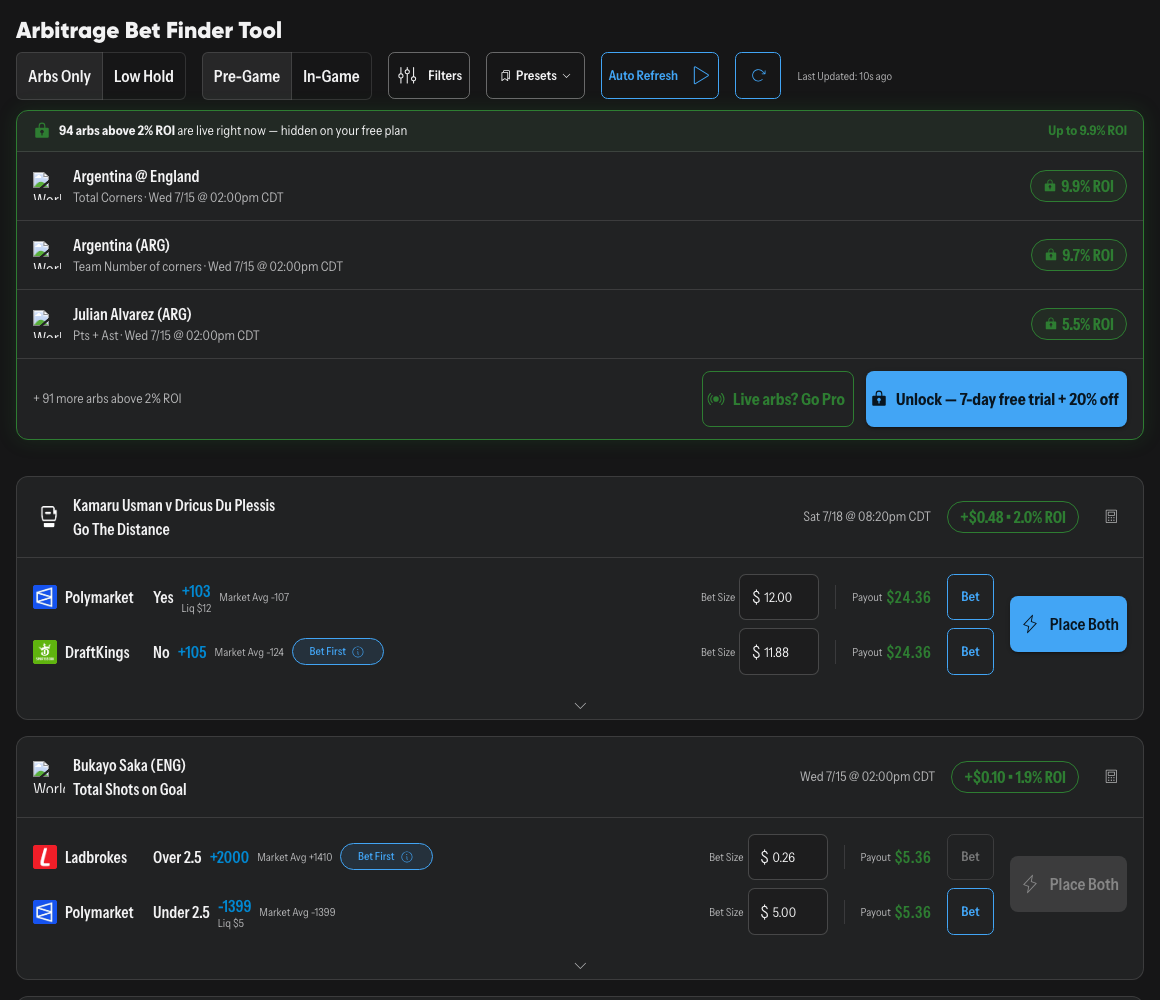
The OddsShopper Arbitrage Tool.
This order-book structure is why the exchange is worth a look in baseball specifically. Because no single bookmaker dictates the Kalshi price, it settles at its own number, and that number regularly disagrees with the books. In a sport where you are choosing between two moneylines on a dozen games most nights, having a second, independently set price on the same game is not a novelty. It is another quote to shop, and shopping is where disciplined baseball bettors improve their price over a long season.
One caution before you deposit.Kalshi operates as a CFTC-regulated designated contract market, a different legal category from a state-licensed sportsbook. Regulators and courts are still actively contesting how sports-related event contracts should be treated, and availability varies by state and changes over time. This is not legal advice, so confirm what is actually offered where you live. Our companions on whether prediction markets are legal and the broader how to bet sports on Kalshi walkthrough go deeper on the distinction and the account mechanics.
Which MLB Markets Kalshi Lists
Kalshi's sports menu has grown quickly, and baseball now stretches beyond a simple game winner. Everything on the exchange is phrased as a binary, yes/no question, which is just a different wrapper on bets you already know.
| MLB Market | What it is | How Kalshi frames it |
|---|---|---|
| Game Winner (Moneyline) | Which team wins the game | A single Yes/No contract: Yes backs a team, No fades it |
| Run Line / Margin | Whether a team wins by more or fewer than a set number of runs | Yes/No on a 1.5-run margin, the same ±1.5 you see at a book |
| Total (Over/Under) | Combined runs over or under a line | Yes/No on the game total |
| Player Props | A hitter to record a hit or homer, total bases, a pitcher's strikeouts | Yes/No on each stat threshold |
| Season Win Totals & Futures | Team win totals, division, pennant, World Series | Live Yes/No contracts you can enter or exit before they settle |
The row that rewards baseball bettors most is the game winner, because MLB carries no point spread in the football sense and lives on the moneyline. It is also the cleanest market to learn the mechanics on, which is why the worked example below uses it. One underrated line is the season win total: because those contracts trade live, a team's over you bought in April can be sold in July for a profit rather than held to the final week. Those season markets are also where our AI panel does its scoring: it works the World Series champion board with the prices hidden, plus division races like the AL Central and NL Central.
The menu keeps expanding, and depth varies by day, so check what is actually listed for a given card rather than assuming a market exists, since availability shifts by week and by state. And read the fine print: every contract settles by its own written resolution rules, so before you buy, know exactly what counts (how a rain-shortened game resolves, how a suspended game is handled, whether a prop needs the player to start). In a sport with daily weather and lineup churn, that is cheap insurance against a "why didn't this pay" surprise.
The home run shelf is deep enough to earn its own guide — our home run prediction markets breakdown covers how those contracts are built and priced.
Reading Cent Prices Vs Sportsbook Moneylines
Here is the one translation I promised, and it works on every Kalshi market, whether winner, run line, total, or prop: the cents are the market's rough implied probability, before fees and spread. A contract that costs 54¢ is the market saying that outcome has about a 54% chance. If it hits, the contract settles at $1.00, so you paid 54 cents to win 46; if it misses, the contract settles at $0 and the full 54 cents is gone.
Every Kalshi price is therefore directly comparable to the moneyline you already read at a book: convert the book's price to a probability (or to decimal odds, the payout per $1 staked) and compare it to the cents, which are already a probability.
| Kalshi Price | Implied probability | Decimal odds (payout per $1) |
|---|---|---|
| 35¢ | 35% | 2.86 |
| 45¢ | 45% | 2.22 |
| 50¢ | 50% | 2.00 (even) |
| 55¢ | 55% | 1.82 |
| 60¢ | 60% | 1.67 |
| 70¢ | 70% | 1.43 |
The row worth sitting with is 55¢. A team trading at 55 cents is a modest favorite, paying about 1.82 on the dollar, and modest favorites are baseball's whole board, because even good teams lose 60-plus games a year and a lone starting pitcher can only tilt a single game so far. That is exactly the band where books make their money: they shade the popular side and move the number toward the public money, so the same 55% team can show up at 1.74 or 1.71 on a Saturday-night marquee game, priced as if it were 57 or 58 percent. The wider the book's vig, the more room Kalshi's independent price has to sit under it, which is why moderate favorites are the first place I check the exchange in baseball.
The Liquidity Reality: MLB Is Thinner Than Football
Now the honest part, and the one that separates baseball from the football version of this guide: MLB order books on Kalshi are generally thinner than NFL or NBA. Football and basketball carry the exchange's deepest sports liquidity; a random Wednesday baseball game between two non-contenders can have a wide bid-ask spread and little size resting on either side. Thin books carry two direct consequences you cannot ignore.
First, a wide spread eats edge the same way a fee does. If the best offer to buy a contract is several cents above the best bid to sell it, the "price" is a range, and you pay the top of that range to get filled, which can quietly erase the gap you thought you were capturing. Second, thin means your own size moves the market: put in more than the book can absorb and you walk the price against yourself. On a deep NFL contract that barely registers; on a sleepy MLB game it becomes the difference between a good fill and a bad one.
None of this makes baseball unplayable on Kalshi. It makes it a read-the-book sport. Our guide to attacking Kalshi's most liquid markets covers reading the order book and using limit orders to name your price instead of chasing the quote, and in baseball that discipline matters even more than it does in football. The takeaway to carry into the next section: a price is not good until you have checked that you can actually get filled at it, and then netted out the fee.
Fees On Kalshi MLB Markets
The exchange is not free, and pretending it is will turn a break-even bettor into a loser over a 162-game grind. Kalshi charges a trading fee that scales with the contract price, and the shape of it is worth memorizing: the fee is highest on coin-flip contracts near 50¢ and smallest in raw cents out at the extremes near 1¢ or 99¢. The reason is that the fee tracks the contract's uncertainty, which peaks at a 50/50 and shrinks as the price climbs toward a near-certain 99¢ or falls toward a near-dead 1¢. So a true pick'em game (two aces, two even teams) is the most expensive place to trade in raw cents. The catch is that the fee is a share of what you risk, and on a long shot that share is the worst on the board: a fraction of a cent on a 5¢ contract is a far bigger bite of your stake than two cents on a 49¢ one. Cheapest relative to your money is the heavy favorite; the long shot only looks cheap. One more lever that changes the number: on Kalshi, resting a limit order that gets filled as a maker is charged differently from crossing the spread as a taker, usually in the maker's favor, so the limit-order habit this guide keeps pushing is also a fee habit. Check the current schedule for the exact split.
There are deposit mechanics too. Debit-card deposits may carry a small processing fee, while debit-card withdrawals and bank transfers generally do not, so how you fund the account can change your real cost. Fee schedules move, so confirm the current one in the app before you size a bet.
The takeaway is not "avoid Kalshi," because on a liquid market its all-in cost is often thinner than a sportsbook's vig. But in baseball that is not automatic, and the liquidity point from the last section is exactly why: on a thin MLB game the spread plus the mid-price fee can erase the whole gap, so a one-cent difference between Kalshi and a book near the middle of the board can be a fee, not an edge. Net the fee and the spread out first, then decide whether the number is actually better.
The habit that keeps you honestthe fee is a penalty on coin-flips. If two MLB contracts look equally close to fair, the cheaper one to trade, relative to your stake, is the lopsided favorite, not the pick'em pitcher's duel, and a limit order that rests as a maker beats crossing the spread either way.
A Worked MLB Example: When Kalshi Beats The Book
Say it is a summer night and you like a home team behind its ace to win a low-scoring game. Picture the kind of spot that makes the exchange worth checking. The numbers here are illustrative, not a live price and not a prediction, but the math is exactly how you would run it on a real game.
At the book, the home team is 1.74 to win in decimal odds, which is a 57.4% implied probability. The other side sits at 2.15, a 46.5% implied probability. Add those two and you get about 103.9%, and those extra 3.9 points of overround are the vig. Strip it out by dividing the favorite's 57.4% by that 103.9% total, and the book's no-vig, market-implied price is about 55%. That de-vigged number is the market's best estimate of the real probability, not a proven truth, but it is a far better yardstick than the inflated 1.74. A bet has positive expected value when its price beats that estimate.
Now you pull up the same game-winner market on Kalshi, and the home team's Yes contract is trading at 49¢, a 49% implied probability, a shade under even money. The fee discipline from earlier pays off right here, because 49¢ sits in the expensive middle of the board. Add the trading fee and any spread, and your all-in cost lands a cent or two higher, call it 50 to 51 cents. That is still four or five cents under the book's 55% no-vig estimate, and far better than laying 1.74 at the book. You are paying about 51 cents, all-in, to win 49 on an outcome the de-vigged market values near 55. If you trust that estimate as your baseline, that four-cent gap is what makes Kalshi the positive-expected-value side here, and it is the cushion I demand: a one-cent gap at this price is a fee, not an edge, so I never call a Kalshi price cheap until I have added the fee and still see real daylight.
It cuts the other way just as often, and in thin MLB markets more often than in football. Plenty of nights the book is sharper, or Kalshi's spread is so wide that the 49¢ you saw is really 54¢ to actually buy, and the edge evaporates. The discipline is never "always bet Kalshi." It is to convert both to the same currency, add your real all-in Kalshi cost, confirm you can get filled, and take whichever side is priced below its true probability.
Don't eyeball it. Build the baseline first.The live odds screen puts every sportsbook's MLB moneyline on one screen so you can shop the number across every major book, and the odds converter turns each book's price into the no-vig, market-implied probability, the true baseline you then measure your Kalshi contract against by hand. When two books drift far enough apart, the arbitrage finder flags the gap, and that same no-vig baseline is what tells you the nights the exchange is the better price. OS Pro starts with a free week trial, so you can run this whole routine on live boards before paying a dollar, and code MLBKALSHI20 takes 20% off your first payment after the free week.
How Kalshi Fits The Rest Of Your MLB Betting
Kalshi does not replace your sportsbooks. Treat it as one more moneyline on the same screen, and baseball is the sport where an extra quote pays off most because you are betting so many games. Football gives you one heavily bet card a week; baseball hands you a full card nearly every night for six months, and a small per-game edge that looks trivial is meaningful across that volume. So the workflow is the same line-shopping discipline as always (de-vig, add the fee, compare), just applied to the highest-frequency sport on the board. In practice, that means a repeatable nightly routine: pull the day's listed MLB markets, put the live odds screen next to them so you can shop the number across every major book, convert each Kalshi cent price and each book's moneyline to a no-vig probability, require a set post-fee cushion before you act, use limit orders on the thin games, and skip any game where unsettled starters, lineups, or weather muddy the price. Four habits make that routine pay.
- Isolate The Starters With First Five Markets. Baseball bettors love the first-five-innings market because it settles on the two starting pitchers and dodges shaky bullpens. If Kalshi lists a first-five or first-three contract on a game, it is worth converting alongside the full-game price, since sometimes the value the bullpen risk is hiding shows up cleaner in the shortened market. Check the board; these come and go by day.
- Convert The Run Line The Same Way. Baseball's run line is almost always 1.5 runs, so a Kalshi margin contract on a big favorite is priced off the same -1.5 idea you see at a book. Convert it the same way, cents to probability, and compare, but remember a one-run game is common, which is why so much baseball value lives on the moneyline rather than the run line. My own filter: I only price the -1.5 contract when the favorite is heavy enough that the book's run line sits near even money and the Kalshi spread on it is a cent or two, not five; on a modest favorite in a thin book, the moneyline is the cleaner trade every time.
- Mind The Liquidity, Every Time. Circle back to the thin-market point, because in baseball it is the whole game: a given MLB contract can be shallow, and shallow means your own size moves the price. Read the order book, use limit orders, and never treat a headline cent price as the price until you have confirmed you can get filled there.
- Chase Cross-Venue Gaps Last, And Carefully. When Kalshi and a book drift far enough apart, you may have an arbitrage candidate, but only once the fees, fills, limits, and each side's settlement rules confirm the gap is real, which is the idea in our prediction-market arbitrage breakdown and the prediction-market strategies guide.
If you are still deciding whether the exchange is for you, the Kalshi sports-betting review covers the platform end to end, and the Kalshi vs. Polymarket comparison lines up the two exchanges on availability, markets, and fees. Want grounded plays while you learn the exchange? Our free expert picks today show the same de-vig-and-shop logic applied to live slates.
FAQ
Can you bet MLB on Kalshi? Yes. Kalshi lists MLB game-winner markets (the moneyline equivalent), run-line and total-style contracts framed as yes/no questions, a player-prop menu, and season win totals and futures, all as event contracts. It is a CFTC-regulated exchange rather than a sportsbook, availability varies by state and changes over time, and this is not legal advice, so confirm what is offered where you live and check the live board for a given day.
How do Kalshi MLB prices work? Every price is in cents, and the cents are the rough implied probability. A team at 58¢ is priced at about a 58% chance; the contract costs 58 cents and settles at $1.00 if it wins. To compare it to a book, treat the cents as a probability and line it up against the sportsbook's no-vig moneyline.
Is Kalshi's MLB liquidity good? It is thinner than Kalshi's NFL and NBA markets. Baseball order books can be shallow, especially on games between non-contenders, so spreads are wider and your own size can move the price. Read the order book and use limit orders before you treat a cent price as takeable.
Are Kalshi's MLB fees worth it? Kalshi charges a trading fee that is highest on prices near 50¢ and lowest near the extremes, plus possible deposit fees depending on how you fund. On a liquid market the all-in cost is usually thinner than a sportsbook's vig, but on a thin baseball game the fee plus the spread can erase a small edge, so net it out first.
Is betting MLB on Kalshi legal? Kalshi operates as a CFTC-regulated event-contract exchange, a different legal category from a state-licensed sportsbook, and its availability is not the same as sportsbook availability. How sports event contracts are classified is contested and varies by jurisdiction and over time. As of August 2026, several states have challenged Kalshi's sports contracts with cease-and-desist letters and lawsuits, and the exchange has kept operating while that litigation proceeds. Minnesota passed a law aimed at the operators offering these contracts there, not at individual traders, that was set to take effect August 1, 2026, but a federal judge granted Kalshi a preliminary injunction on July 27, 2026 that blocks enforcement while the case proceeds, so the exchange kept operating there; the court framed it as a status-quo hold, not a final answer, and whether sports contracts fit the same federal preemption is still the open question. This is not legal advice; Minnesota readers should confirm the current status locally before trading, and everywhere else confirm current availability, be of legal age, and trade responsibly.
One market that confuses newcomers most is YRFI/NRFI — our explainer on what first inning runs means breaks it down.
More on this: Murakami Rookie Of The Year Odds: The Bat Kalshi Doubts · MLB Worst Record Odds: The Race Nobody Wants Is On Kalshi · How Often Do MLB Players Hit A Home Run? Of Games · Kalshi MLB Odds: AI Panel Takes Mariners At 45.5 Cents · MLB Playoffs 2026 Odds: Who Makes It And Who Wins It All
In Summary: Convert, Net, Then Compare
The edge I keep coming back to is not "Kalshi versus the books." It is your all-in price versus the market's no-vig estimate, and in baseball, the sport where you shop the most games, that discipline is worth the most. Start with the de-vigged moneyline, add Kalshi's fee and its wider MLB spread to the contract price, confirm you can actually get filled, and only trade when the gap that is left is big enough to survive a bad fill. My own rule: near 50¢, where the fee bites hardest and a thin baseball book hides the most spread, a one-cent difference is not an edge, and I want real cushion before I treat the exchange price as the better bet. Do that across a daily card and Kalshi stops looking exotic and starts working like one more sharp moneyline on your screen.
If you gamble, do so responsibly and only where you are of legal age.
De-vig every MLB book to its no-vig price with the OddsShopper odds tools, then use the arbitrage finder to catch the book-to-book gaps worth acting on. That same no-vig baseline is what tells you the nights a Kalshi contract, all-in, is the better number. Every OddsShopper Pro membership starts with a free week trial, every tool included, and code MLBKALSHI20 takes 20% off your first payment after the free week.
Trade prediction markets on Polymarket too.Most readers here already have Kalshi — Polymarket is the other major venue, and code OS4 adds a $50 trading bonus on a $10 deposit through the Polymarket US App: Get the Polymarket bonus →
Affiliate disclosure: OddsShopper may earn a commission on signups through this link. Bonus terms as stated by Polymarket US at signup. 18+ Only. Restrictions and eligibility requirements apply. Not available in all jurisdictions. Trading is risky. 100% loss can occur. See polymarket.com/tos for more information. The Polymarket US App serves as an independent software provider and affiliate of Polymarket US and Polymarket Clearing, the CFTC-regulated exchange and clearing organization.