Kalshi or DraftKings is not really a brand question, it is a plumbing question. One is a CFTC-regulated exchange where you trade event contracts against other people; the other is a state-licensed sportsbook that sets its own line and books your action against the house. The plumbing decides everything downstream: what the price includes, how you exit, who can play, and which side of the same game each venue quotes cheaper. This comparison prices one real NFL market both ways, with the math shown, and ends with an honest routing guide for three kinds of bettors. Prices and fee figures below were pulled August 1, 2026; check the live boards for current numbers.
The Quick Answer
DraftKings buries its cost in the line as vig; Kalshi shows its costs as a visible spread plus a trading fee. In our worked Week 1 market, the favorite was cheaper at DraftKings (-150 versus an effective -161 taking Kalshi's ask) while the underdog was cheaper on Kalshi (an effective +129 versus +126) and a resting limit order flipped the favorite to the exchange as well. DraftKings wins on catalog depth, props and parlays; Kalshi wins on exits, both-sides trading and an 18+ door. The full math is one section down.
Same Game, Two Prices: A Worked NFL Example
Take Atlanta at Pittsburgh, Week 1, September 13. On Kalshi, fetched August 1, 2026, Pittsburgh traded at 58 cents bid, 60 cents ask, with Atlanta at 40 cents bid, 42 cents ask. A representative DraftKings-shaped quote on a favorite of that size, typical of big-book NFL pricing as of August 2026, is Pittsburgh -150, Atlanta +126.
Stay ahead of the markets.
Daily insights and expert picks on Kalshi, Polymarket, and what's moving markets.
Free forever. Unsubscribe anytime.
First, strip the book's margin. Pittsburgh -150 implies 60.0%; Atlanta +126 implies 44.2%. Together that is 104.2%, so the quote carries about 4.2% of hold. De-vigged, the fair numbers are roughly 57.6% Pittsburgh and 42.4% Atlanta.
Now cost out the exchange, side by side:
| Position | Kalshi All-In (100 Contracts) | Effective Odds | DraftKings Line | Cheaper Venue |
|---|---|---|---|---|
| Pittsburgh, Taking The 60c Ask | $60.00 + $1.68 fee = $61.68 | about -161 | -150 | DraftKings |
| Pittsburgh, Resting At The 58c Bid | $58.00 + $0.43 maker fee = $58.43 | about -141 | -150 | Kalshi, if filled |
| Atlanta, Taking The 42c Ask | $42.00 + $1.71 fee = $43.71 | about +129 | +126 | Kalshi |
Read that table twice, because it is the whole article in miniature. The same game splits three ways: the book is cheaper on the favorite at market, the exchange is cheaper on the underdog even paying the taker fee, and patience with a limit order beats the book on both sides. Anyone who tells you one venue simply has better prices has not done the arithmetic per side.
The True Cost: DraftKings Vig Vs Kalshi Fees And Spread
The two cost structures are mirror images. DraftKings prices its margin into the line itself: a standard NFL moneyline pair as of August 2026 typically sums to roughly 104% to 105% of implied probability, and that overage is the hold you pay no matter which side you take. Nothing itemizes it; the line simply is the cost.
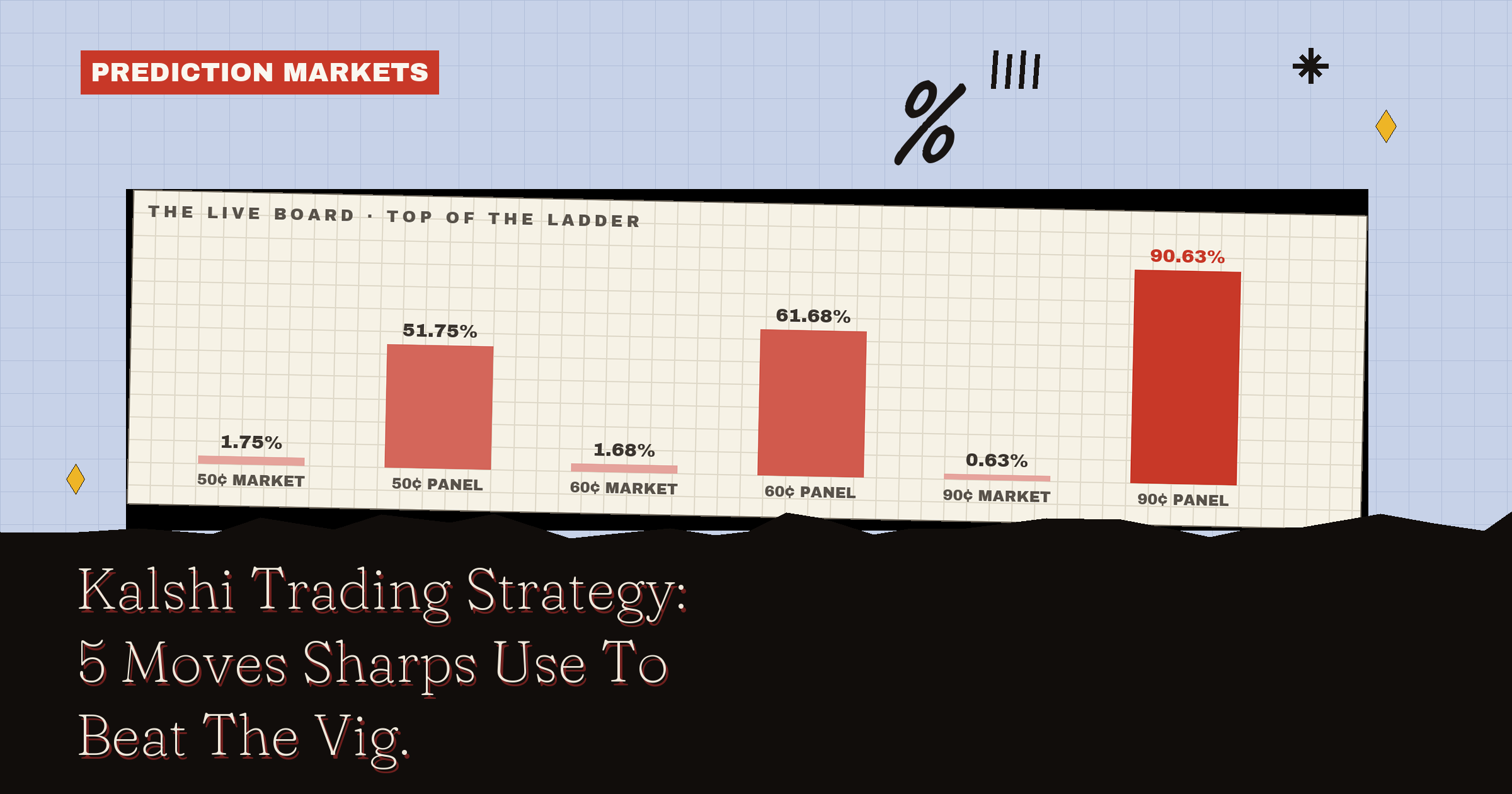
Kalshi itemizes. Per Kalshi's posted fee schedule, last updated July 7, 2026, a standard taker order is charged 0.07 x contracts x price x (1 - price), rounded up, which peaks at $1.75 per 100 contracts on a 50-cent market. Resting orders that later fill pay a maker fee at 25% of the taker rate on the series that carry one, and the exchange's own market metadata, checked August 1, 2026, lists NFL and college game series among them. Cancelling an unfilled order costs nothing. On top of the fee sits the bid-ask spread, two cents in the Pittsburgh market above, which is the exchange's version of paying retail: crossing it costs about 3.3% of a 60-cent entry, and the $1.68 taker fee is another 2.7% of that outlay. Every contract eventually settles Yes or No at $1.00 or zero, so all of these costs are measured against a known payout.
The practical difference: at a sportsbook your cost is fixed and hidden, on an exchange your cost is visible and negotiable. A disciplined limit-order trader on Kalshi routinely pays less than the book's hold; an impatient market-order trader can easily pay more.
Cash-Out Vs Selling Your Position
Exiting early is where the two products stop resembling each other entirely. DraftKings' cash-out is a house-generated offer: one number, computed with margin against you, accept or decline. There is no counter-offer and no visibility into what the position is objectively worth.
On Kalshi you exit by selling contracts into the order book, at the bid if you want out now, or at your own price with a resting order. The market may be thin, the spread may be wide, but the exit price is set by competition among traders rather than by the counterparty who profits when you leave cheaply. Over a season of futures positions and mid-game swings, exit quality compounds into real money, and it is the single biggest structural reason traders who learn the order-book mechanics stop missing the cash-out button.
Market Breadth: What Each Lists That The Other Can't
DraftKings' catalog is far deeper inside sports: player props, alternate lines, same-game parlays, live in-play menus across every major league. If your betting life is built on prop volume and parlay construction, the book is simply the fuller store.
Kalshi's breadth runs perpendicular. The exchange lists markets no sportsbook is licensed to touch: elections, Fed decisions, inflation prints, weather, awards, entertainment, alongside its sports boards. The weather book is the cleanest example: no sportsbook quotes tomorrow's high temperature, and our Kalshi weather markets hub tracks those temperature contracts live through the trading day, from the morning's open markets to what settled overnight. Kalshi also lets you trade both directions, buying No on an overpriced favorite the way a book would never let you fade its own line. Our AI panel publishes scored boards on many of those markets, from the exchange-vs-book price studies to award and futures verdicts; those panel figures are model estimates, not predictions of fact and not financial advice, and they exist precisely because exchange prices are open enough to argue with.
Limits: The Ban Hammer Vs The Order Book
Sportsbooks manage risk by managing customers. Consistent winners at U.S. books commonly see stake limits cut to token size, and this is on the record, not folklore: at a September 2024 Massachusetts Gaming Commission roundtable, DraftKings and six other operators defended the practice to regulators, with BetMGM's senior director of compliance stating the book limits roughly 1% of its Massachusetts patrons, per ESPN's report on the hearing. The practice remains standard as of August 2026. The house is your counterparty, so the house decides how much of your action it wants.
An exchange has no such lever to pull, because it is not on the other side of your trade. Kalshi matches buyers with sellers and collects fees either way, so a winning trader is revenue, not risk. The honest caveat: your real cap on an exchange is liquidity. A thin market might only absorb a few hundred dollars near the quoted price, which functions like a limit even though nobody imposed it. Deep boards take size; obscure ones do not.
Regulation And Who Can Play
The legal frames could hardly be more different, and neither is a gray area. DraftKings Sportsbook operates under state gaming licenses, state by state, generally at 21 and older in most markets. Where sports wagering is not legalized, DraftKings simply is not available.
Kalshi is a designated contract market regulated federally by the CFTC, offering event contracts at 18 and older. Its availability does not track the sports-betting map, though sports contracts specifically have been contested by some state regulators, with those disputes now running through the federal courts, and offerings can shift, so verify what is listed where you live before funding either account. The one-line version: 21+ and state-mapped on one side, 18+ and federally chartered with state-level friction on the other. For the fuller structural breakdown, our exchange vs sportsbook explainer goes deeper than a comparison shopper needs on day one.
Which Fits You: Three Bettor Profiles
- The Recreational Parlayer. DraftKings, without much argument. Same-game parlays, props and boosts are the product you actually use, and Kalshi's combo offerings are not built for that style. Just know the hold on parlays is a multiple of the single-bet hold.
- The Price Shopper. Both, run through one screen. I treat Kalshi as one more book column: de-vig the book quote, add Kalshi's fee to its ask, and route the bet to the cheaper number. The live odds screen does the line-shopping legwork across every major book and surfaces the no-vig fair price, which is the benchmark both venues have to beat. In my experience the winner flips market by market, which is exactly why the comparison pays.
- The Futures And Position Trader. Kalshi, decisively. Sellable positions, both-sides freedom and visible costs matter most on long-dated markets, where a book futures ticket locks your money until settlement. The fee mechanics are worth 20 minutes before your first size trade.
For the platform-agnostic version of this comparison — exchange mechanics against sportsbook mechanics, no brand names — see Kalshi exchange vs sportsbook.
How The NFL Season Changes The Comparison
The gap between these two narrows once real games start. Checked against Kalshi's live listings on August 3, 2026, the exchange's preseason NFL board is season-long: team win totals, exact wins, division winners, and fantasy rank-list markets on which player finishes as the top fantasy scorer at each position. The per-game boards that ran all last season, moneylines, quarter and half spreads, turnovers, and player props like receptions and anytime touchdown, show no open markets in the preseason lull and repopulate week by week once the season kicks off in September.
That timing matters for routing. In-season, Kalshi becomes a live per-game venue you can price against DraftKings on the same Sunday markets, and its deepest sports liquidity arrives with the NFL slates. DraftKings still wins breadth on any given game, hundreds of props and same-game parlay construction against Kalshi's narrower prop menu, so the worked-example discipline above does the deciding: de-vig the book quote, fee-adjust the contract, and route per market. Nothing about the fee math changes with the calendar; per Kalshi's schedule, the NFL game series carry maker fees, which makes resting orders the cheap route on exactly the markets that get deepest in-season.
The Verdict Is Per Market, Not Per Brand
The prediction market vs sportsbook question has no single winner. The wrong question is which platform is better; the right question is which one is cheaper for this bet, today. DraftKings earns the parlay-and-props bettor. Kalshi earns the trader who wants exits and both sides. The bettor who wins the comparison is the one who prices every wager in both places and lets the arithmetic, not the brand, make the call.
More on this: Prediction Market Vs Sportsbook: An Exchange Is Not A Book · Kalshi Vs Sportsbooks NFL: Where The Better Price Is · MA-6 Primary: DraftKings Cash Floods Moulton's Open Seat · NFL MVP Odds: Kalshi Prices Josh Allen Cheaper Than Polymarket · NFL Win Totals 2026: Kalshi Vs DraftKings Vs FanDuel
Hottest Prediction Markets Right Now
- 2028 Democratic presidential nominee · $166M traded
- Rocket Classic Winner · $85M traded
- 2027 Pro Football Champion · $52M traded
- Pro Baseball Champion · $41M traded
- Bitcoin price at the end of 2026 · $30M traded
- 2027 Pro Basketball Champion · $19M traded
Every market above links to our full AI model verdict; browse them all on the OddsShopper prediction markets hub.
Event contracts involve risk and are not appropriate for everyone. 18+ on Kalshi; sportsbook age and availability vary by state. Trade and wager responsibly.
Trade prediction markets on Polymarket too. Most readers here already have Kalshi — Polymarket is the other major venue, and code OS4 adds a $50 trading bonus on a $10 deposit: Get the Polymarket bonus →
Affiliate disclosure: OddsShopper earns a commission on signups through this link. Terms as stated by Polymarket; 18+, availability varies by state.