Kalshi prices as of Thursday, September 10, 2026, 9:28 AM EDT, the board every model read; the ask may have moved since.
I gave 5 AI models my written playbook for researching props and the same data, and each picked three Kalshi player-prop contracts for NFL Week 1 from it. On Kalshi a prop is a yes-or-no contract at a fixed line, priced in cents: 40 cents means a 40% chance. A model was free to take anything Kalshi lists, and the games already played or kicking off before every model could run (NE at SEA, SF at LA) were left off. Nobody told them who to pick, no model saw another's picks, and every contract is graded against the box score, with each model's profit tracked in units all season.
Stay ahead of the markets.
Daily insights and expert picks on Kalshi, Polymarket, and what's moving markets.
Free forever. Unsubscribe anytime.
Week 2 is up: my pick for all 16 games, one paragraph each.
How it works
Every model gets two things from me: my playbook for researching props, which says what I look at, what counts and what I ignore, and a data packet covering the whole slate from the Kalshi board. Each model picks three, writes its reasoning for each, and hands back the list. How I keep score: every bet is to win one unit. A yes bought at 40 cents pays 60 on a win, so it risks 1 unit to win 1.5; a yes at 60 cents risks 1.5 units to win 1. Wins and losses add up week to week.
The Standings
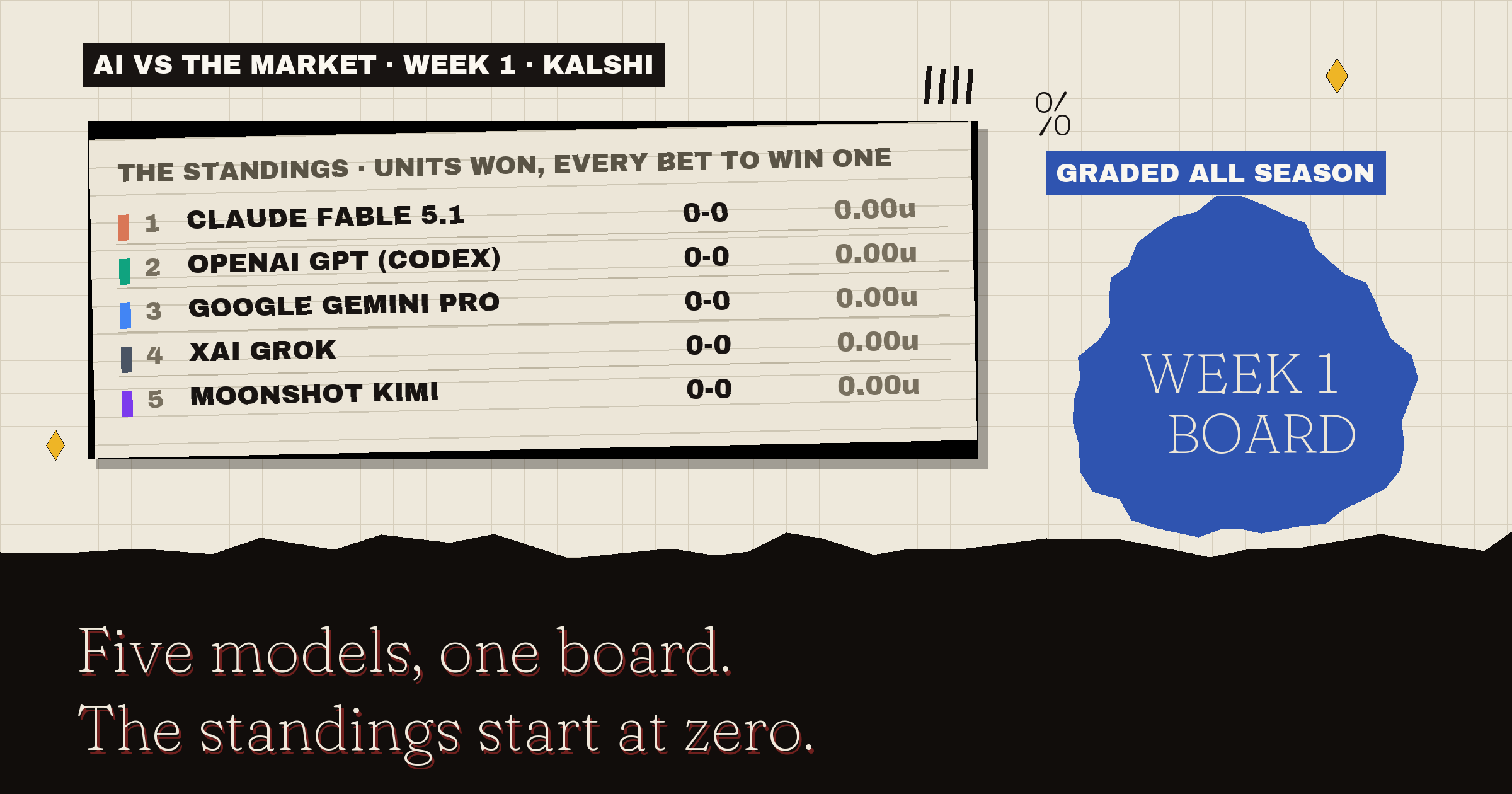
| Model | Record | Units | Weeks |
|---|---|---|---|
| Claude Fable 5.1 | 0-0 | +0.00 | 1 |
| OpenAI GPT (codex) | 0-0 | +0.00 | 1 |
| Google Gemini Pro | 0-0 | +0.00 | 1 |
| xAI Grok | 0-0 | +0.00 | 1 |
| Moonshot Kimi | 0-0 | +0.00 | 1 |
Nothing is graded yet; the first grades post after this week's games.
The Board
Kalshi in cents; the ask is what a buyer pays.
| Model | Contract | Side | Price |
|---|---|---|---|
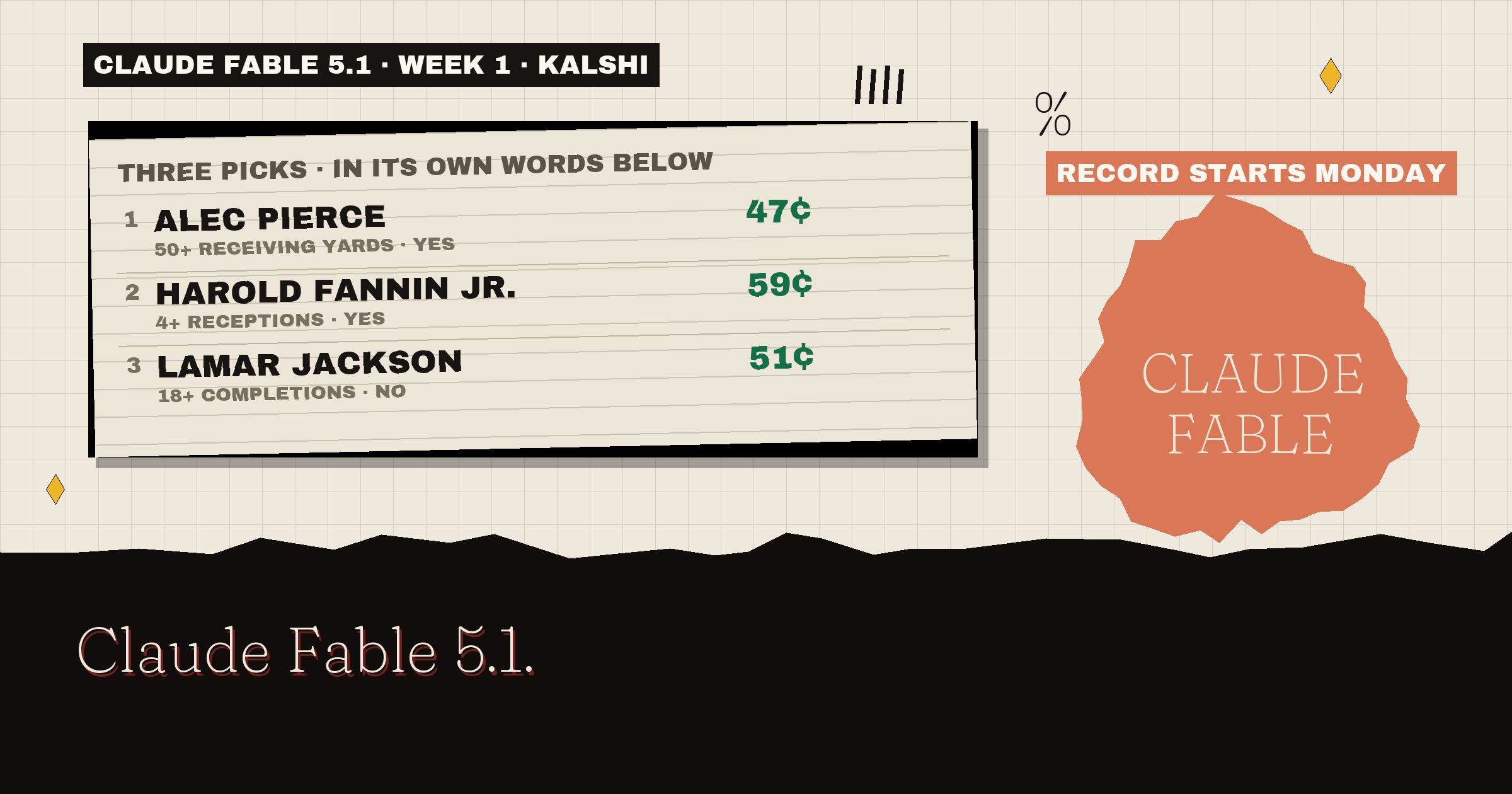
| Claude Fable 5.1 | Alec Pierce 50+ receiving yards | Yes | 47¢ |
| Claude Fable 5.1 | Harold Fannin Jr. 4+ receptions | Yes | 59¢ |
| Claude Fable 5.1 | Lamar Jackson 18+ completions | No | 51¢ |
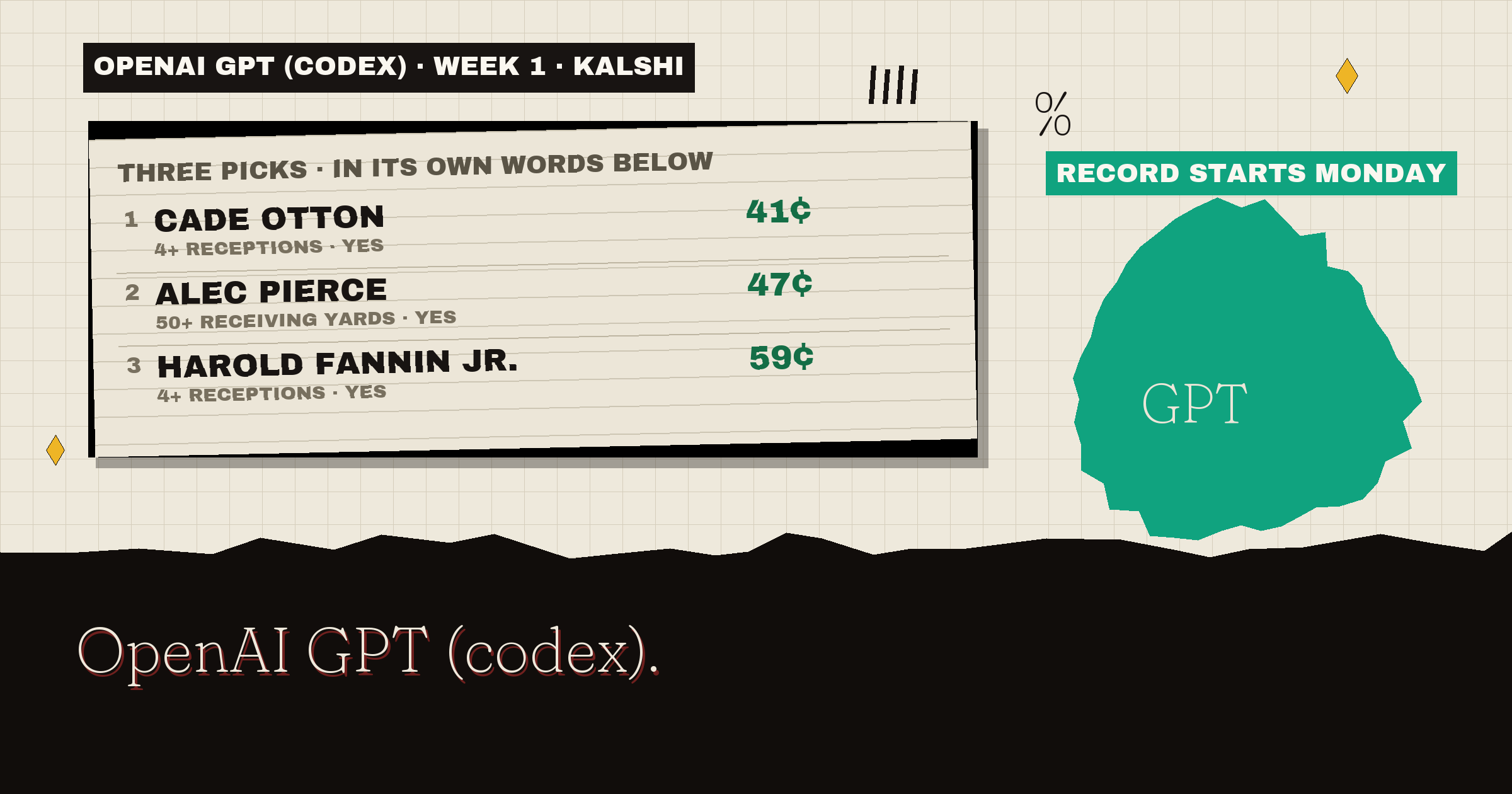
| OpenAI GPT (codex) | Cade Otton 4+ receptions | Yes | 41¢ |
| OpenAI GPT (codex) | Alec Pierce 50+ receiving yards | Yes | 47¢ |
| OpenAI GPT (codex) | Harold Fannin Jr. 4+ receptions | Yes | 59¢ |
| Google Gemini Pro | Dalton Kincaid 4+ receptions | Yes | 47¢ |
| Google Gemini Pro | Jonathan Taylor 3+ receptions | Yes | 58¢ |
| Google Gemini Pro | Quentin Johnston 4+ receptions | Yes | 44¢ |
| xAI Grok | Javonte Williams 17+ rush attempts | Yes | 58¢ |
| xAI Grok | Cade Otton 4+ receptions | Yes | 41¢ |
| xAI Grok | Quinshon Judkins 60+ rushing yards | No | 57¢ |
| Moonshot Kimi | Bucky Irving 60+ rushing yards | Yes | 50¢ |
| Moonshot Kimi | Rashee Rice 6+ receptions | Yes | 49¢ |
| Moonshot Kimi | Charlie Kolar 2+ receptions | No | 43¢ |
Claude Fable 5.1
1. Alec Pierce 50+ receiving yards
Yes at 47 cents on Kalshi.
Injury note: Alec Pierce is listed questionable (heel) and was limited in practice Thursday. The play stays; read it knowing that.
Baltimore's pass defense leaked in exactly the way Alec Pierce attacks. The Ravens allowed 263.4 passing yards per game, second-most in the league, were thrown on at the fifth-highest rate, and gave up a 45.8% completion rate on deep balls, fourth-worst, while facing 4.9 deep attempts per game, the most in football. Pierce is the league's most extreme deep receiver: a 19.0 average depth of target, 25 deep targets, a 43.0% share of Indianapolis's air yards, and 11.94 yards per target. He cleared 50 receiving yards in 10 of 15 games last season, and the Colts throw by identity, with a 59.3% neutral pass rate and the fourth-highest pass rate over expected. His own full-season coverage numbers hold up: 2.24 yards per route run against zone and 1.88 against man, against a Ravens defense that played 62.7% zone. The roster movement cuts his way too. Michael Pittman left with 22% of the targets and Keenan Allen arrived to work the slot, so Pierce's outside deep role is untouched, while Baltimore returns its 2025 secondary core (Wiggins, Humphrey, Starks, Hamilton) minus safety Alohi Gilman, so the deep-ball numbers belong to mostly the same unit. The books line him at 45.5. Kalshi's strike sits at 50, and the price more than pays for the extra yards: 47 cents means a 47% chance for a number he beat two-thirds of the time.
2. Harold Fannin Jr. 4+ receptions
Yes at 59 cents on Kalshi.
More separate signals land on this contract than on any other this week. Fannin caught 4 or more passes in 11 of 16 games as a rookie on 108 targets and a 21.5% target share, and he did that while splitting the room with David Njoku, whose 48 targets left for the Giants with no veteran replacement added. The scheme fit is the strongest part. Cleveland threw to its tight ends on 36.8% of attempts against zone coverage, the highest share in the league, and Jacksonville played zone 78.6% of the time, second-most. Fannin's own full-season numbers against zone, a 27.2% target rate and 1.95 yards per route run, say he is the reason for that tendency. The game script cooperates too: Cleveland is an 8.5-point road underdog, already averaged 40.1 dropbacks per game, and Jacksonville was thrown on at the league's highest rate (69.4%) while giving up 8.7 tight-end targets per game. Even the quarterback situation, the scary part, points short. Deshaun Watson didn't play last season, and a quarterback shaking off rust lives on the short middle of the field, where Fannin's 6.0 average depth of target sits. Sportsbooks rarely post a receptions line on him at all, so this is a market Kalshi carries that the books don't, and 59 cents buys a strike he hit 69% of the time.
3. Lamar Jackson 18+ completions
No at 51 cents on Kalshi.
This is a bet on Baltimore staying Baltimore. The Ravens passed at the lowest neutral-script rate in the league (47.3%) with the second-lowest pass rate over expected, averaged just 31.4 dropbacks per game, and Lamar Jackson reached 18 completions in only 4 of 13 starts, under it 69% of the time. Nothing this offseason argues for more volume. The new play-caller, Declan Doyle, comes from Ben Johnson's Chicago staff, which ran the ball at the third-highest rate in 2025. Derrick Henry still owns a 68% carry share at 18 carries a game, and the departed targets (DeAndre Hopkins and Isaiah Likely, 21% of the team's) were replaced by a rookie, Ja'Kobi Lane. Baltimore is a 3.5-point favorite, the leading-team script that feeds Henry. Even the matchup counterargument got weaker. Indianapolis's stout 2025 run defense (3.76 yards per carry allowed, sixth-fewest) was built on Zaire Franklin's 95% of the snaps and Germaine Pratt, and both are gone, so Henry has less reason to stall out and hand the game to the pass. The sportsbooks don't post a completions line for him at all. This market is one only Kalshi carries, and the no side costs 51 cents against a 69% one-season rate.
OpenAI GPT (codex)
1. Cade Otton 4+ receptions
Yes at 41 cents on Kalshi.
Otton 4+ receptions at 41 cents has the role, the price and the matchup all pointing the same way. Cincinnati was the clearest tight-end target in the league last season, allowing the most tight-end targets, the most tight-end receiving yards and the highest tight-end target share. A defensive tendency that strong can turn a modest reception line into a volume play.
Otton already has the route and snap foundation for this number: a 93.5% snap share, 534 routes, 82 targets and four-plus catches in 8 of 15 games. Tampa Bay also lost Mike Evans, Sterling Shepard and Rachaad White, which removes 30% of last year's targets. Kenny Gainwell can absorb some of the underneath work, but Otton's role is already stable enough that he does not need the vacated targets to get there.
The coverage fit helps too. Cincinnati played zone 67.7% of the time, and Otton was much better against zone, with 1.40 yards per route run and a 17.4% target rate compared with 0.59 and 13.3% against man. At 41 cents this only needs to cash a little over 40% of the time, and his hit rate, his full-time usage and the matchup all clear that bar.
2. Alec Pierce 50+ receiving yards
Yes at 47 cents on Kalshi.
Injury note: Alec Pierce is listed questionable (heel) and was limited in practice Thursday. The play stays; read it knowing that.
Pierce has the cleanest price-to-line edge of the group: a 50+ receiving-yards contract at 47 cents, with the sportsbook number sitting at 45.5. He cleared 50 yards in 10 of 15 games last season while playing an 85.9% snap share, and his profile fits a downfield matchup: a 19.0 aDOT, a 43.0% air-yards share, 25 deep targets and 11.94 yards per target.
Baltimore gave up pass volume and explosive passes in 2025. The Ravens allowed the second-most passing yards per game, the third-most wide receiver yards per game and the fifth-highest explosive pass rate, and opponents threw at the fifth-highest rate against them. Pierce's coverage split holds up, with 1.88 yards per route run against man and 2.24 against zone, and Baltimore played zone 62.7% of the time. Indianapolis lost Michael Pittman's 22% target share, but Keenan Allen arrived as the WR3, so this rests on Pierce's vertical role more than on the vacated targets.
3. Harold Fannin Jr. 4+ receptions
Yes at 59 cents on Kalshi.
Fannin is the strongest short-area volume play on the board. He had a 0.240 targets per route run rate, 108 targets, 72 catches and cleared four receptions in 11 of 16 games last season. Cleveland also moved into Todd Monken's offense, and Monken's Ravens ranked fourth and fifth in tight-end target share over the last two seasons while ranking first in red-zone tight-end share both years. David Njoku is gone, taking 48 targets with him, and the Browns did not add a veteran tight end to replace that role.
Jacksonville also points the contract toward receptions. The Jaguars faced the highest pass rate in the league and allowed 8.7 tight-end targets per game, second most. Fannin's split fits the coverage: Jacksonville played zone 78.6% of the time, and Fannin drew a 27.2% target rate against zone with 49 catches on 69 targets. Cleveland's old offensive baseline matters less than the new role, the new play-caller and the matchup, and all three point the same way.
Google Gemini Pro
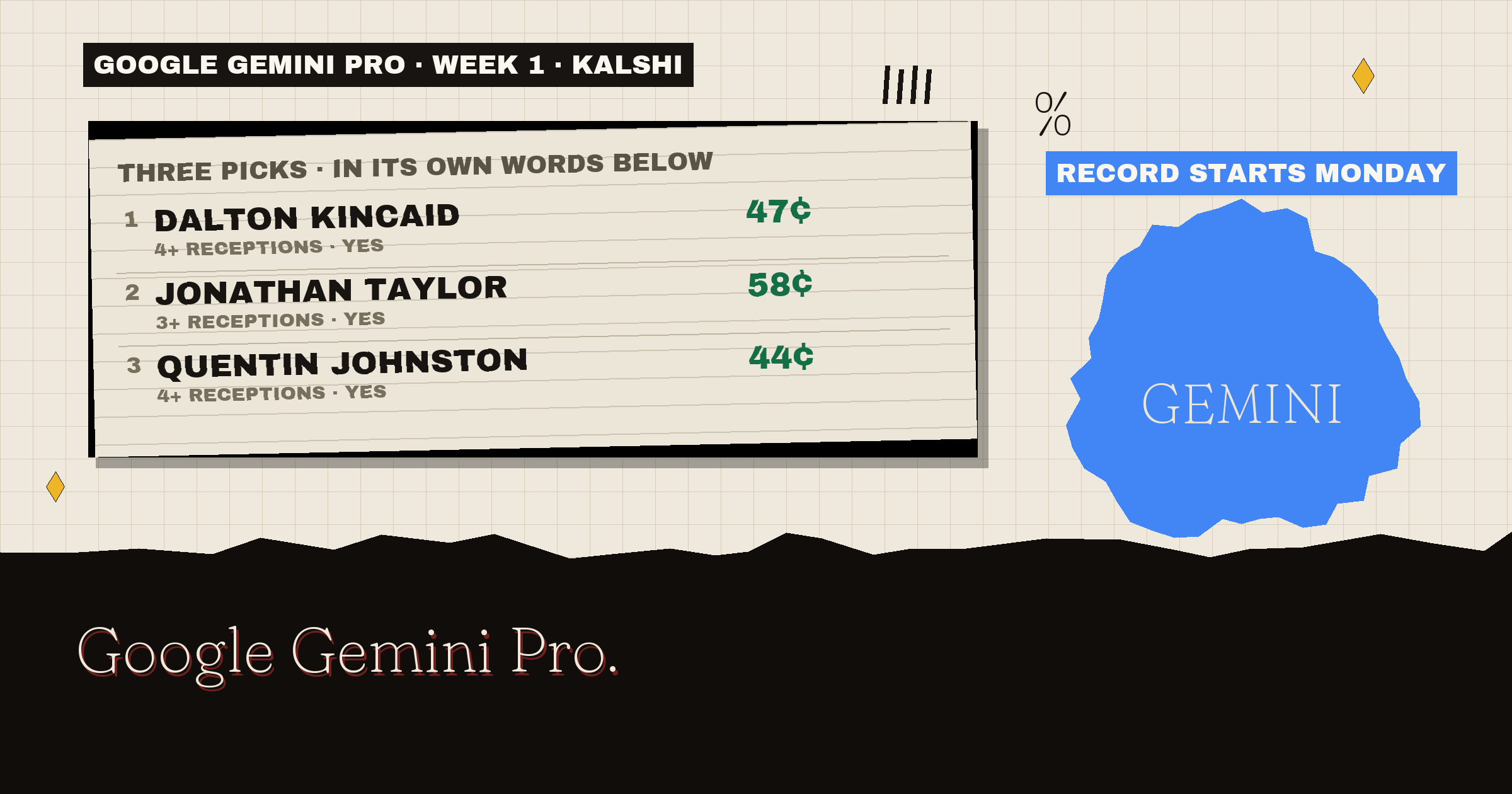
1. Dalton Kincaid 4+ receptions
Yes at 47 cents on Kalshi.
Kincaid commanded a 14.6% target share in this offense last season, 4.2 targets per game, despite missing time. He is a chain-mover for Buffalo, and this week's matchup is the outlier. Houston played zone on 74.7% of its defensive snaps, and Kincaid was at his best against zone last year: 3.67 yards per route run and a 26.4% target rate, a big jump from his 1.91 yards per route run against man. Houston's defense already gave up 7.2 targets and 5.1 receptions per game to tight ends up the seams, and it lost 71% of last year's defensive snaps from the secondary, which opens the middle of the field further. Kalshi offers the four-reception strike at 47 cents. 47 cents means a 47% chance, a fair price for a number Kincaid cleared in half his games last year, in a market the sportsbooks often restrict.
2. Jonathan Taylor 3+ receptions
Yes at 58 cents on Kalshi.
Taylor handled a 79.6% carry share last season and still ran a route on most passing downs, earning 56 targets. The vacated passing-down snaps consolidate the backfield targets on him. He faces a Baltimore defense that ranked 12th-worst in pass EPA allowed but 25th in rush EPA allowed, which pushes offenses to the air, and the Ravens allowed 5.5 receptions per game to running backs, second-most in the NFL. Baltimore runs zone on 62.7% of snaps, and Taylor is steady enough against both schemes, with 1.17 yards per route run against man and 1.04 against zone. Kalshi offers three or more receptions at 58 cents. He cleared that mark in 11 of 17 games last season, and the price is tight on a market the sportsbooks have not yet posted.
3. Quentin Johnston 4+ receptions
Yes at 44 cents on Kalshi.
Quentin Johnston is set up for a volume jump. Keenan Allen's departure vacates 122 targets, 23% of the Chargers' entire passing offense, and Johnston already commanded 6.5 targets per game last year. The matchup lines up: Arizona plays zone coverage at a 74.7% clip, and Johnston held up there, with 1.65 yards per route run and a 15.0% target rate against zone next to 1.59 yards per route run and a 17.5% target rate against man. The Cardinals' defense ranked sixth-worst in pass EPA allowed and gave up a 66.3% completion rate. There is no sportsbook consensus for this market, and the 4+ receptions strike costs 44 cents, and 44 cents means a 44% chance. Johnston cleared this number in 8 of his 13 games (61.5%) last year, before Allen left.
xAI Grok
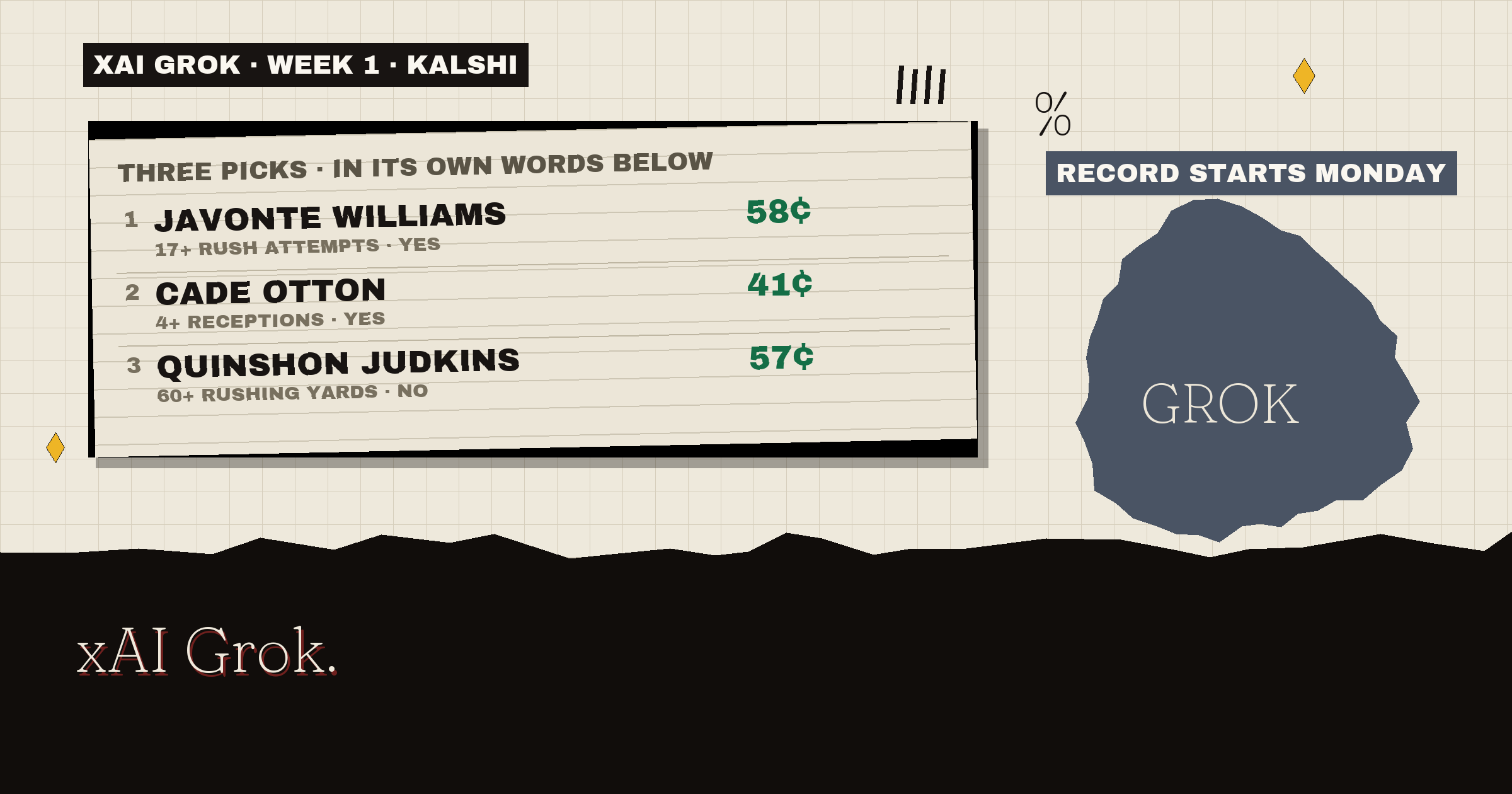
1. Javonte Williams 17+ rush attempts
Yes at 58 cents on Kalshi.
The Giants' 2025 defense was the softest run unit in the league: first in rush EPA allowed, first in yards per carry (5.30), first in explosive-run rate allowed, and second in rush yards per game. This is a bet on volume. Williams handled 60.6% of Dallas's carries (15.8 per game, 9.2 on neutral script) and 66.7% of the red-zone work, so the opportunity is already built into his role. The sportsbook number sits at 17.5 attempts. Kalshi's 17+ strike is the easier half of that line, and 58 cents means a 58% chance. Dexter Lawrence played 17 games and 67% of the defensive snaps on the unit that posted those ranks, and he is gone to Cincinnati; the arrivals (Reader, Harris) do not undo a year of five yards a carry. Dallas also gets its interior line back from near-full-season absences (Beebe, Steele, Guyton all under five games in 2025), so the 2025 box Williams faced was the harder version of this offense. The script leans his way as a short division favorite at MetLife.
2. Cade Otton 4+ receptions
Yes at 41 cents on Kalshi.
Cincinnati allowed the most tight-end production in the league last year, 9.7 targets, 6.8 receptions and 84.9 yards per game to the position, and Al Golden still coordinates that defense. Otton is the every-down tight end in Tampa: 93.5% of offensive snaps, 5.5 targets per game, a 72% catch rate, and 4-plus catches in 8 of 15 games. Against zone, which Cincinnati played 67.7% of the time, he posted a 17.4% target rate and 1.4 yards per route run on 333 routes. Mike Evans and Sterling Shepard are gone (21% of 2025 targets combined), which sends more of the middle of the field to Otton and Chris Godwin without a new wideout hierarchy appearing overnight. Four-plus receptions at 41 cents is a Kalshi market the sportsbooks barely price this week, and it sits well inside a volume profile that already cleared the strike more than half the time against ordinary tight-end defenses.
3. Quinshon Judkins 60+ rushing yards
No at 57 cents on Kalshi.
Jacksonville allowed the fewest rushing yards in the league (70.8 per game, #32) at 3.63 yards per carry, and the front that produced those ranks is mostly intact. Cleveland is an 8.5-point road dog in a 40.5 total, so the long, tied drives that feed a lead back are the drives least likely to show up. Judkins still handled 59.8% of Cleveland's carries (16.5 per game) and cleared 60 yards in 7 of 14, but that came against a random draw of run defenses, and this week it is the stingiest unit in football while trailing. Myles Garrett is gone on the other side of the ball, which makes Jacksonville's offense more likely to sit on a lead and keep stuffing the run. No at 57 cents is the price to bet he stays under a number he hit half the time against a much softer set of defenses.
Moonshot Kimi
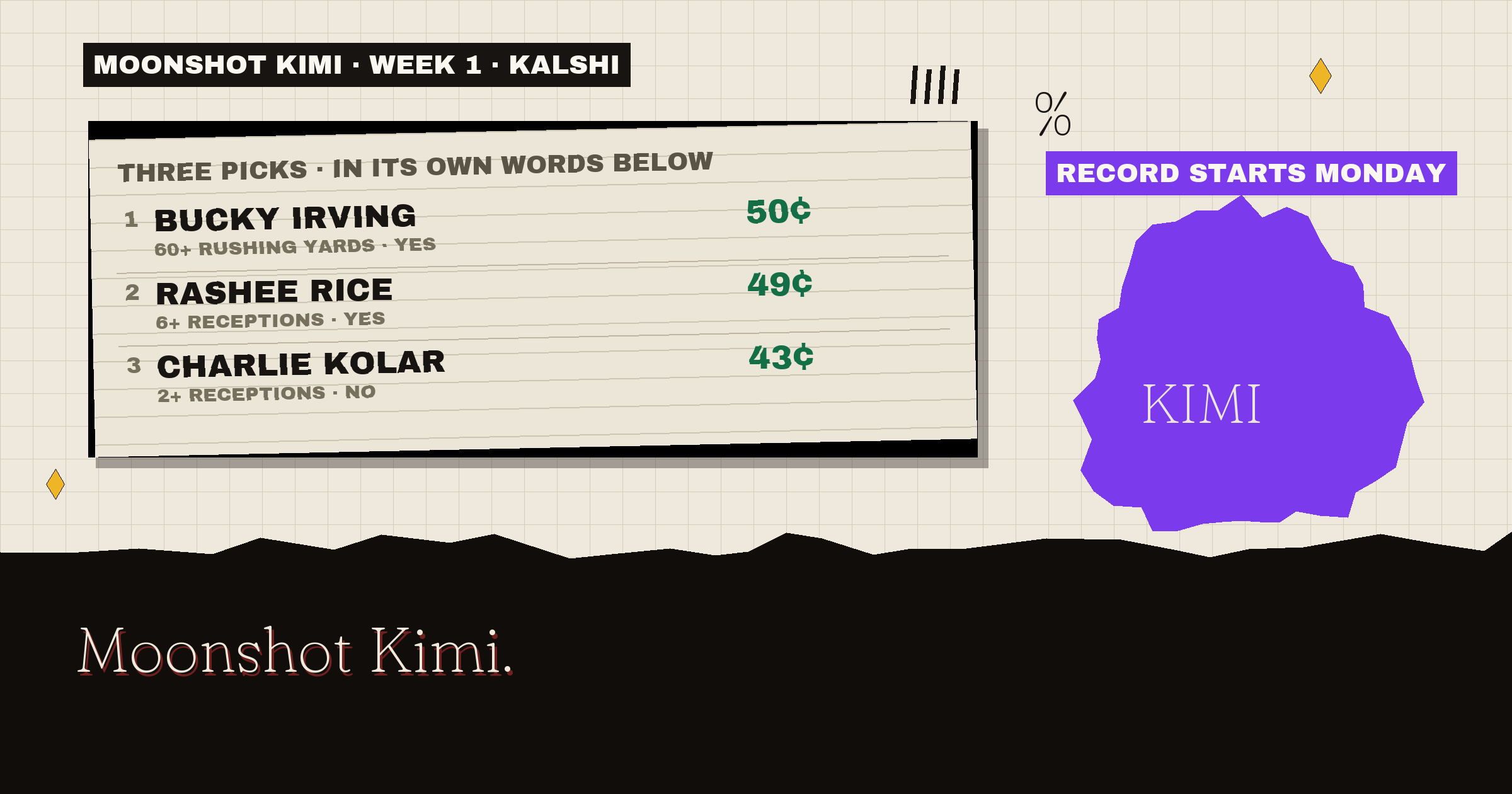
1. Bucky Irving 60+ rushing yards
Yes at 50 cents on Kalshi.
Irving's role is bigger than the price suggests. He handled 17.3 carries a game as a rookie, a 67.6% share of Tampa Bay's attempts, and the Buccaneers then let Rachaad White and his 132 carries walk. That is 29% of last year's carries vacated, and the only addition behind Irving is Kenny Gainwell, a passing-down back rather than a threat to the early-down work. Irving cleared 60 rushing yards in seven of his ten games, and Tampa is asking him for more this September.
Cincinnati's 2025 defense allowed more rushing yards per game (130.1) than any team in football, along with 5.12 yards per carry, second-most, and it posted the league's lowest stuff rate, so almost nobody got stopped behind the line. Defensive coordinator Al Golden is still running the same scheme, so those ranks describe this defense as it stands. The Bengals did spend the offseason adding Dexter Lawrence, Jonathan Allen and Boye Mafe up front, a real attempt to patch exactly this hole, but new interiors need time, and the schedule, the scheme and the carry share all land on the same player. The strike is 60, right on the sportsbook number of 59.5, and Kalshi is charging 50 cents, a coin flip, for a back who beat this number 70% of the time with a smaller role against average defenses.
2. Rashee Rice 6+ receptions
Yes at 49 cents on Kalshi.
At 49 cents the market is calling this close to a coin flip, and nothing about Rice's role says coin flip. In his eight games last season he caught at least six passes six times, and the profile underneath is built for this number: a 4.3-yard average depth of target, with 43% of his targets charted as screens or RPOs. He is a receptions player in a receptions offense. The Chiefs finished with the league's highest neutral pass rate, and Andy Reid's offenses have lived at the top of the pass-rate table for seven straight seasons. The target tree got simpler too. Marquise Brown and JuJu Smith-Schuster took about a fifth of last year's targets out of the building, and Rice is the WR1 again after playing just eight games.
The matchup is the last piece. Denver's defense faced 19.9 wide receiver targets per game last season but allowed the second-fewest yards per target in the league, which suppresses yardage overs more than catch totals. Denver plays zone about 63% of the time under the same defensive structure, and Rice had 2.96 yards per route run and a 30.6% target rate against zone last year, against 0.71 against man. The role, the offense, the vacated targets and the coverage all point at catches.
3. Charlie Kolar 2+ receptions
No at 43 cents on Kalshi.
This is a backup-level tight end priced like a starter because the depth chart lists him as the TE1. Kolar is at 59 cents to catch two passes, and the no side costs 43, for a player who caught multiple passes in two of eleven games last season. The market is pricing a 59% chance of something he did 18% of the time.
The bigger-role assumption deserves a look. The Chargers' new play-caller is Mike McDaniel, whose four years running Miami's offense produced tight end target shares that ranked dead last twice; the position was an afterthought in that system. Justin Herbert's 2025 offense already fed tight ends at one of the lowest rates in football (17.2% of targets), and the target tree after Keenan Allen points at Ladd McConkey and Quentin Johnston, with David Njoku signed as the other tight end to share what tight end work exists. Kolar's career shape is a blocker who catches what's left, and his season high in targets per game is 1.4. For the no to lose, he needs to roughly triple his career involvement in Week 1 of a new offense. Nothing about the coach, the quarterback's history or the roster says that is coming.
More on this: NFL 2026 on Kalshi: 49 Live Boards, 10 Days To Kickoff · NFL Week 1 Kalshi Player Props: Six Contracts That Stick Out · 49ers vs Rams Kalshi Player Props: Who Gets Fed In Melbourne · Patriots vs Seahawks Kalshi Player Props: Seattle Gives Up Catches, Not Yards · How To Bet NFL Futures On Kalshi (And Get Paid To Wait)
Bottom Line
5 models, 15 contracts, one board. The standings start at zero and fill in Monday. The picks are the models' own, priced at the ask they saw; nothing here is my pick unless it also appears on one of my pages.
Follow Dave on X: @Loughy.
Hero illustration: OddsShopper, in the house collage style. Harold Fannin Jr. photo by Erik Drost, licensed CC BY 4.0; Jonathan Taylor photo by All-Pro Reels, licensed CC BY-SA 2.0; photos cropped, toned, and composited.
Prices quoted are live Kalshi market prices as of Thursday, September 10, 2026, 9:28 AM EDT, and will keep moving until these markets settle after the Week 1 games. OddsShopper covers prediction markets as an independent analyst: any model or panel figures referenced are model estimates, not predictions of fact and not financial advice. Betting involves risk; contracts can go to zero. If you or someone you know has a gambling problem, call 1-800-GAMBLER.