Before you read Trump travel prediction market insider information into a sharp-looking trade, check the cheaper explanation: for travel markets specifically, the trail that settles the contract is public. Presidential movement leaves a published paper trail, and these CFTC-regulated event contracts name the documents that settle them.
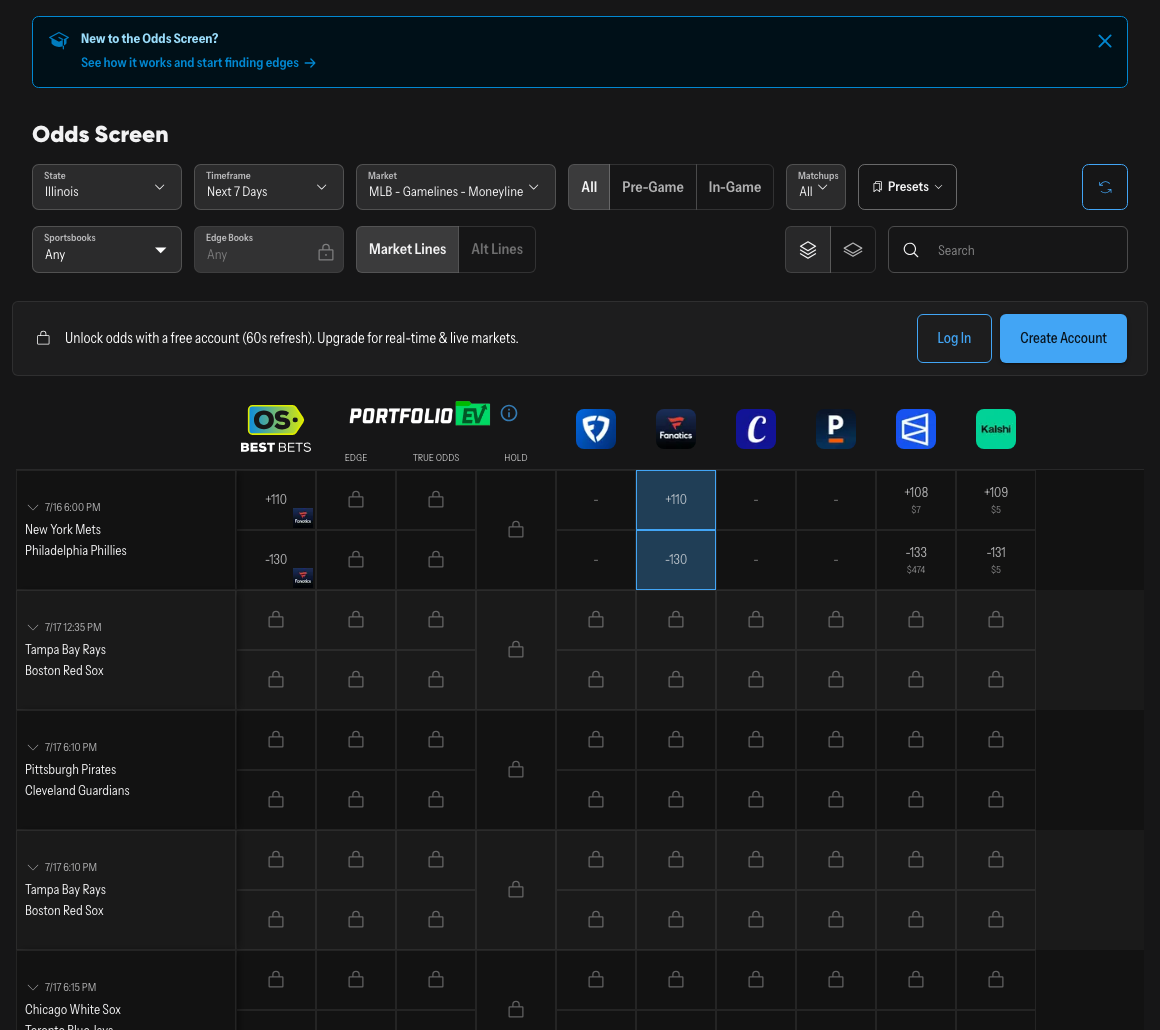 The OddsShopper live odds screen — every book's price on one board, refreshed in real time. Open the live board.
The Quick Answer
When someone calls a Trump travel market days early, the likeliest explanation is that they read the public record faster than everyone else: presidential visits get announced by host governments, telegraphed to the traveling press, and fenced by federal flight restrictions that appear on a public FAA feed before the trip. Venue rules do separately ban trading on material non-public information, and the exchange's own contract terms name the exact sources a visit must be documented by. Below: the settlement language for these markets word for word, the twenty-two-entry source list a visit gets proven against, the public feeds that trail actually runs through, and the one market class where the suspicion is much harder to dismiss.
The Question Behind The Question
One prediction market forum post keeps getting quoted back at me. It landed on the Polymarket subreddit and it read, in part: "Someone Keeps Predicting Trump's Travel Plans With Surprising Accuracy … Either they've done exceptional research, or they know something the rest of us don't."
That is not a conspiracy post. That is a good question asked badly, and it stings because both branches feel equally plausible from the outside. You are staring at a screen showing a price and a timestamp. Somebody bought well before the news, the news arrived, they were right, and the screen gives you no way to tell diligence from access.
There is a way to tell, and it starts somewhere most traders never look: the contract's own settlement terms, which turn out to be a research checklist hiding in plain sight.
What A Travel Market Actually Settles On
Kalshi runs several presidential travel and visit series, including a weekly "Where will Trump visit this week?" and an annual "What countries will Trump visit this year?" Both settle under the same publicly hosted contract terms document, and its language is unusually plain for a legal document. The underlying is "the physical presence of <person> within the geographic boundaries of <area> <time period>," and the payout criterion covers the values where that person "has physically travelled to and been present within" those boundaries.
Then it gets specific about what does not count:
| Does NOT Constitute A Visit | Why it matters to a trader |
|---|---|
| Flying Over The Area Without Landing | Airspace transit is common on long-haul routes and settles nothing |
| Layovers Where The Person Stays In The Airplane Or Airport | A refueling stop is not a visit, however it is reported |
| Virtual Or Remote Appearances | A video address to a summit does not resolve a travel market |
| Presence In International Waters Adjacent To The Area | Carrier and shipboard events sit outside the boundary |
| Presence Solely Within Embassy Or Consulate Grounds | Diplomatic compounds sit outside the boundary, even inside the area |
| Plans, Announcements, Or Scheduling Of Future Visits That Do Not Occur In The Time Period | An announced trip that gets cancelled resolves No |
That last row is the one I keep coming back to, because it quietly inverts the whole insider premise. If knowing the plan were sufficient, the person with the schedule would win every time. Under these terms, the plan is explicitly not the event. A trip announced with fanfare and then scrubbed pays nothing, and cancellations are exactly the kind of thing an insider would know about and an outsider would not.
The edge is smaller than it looks.These markets pay on documented arrival, not on hearing about intent first. Someone holding the itinerary still has to be right about whether the trip survives contact with the week.
The terms also spell out what evidence Kalshi will accept, and the list is expressly open-ended. "Acceptable evidence includes but is not limited to: official announcements, news reports with specific location details, verified photographs or videos showing <person> at an identifiable location within <area>, flight records showing arrival, official schedules showing completed events, or social media posts from official accounts showing presence within <area>." Every one of those is a public artifact. None of them is a whisper. The evidence examples can grow; the source agency list, which is where my argument actually lives, is enumerated rather than open-ended. For a fuller walkthrough of how this machinery works generally, our guide to Kalshi resolution criteria covers the same document class across market types, and what happens at settlement covers the payout mechanics.
The Twenty-Two Names That Prove A Visit
Here is the promised payoff. The contract terms list the source agencies a visit is documented against, and the list is not a vague nod to "the media." It runs 22 entries deep: official government sources of the area, official representatives or offices of the person, the New York Times, the Associated Press, Bloomberg News, Reuters, Axios, Politico, Semafor, The Information, the Washington Post, the Wall Street Journal, ABC, CBS, CNN, Fox News, MSNBC, NBC, BBC, The Guardian, local news outlets with verifiable mastheads in the area, and official social media accounts of the person or their official representatives. The separate presidential foreign-trip series, "Foreign trips by the POTUS," narrows much further: its contract terms name the source agency as "the White House and The New York Times," while the exchange's live settlement-source field for that series currently lists the White House alone. Either way, the answer there comes from one or two announcing bodies rather than 22.
Read that list as an instruction rather than a disclosure and it changes what you do with an evening. The exchange is telling you, in writing, which 22 named entries can carry the answer. A trader who has set alerts on the local mastheads in likely destination cities, on the host government's communications office, and on the White House pool feed is doing nothing exotic. They are reading the specified sources on the specified schedule, which is the entire job.
The Public Trail: Where Early Reads Actually Come From
Three streams carry most of the early signal, and none of them requires a source inside the building.
The host government usually announces first. A head-of-state visit is a diplomatic event for the destination as much as the traveler, and foreign ministries and local governments publish and brief on their own timelines. The contract terms list "official government sources of <area>" first. That ordering makes sense to me for this reason, though the document itself does not explain it.
The traveling press has to be told in advance. Presidential travel moves a press pool, and pool logistics (call times, filing locations, embargoed schedules) generate reporting from outlets that are themselves named source agencies on the travel contracts. Worth noting how the exchange itself rates that reporting: a separate Kalshi series about inbound travel, "Visitors to the USA this year," names "official White House press pool reports" outright as a settlement source. The Trump-travel contracts do not list the pool by name. They get there through the wire services and mastheads that carry pool reporting.
Federal airspace restrictions get published before the trip. This is the underrated one. When the president travels, the FAA issues temporary flight restrictions around the movement, and they are public. The National Business Aviation Association's guidance describes VIP restrictions as "generally not made available to the public until two or three days before the event," structured as "an outer ring (usually 30 nautical miles, but sometimes slightly more or less) and one or more inner rings (usually 10 nautical miles, but sometimes 8, 9, or 10 nautical miles)." The determinations, per NBAA, "are made by the United States Secret Service (USSS), in coordination with FAA Security," and the information "is typically distributed via Flight Data Center (FDC) Notice to Airmen (NOTAM) in advance of the event."
Read that as a clue, not a regulation.A published, geographically precise, two-to-three-day-ahead notice that a 30-nautical-mile bubble of protected airspace is about to appear over a specific city is a strong advance signal for anyone who checks it. Pilots check it because they have to. Almost no traders do.
One caveat decides whether that signal is usable: a VIP restriction tells you a protected principal is coming, not which one. The same structure gets issued for the vice president and other protected persons, and the notice does not name the individual. Pair it with a named source agency before you treat it as a Trump trip, and never as settlement, because only a source agency's report of a completed visit resolves the contract.
A Worked Example: Running A Real Strike Through The Contract Terms
Take a live one. Kalshi's annual "Which states will Trump visit this year?" market carries a Minnesota strike, and it settles under the same VISITAREA terms quoted above. Here is the order I would work it, using only what the contract itself names. I am stopping before any price, because the point of the exercise is the evidence chain, not a position.
- Start on the destination side, not the Washington side. For a Minnesota strike, "official government sources of <area>," entry one on the list, means the governor's office and the relevant city hall, not a private venue or convention operator. A venue's announcement is a research lead; only the named source agency's reporting counts toward resolution.
- Check the airspace feed midweek, when NBAA's two-to-three-day window opens, for a restriction appearing over the Twin Cities or wherever the event would sit. Remember both limits from above: it does not name the principal, and it never settles anything.
- Cross it against the named local masthead. "Local news outlets with verifiable mastheads in <area>" is entry 21, and in Minnesota that is a paper like the Star Tribune, which will carry the road closures and the advance logistics before it carries the visit itself.
- Run the exclusion list before you size anything. For a domestic strike, two exclusions actually bite. A flight that transits the state without landing settles nothing. A landing where he "remains in an airplane or airport" is not a visit either, and a refuel at MSP is not Minnesota for these purposes. And an announcement alone never resolves Yes: "plans, announcements, or scheduling of future visits that do not occur" are excluded outright.
- Only then look at the price, knowing the contract pays when a source agency reports a completed arrival, not when you read about the plan.
Two mechanical details shape the trade itself. The minimum tick is one cent, so these markets move in single-cent increments and a spread of a few cents eats a real fraction of what you are forecasting. Kalshi's position accountability level on these contracts sits at "$25,000 per strike, per Member," which flags how much any one account has accumulated before the exchange takes an interest, which is worth knowing before you read somebody's large position as proof of anything.
Expiration is not fixed either. The terms set a latest expiration date, but if the event described in the payout criterion occurs, "expiration will be moved to an earlier date and time in accordance with Rule 7.2." Thin books behave differently under that kind of acceleration, which is its own topic in prediction market liquidity and in how a single large order moves a thin market.
The discipline underneath all of this is one sports bettors already run: never accept one screen's number as the truth, which is what a live odds screen — shop the number across every major book is for. Pointed at an event contract, the reflex is identical.
Where The Rules Draw The Line
None of the above means inside information is permitted. The prohibition is written down. Kalshi's published trading prohibitions state: "Pursuant to Kalshi Rule 5.13(s), you are prohibited from participating in a contract if you are either (i) an employee of the source agency, (ii) have material non-public information regarding this contract, or (iii) have the ability to influence the outcome of the contract."
The travel series carry that same restriction on their face. Both prohibitions attached to the presidential visit series read, verbatim: "Persons who are employed by any of the Source Agencies are not permitted to trade on the Contract," and "Persons who hold any material, non-public information on the Underlying are not permitted to trade on the Contract."
Two things about that deserve a beat. Clause (iii), the ability to influence the outcome, does not ask whether you knew. It asks whether you could decide. For a travel market, the people who choose where the president goes are barred either way.
The second is the callback: this prohibition is anchored to the source agencies, that same twenty-two-name list. The document telling you where to look is the document telling a subset of people they may not look at all. Kalshi's CFTC-filed rulebook defines a "Source Agency" as "the agency that publishes the Underlying and/or Expiration Value for any Contract," and defines the Source Agency Prohibition as the list of those agencies "which may implicate trading prohibitions under Chapter 5 of these Rules such as if a Trader has access to material non-public information or is a decision maker."
Where the line actually falls.Material non-public information, in the venue's own framing, means information you hold by virtue of your position, not information you gathered through research that others could also have found in the public domain. Reading the FAA feed is research. Being told by the advance team is not.
Our broader look at Kalshi's rules and the full trust question both take that distinction further.
Where The Suspicion Is Much Harder To Dismiss
I would be selling you something if I stopped here and implied every "how did they know" story has a benign answer. Travel markets are close to the friendliest case precisely because their trail is public. The hard cases are the markets whose resolving fact gets produced privately and then announced.
| Public-trail markets (travel, visits, appearances) | Private-fact markets (unannounced decisions, releases) | |
|---|---|---|
| Who Holds The Answer Early | The plan, yes: a small circle. The outcome, no: it hasn't happened yet | Both the plan and the outcome, before anyone else |
| What Settles It | A completed event documented by at least one of the 22 named source agencies | A resolving fact known privately first, then released through the specified source |
| What The Public Trail Gives You | Advance research inputs: airspace notices, host-government releases, local mastheads | Nothing until the release |
| What Early Accuracy Suggests | Someone read the specified feeds on schedule | Ambiguous on its face, and worth asking about |
| Your Realistic Defense | Read the same sources | Treat it as a standing cost you cannot price away |
To be exact about what that first column does and does not mean: an FAA airspace notice never settles a travel contract. Only a source agency's report of a completed visit does. The notice is a research input that arrives early, which is precisely why it is useful and precisely why using it is not insider trading.
Reporting by Al Jazeera in March 2026 described 38 accounts on Polymarket, per the report allegedly controlled by one person, placing four to ten bets each roughly a day before the late-February strikes, with what the report characterized as a near-perfect success rate, netting more than $2 million. Economist Paul Krugman, quoted in that coverage, said: "Somebody close to Trump knew what he was about to do, and exploited that inside knowledge to make huge, instant profits." A White House spokesperson responded that the administration does not "tolerate any administration official illegally profiteering off of insider knowledge" and called the accusations "baseless and irresponsible reporting." Those remain allegations reported in the press, not findings by a court or a regulator, and I am describing the dispute rather than resolving it.
Venues do act on this class of case: in February 2026, multiple outlets reported that Kalshi fined and suspended a video editor after alleging he traded markets tied to his employer's unreleased videos, the exchange saying its surveillance flagged the account for statistically anomalous success in low-probability markets. Whatever you make of any single case, the structural point holds. Exposure lives where a small circle owns the answer before the public does, and travel markets are the opposite shape. Our writeups on settlement disputes and on whether fast-resolving crypto markets are rigged work through what a truly contested resolution looks like.
More on this: Trump Next Press Secretary Odds: Kalshi's Favorite Said No · What Will Trump Say This Week? Kalshi Odds · What Will Trump Say? Kalshi Mention Market Odds · Trump Cabinet: Who The Market Expects To Leave Next · Trump Early Departure Odds: Does Trump Leave Office Early?
What The Screen Still Can't Tell You
So circle back to the Redditor. Exceptional research or something the rest of us don't know. For travel markets, the first option is available to anyone willing to read 22 named sources and one FAA feed, and the second is both banned in writing and less useful than it sounds, because knowing the plan does not settle a contract that pays only on arrival.
Any individual trader's motive stays unresolvable from the outside, and the price chart was never going to reveal it. The contract terms will, though, and in a more useful direction: a market whose exclusion list runs six items long and whose source agencies number 22 is built to be settled in public; one whose resolving fact is produced privately and then released is not. That distinction, an enumerated public source list versus a resolving fact produced privately and then released, is the thing worth checking on the terms page before you commit anything. If you choose to trade the readable ones, work them with the sources the contract names; treat the private-fact ones as carrying a cost you cannot price away. If the category is new to you, start with how prediction markets work, how they differ from sportsbooks, and where they are legal. For a political market class built on published data rather than private plans, Trump approval rating markets make a useful contrast.