Two companies on Kalshi's 2026 IPO board have already paid out this year, and neither of them did it the way you would guess. One was a sandwich chain. The other got there without a single SEC document. Meanwhile the priciest contract on the board belongs to a company that announced its IPO paperwork in public, on its own website, almost three months ago, and it still has not settled.
That gap is the whole point of how this market works, and it is why a board that looks like a popularity contest between famous private companies is actually a very narrow bet about paperwork and calendars. Kalshi, a CFTC-regulated event-contract exchange, lists 29 companies under one question and lets you take a yes-or-no position on each. Twenty-seven are still live. We ran all 27 past our AI panel without showing the models a single price, then compared what they said to what traders are paying. The panel disagrees with the market on the name at the very top, and it disagrees in the other direction on the name most people are actually waiting for.
New to Kalshi event markets? Start here with how event contracts work. Prices on this page carry an as-of stamp and refresh on our standard market-pulse cycle while this story moves.
What It Takes To Settle Yes
Kalshi's own headline for this event is "Which companies will officially announce an IPO this year?" Read the contract and the word "announce" turns out to be doing no work at all.
Every company's contract reads the same way: "If [company] confirms an IPO before Jan 1, 2027, then the market resolves to Yes." The settlement clause defines "confirms" as exactly three things. The SEC declares the company's Form S-1 effective. Or the IPO is priced. Or a securities exchange assigns it a ticker. Any one of the three settles the contract immediately, even if the shares do not start trading until 2027.
All three of those sit at the very end of the going-public process, which is the distinction that decides these contracts. That has four consequences worth holding onto, because they explain nearly every price on the board.
- A Confidential Filing Does Not Count. Companies are allowed to start by handing the SEC a draft registration statement in private, called a Form DRS. It never appears on the SEC's public EDGAR database until the company chooses to make its registration public. So a company can be deep into SEC review while the public record shows nothing at all.
- Announcing That You Filed Does Not Count Either. On June 1, 2026, Anthropic published a note on its own site saying it had "confidentially submitted a draft registration statement on Form S-1 to the U.S. Securities and Exchange Commission for a proposed initial public offering," adding that "the number of shares to be offered and the price have not yet been set." A real, verifiable, company-confirmed announcement, and it settles nothing.
- Even A Public S-1 Is Not The Trigger. The SEC has to declare it effective, which in practice happens the day the deal prices.
- The Exchange Does Not Have To Be American. "A securities exchange" is not qualified anywhere in the rules. A Hong Kong listing code counts the same as a New York one. Remember that, because it is how the board's second winner settled.
Stay ahead of the markets.
Daily insights and expert picks on Kalshi, Polymarket, and what's moving markets.
Free forever. Unsubscribe anytime.
The Two That Already Confirmed
Jersey Mike's is the clean textbook case, and it is worth walking through because it sets the clock for everyone still on the board. The sandwich chain went through SEC review privately, filed its public Form S-1 on July 2, 2026, amended it on July 20, then announced pricing at $23.00 a share for 43,478,261 Class A shares on July 29 and opened on the New York Stock Exchange under JMKE the next morning. Net income of $55 million on $724 million of revenue for the 12 months to December 2025, backed by Blackstone.
Twenty-seven days from public filing to priced deal. Every model on our panel used that number as its yardstick, and it is the honest one: a company that surfaces a public S-1 as late as mid-November can still confirm before the deadline. A company that has not started the private half of that process is running out of room, though the private half is exactly the part nobody outside it can see.
Shein settled a different way. Its contract went to Yes on August 24, the day it launched a Hong Kong offering of 280 million shares and picked up the stock code 00625, a week before the final price was even set. Trading is due to begin September 1. Not one SEC document was involved in the listing that finally settled it.
The reason it happened in Hong Kong rather than New York is the story behind the number, and it is documented rather than speculated. Shein spent years trying to list in the United States and then in London, and got neither. Forbes reported on the day of the Hong Kong launch that the earlier attempts ran into "concerns around supply-chain transparency and data ownership in the U.S., while China's securities regulator did not approve the proposed London listing."
Two sets of numbers are circulating on the deal, and they sit on different bases. The marketed range tops out near $27 billion of value and $1.8 billion raised. The price the company is actually guiding to, just above the midpoint of that range, works out a little above $26 billion and about $1.7 billion. Set either against the roughly $100 billion tag Shein carried in 2022 and you get the same picture: a three-year fight over disclosure and sourcing, priced at a haircut somewhere in the low seventies of a percent, plus a different continent.
Both outcomes teach the same lesson in opposite directions. The trigger is mechanical, it is not American-only, and it can fire on a company almost nobody had in the top tier.
The Filing Window Is Not The Constraint
The easy story about 2026 would be that the IPO market is shut and everyone is stuck. The SEC's own filing records say otherwise.
Counting documents filed between January 1 and August 27 of each year that contain the phrase "initial public offering," EDGAR shows 356 Form 424B4 filings in 2026 against 343 in 2025 and 218 in 2024. A 424B4 is the final prospectus a company files once its IPO has actually priced, which makes it the closest thing there is to a running count of deals that got done. On the pipeline side, S-1 registration statements run 5,483 in 2026 against 3,995 and 2,825 in the two prior years. Both measures put 2026 ahead.
So the window is open. What it is not is a reason for any particular company to walk through it. The panel landed on the same phrasing independently across several seats: an open window is permission, not intent. The same eight months that produced those 424B4s also contain Discord letting its own March target pass, Kraken pausing its listing in March, and OpenAI's finance chief pointing at 2027.
What actually binds this board is narrower than capital markets: 27 private companies, 127 days, and a settlement trigger that only fires at the finish line.
The Board
Here is every live contract, the actual two-sided quote behind it, and where our panel landed after both rounds. All 27 carry both a bid and an ask, so none of these are one-sided display prices. Most of the lower half is still thin, though: Mistral AI is quoted 4 bid against a 12 ask and Ripple Labs 3 against 9, spreads as wide as the price itself, which means the round trip costs more than the position on a lot of this board. The "stage" column is the panel's own classification of how far along each company actually is on the public record.
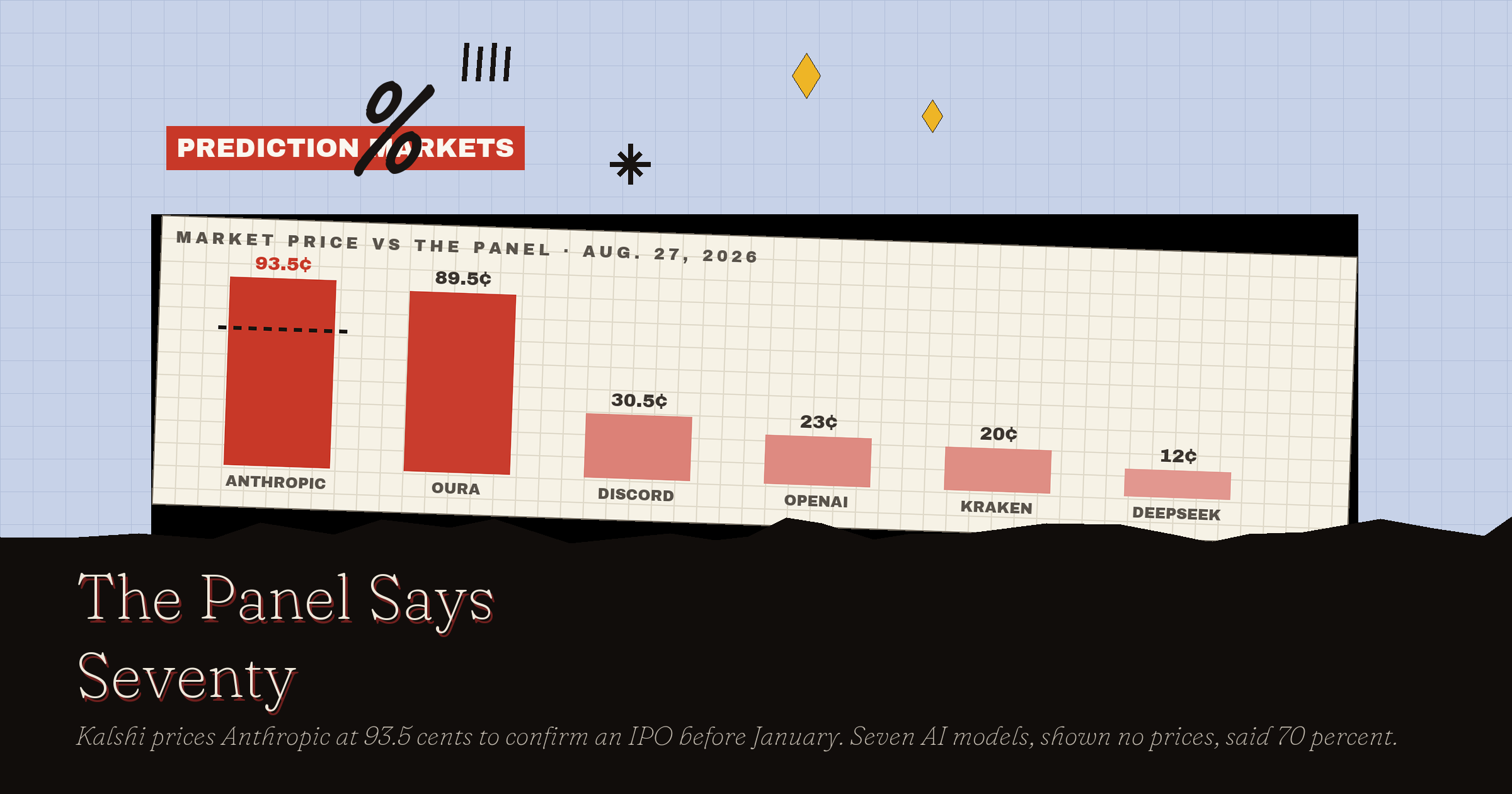
The dashed line across the Anthropic bar is the panel's number, not the market's.
| Company | Stage On The Public Record | Yes Bid / Ask | Panel Blend |
|---|---|---|---|
| Anthropic | Filed privately, publicly confirmed | 92¢ / 95¢ | 70% |
| Oura | Filed privately, actively marketing | 87¢ / 92¢ | 82% |
| Discord | Filed privately, target date missed | 29¢ / 32¢ | 12% |
| OpenAI | Filed privately, 2027 stated | 21¢ / 25¢ | 40% |
| Kraken | Filed privately, paused | 19¢ / 21¢ | 12% |
| DeepSeek | No filing surfaced | 8¢ / 16¢ | 0.7% |
| Plaid | Bank talks reported | 8¢ / 13¢ | 7% |
| Gopuff | No filing surfaced | 6¢ / 13¢ | 1% |
| Ramp | Readiness reported, no filing | 6¢ / 13¢ | 5% |
| Skims | No filing surfaced | 7¢ / 10¢ | 2% |
| Bloomberg | No filing surfaced | 6¢ / 10¢ | 0.3% |
| Mistral AI | Raising privately instead | 4¢ / 12¢ | 2% |
| Deel | Pipeline lists only | 4¢ / 11¢ | 4% |
| Rippling | No filing surfaced | 6¢ / 8¢ | 2% |
| Databricks | Watched, CEO resistant | 5¢ / 8¢ | 4% |
| Beast Industries | No filing surfaced | 5¢ / 8¢ | 1% |
| Stripe | Stated no rush | 5¢ / 8¢ | 1.5% |
| Airwallex | No filing surfaced | 4¢ / 8¢ | 2.5% |
| Ripple Labs | No filing surfaced | 3¢ / 9¢ | 2.5% |
| Glean | No filing surfaced | 5¢ / 6¢ | 1.5% |
| Applied Intuition | No filing surfaced | 3¢ / 6¢ | 1.5% |
| Anduril | Raising privately instead | 3¢ / 5¢ | 3% |
| Vanta | No filing surfaced | 2¢ / 6¢ | 1.5% |
| Celonis | No filing surfaced | 3¢ / 4¢ | 2% |
| Brex | No filing surfaced | 2¢ / 4¢ | 2% |
| xAI | No filing surfaced | 2¢ / 3¢ | 1.5% |
| Anysphere (Cursor) | No filing surfaced | 1¢ / 3¢ | 1.5% |
Prices fetched August 27, 2026. Panel numbers are the median of seven seats after the revision round.
More live boards from the same panel: Anthropic's month-by-month IPO ladder (its before-October rung is quoted 25¢ bid, 26¢ ask today, down from the 44¢ it held a week ago) · the OpenAI IPO board (the before-June-2027 rung sits at 69¢ bid, 76¢ ask, which is where that market's weight actually lives). Kalshi prices fetched August 27, 2026.
Take the midpoint of each of those 27 quotes and add them up, which is a rough count rather than a precise one because a midpoint on a wide spread is an approximation: the market implies about four more confirmations before January on top of the two already banked. Do the same with the panel's numbers and you get under three. About two-thirds of that difference sits in the tail rather than at the top: the argument is over whether 22 companies with no registration on file deserve a nickel each or a penny.
Every Seat's Number
Seven seats priced all 27 companies, twice. Below are the five contracts with a double-digit BID, seat by seat, because those are the only ones with real money on both sides of a double-digit price. Every other company on the board sits in single digits for every seat, and its blended number is in the table above.
| Seat | Anthropic | Oura | Discord | OpenAI | Kraken |
|---|---|---|---|---|---|
| Market (Mid) | 93.5% | 89.5% | 30.5% | 23% | 20% |
| Claude Fable | 68% | 80% | 14% | 42% | 12% |
| Claude Opus | 74% | 85% | 12% | 45% | 12% |
| Claude Sonnet | 66% | 82% | 10% | 38% | 13% |
| GPT | 68% | 82% | 14% | 40% | 11% |
| Gemini | 75% | 82% | 12% | 45% | 15% |
| Kimi | 70% | 85% | 12% | 38% | 11% |
| Grok | 73% | 83% | 13% | 38% | 11% |
| Panel Blend | 70% | 82% | 12% | 40% | 12% |
Every seat on this panel is graded against real market settlements — records to date: Claude Fable 83% on 779 graded calls · Claude Opus 84% on 849 graded calls · Claude Sonnet 82% on 824 graded calls · GPT 84% on 6,310 graded calls · Gemini 86% on 5,009 graded calls · Kimi 82% on 2,550 graded calls · Grok 84% on 4,307 graded calls. Recomputed daily; the full scoreboard is public.
These are model estimates, not predictions of fact and not financial advice. Seven of the panel's nine seats priced this board on August 27; the other two were unavailable for this run, and the numbers above are the seven that ran. Kalshi contracts are for adults 18+ and availability varies by state. Every number in this piece gets graded in public once the market settles, on the full graded scoreboard.
Anthropic, Oura And OpenAI: Where The Panel Splits From The Market
Anthropic: The Board's Favorite, And The Panel's Biggest Discount
Anthropic is the most heavily traded contract on the board after OpenAI. About 84,600 contracts are currently held open on it, and roughly 280,500 have changed hands over its life. The first number is the size of the position still open on the question today; the second is a running total that only ever grows. It is quoted 92 bid, 95 ask. The panel says 70.
The gap comes down to one unglamorous fact. As of August 27, there is still no public Anthropic S-1 on EDGAR. Reporting through August points at a public filing as soon as late August and a fourth-quarter listing, but reporting is not a filing, and the seats priced accordingly. Anthropic's own release named no exchange, no date and no ticker. Several seats noted an asymmetry cutting the other way. Settling this contract does not require Anthropic to complete an IPO, only to reach one of the three triggers, and the two that realistically fire first, a priced deal and an assigned ticker, land within days of each other at the end of a process the company started in June. That is what keeps the panel at 70 rather than 40 despite the blank public record.
The month-by-month version of the same question, linked above, breaks this single contract into a rung for every deadline from October through next April.
Oura: The Only Company On The Board Actually Selling A Deal
Oura is the one name where the panel sits close to the market and, if anything, treats it as the strongest position on the board rather than the second-strongest. The smart-ring maker filed confidentially on May 21, 2026, and on August 24 reporting put it in market for as much as $3 billion at a valuation above $16 billion, targeting September, with Goldman Sachs, Morgan Stanley, JPMorgan, Allen & Company and Jefferies on the syndicate. Revenue has gone from roughly $500 million in 2024 to about $1 billion in 2025 and is tracking toward $2 billion.
A date, a size, a valuation and five named banks is the fullest position on the board. All seven seats ranked Oura the single most likely name here, ahead of Anthropic, and a September launch leaves a full quarter of slack if the timing slips.
OpenAI: The One Place The Panel Sits Above The Market
OpenAI is quoted 21 bid, 25 ask. The panel says 40. This is the only contract on the board where the models sit meaningfully above what traders are paying, and the split traces to a single quote.
On August 19 the company's finance chief, Sarah Friar, told an all-hands that OpenAI "will be a public company in 2027," with the qualifier that it could come sooner if the business keeps inflecting. She also reportedly told staff the company had already filed confidentially in June and that the filing could be made public within weeks. Traders appear to have weighted the year. The panel weighted the "within weeks," and specifically the fact that this board pays on a trigger that fires months before the shares ever trade. A company can confirm in November and list in 2027, and the contract still settles Yes.
This was the widest disagreement inside the panel itself. In the first round the seven seats spread from 32 to 62 on OpenAI, a thirty-point range on a single contract, and they only converged to 38-to-45 after reading each other. Nothing else on the board produced anything close to that.
One more thing worth knowing about this particular contract, because it is checkable in 30 seconds and almost nobody looks. Kalshi lists the identical OpenAI question twice: once here on the 2026 board, and once as the January rung of its own dedicated ladder. The settlement language on the two is word for word the same, and so is the deadline. On August 27 the two listings did not agree. The board contract was quoted 21 bid and 25 ask; the ladder rung was 17 bid and 21 ask, on a market carrying about 36,800 contracts of open interest. Same question, same rules, four cents apart at the midpoint. Our standing OpenAI board, linked above, tracks that full ladder.
Dark Horses The Panel Won't Dismiss
Worth saying plainly: not one of the 27 live companies has a public S-1 or F-1 on EDGAR today, the five leaders included. Below the top five, all 22 remaining names drew single digits from every seat. A handful still got argued over.
Ripple Labs (3¢ / 9¢, panel 2.5%) and Airwallex (4¢ / 8¢, panel 2.5%) sit slightly above the floor for one reason: the ticker trigger is not American. Both are plausible non-US listing candidates, and Shein just demonstrated that a foreign stock code settles this contract before a price is even set. Gemini flagged that mechanism by name as the route by which "a dark horse" resolves without warning.
Databricks (5¢ / 8¢, panel 4%) is the board's most interesting contradiction. Chief executive Ali Ghodsi told Bloomberg Television in June that "We will be a public company. I just think this is a terrible year to go public," pointing at the mega-deals soaking up institutional capital. It is also one of the biggest names on the private secondary market, where existing shareholders sell to new ones without the company listing at all. That is the liquidity an IPO is usually needed for, and it removes the deadline.
Bloomberg (6¢ / 10¢, panel 0.3%) carries the largest proportional gap on the entire board. Every seat put it at the absolute floor, on the grounds that a founder-controlled private company with decades of stated refusal is not a listing candidate in any four-month window. Somebody is paying six cents anyway.
Stripe (5¢ / 8¢, panel 1.5%) rounds it out, for the same reason. Co-founder Patrick Collison has said that "for us right now, an IPO would be a solution in search of a problem," because "we have a self-funding business that's growing very well." CNBC reported in February that an employee tender offer valued Stripe at $159 billion. That is the liquidity a listing would otherwise provide, delivered without one.
Where The Panel Changed Its Mind
After the first round, every seat read the others' reasoning anonymously and could revise. The movement was almost entirely on one name.
The two biggest cuts were both on OpenAI. GPT came in at 62 and dropped to 40. Gemini came in at 60 and dropped to 45. Both were pulled down by the seats arguing that a chief financial officer naming a year outranks a report about paperwork, and Kimi, which barely moved at all, wrote the cleanest version of that case:
the CFO's own 2027 base case is better intent evidence than "within weeks" optionality — a public S-1 is not a trigger. — Kimi
Opus moved the opposite way on the same contract, from 32 up to 45, by reasoning about when the trigger fires rather than when the shares trade:
More important, the ticker trigger is loose and not US-only — Shein resolved on a Hong Kong stock code before final pricing, and a US public S-1 typically carries a reserved exchange symbol. That lowers the effective bar for the filed names from 'priced deal' to 'public S-1'. — Claude Opus
[Editor's note: the second half of that reasoning overstates the rule. A symbol printed on a company's own registration is a proposed ticker, not an exchange assigning one, so a public S-1 by itself does not settle these contracts. Kalshi's language still requires the SEC to declare the registration effective, the deal to price, or an exchange to assign the ticker. The Shein half of the point holds: a Hong Kong code settled that contract a week before its price was final.]
Grok raised Anthropic from 60 to 73, then trimmed OpenAI to 38 and explained why it would not follow the higher seats:
Other forecasters' OpenAI 60s overweight the filing against Friar's dated 2027 guidance; I hold ~38. — Grok
Sonnet barely touched the headline names and did its revising in the tail, cutting Ramp from 12 to 5 and Databricks from 10 to 4 on the reasoning that readiness and chatter are not filings. Fable landed at 42 on OpenAI and said plainly why the debate did not move it: "nothing in their reasoning added facts beyond the card."
What Would Change The Panel's Mind
Every seat named roughly the same list, and each item is a document you can check rather than a mood.
- A Public S-1 Or F-1 Lands On EDGAR For Anthropic, Oura Or OpenAI. The filing settles nothing on its own, but it is the last visible step before the two that do settle it, and Jersey Mike's covered that ground in 27 days. Direction: sharply up, for whichever name files.
- Reporting That Oura's September Window Has Slipped With No New Date. The board's strongest position rests on a reported date, a size and a syndicate. Remove the date and the panel's 82 falls toward the fifties. Direction: down.
- Discord Says Publicly That It Will Not Proceed, Or Relaunches With New Banks And A Fourth-Quarter Date. The market pays 30.5 cents here against a panel blend of 12, the widest gap on the board in proportional terms outside the pure floor names. Either outcome resolves it in one headline. Direction: both are live.
- A non-US Exchange Assigns A Code To Any Of The Silent 22. Shein's Hong Kong route is the mechanism that turns a two-cent contract into a settled one without a single SEC document. Direction: up, and without warning.
Settlement Timeline
| Item | Detail (as of August 27, 2026) |
|---|---|
| What Settles A Contract | SEC declares the Form S-1 effective, OR the IPO is priced, OR a securities exchange assigns a ticker |
| Deadline | Before January 1, 2027; contracts expire January 1, 2027 |
| Days Remaining | 127 |
| Already Settled Yes | Jersey Mike's (July 30, NYSE ticker JMKE) · Shein (August 24, Hong Kong code 00625) |
| Next Known Catalysts | Shein final pricing August 31 and first trade September 1 · Oura's reported September window · Anthropic's public S-1, reported as possible from late August |
| Practical Last Call | Roughly mid-November for a public S-1, on Jersey Mike's measured 27-day filing-to-pricing pace; December deals are rare |
| Re-Score Trigger | This page is re-scored whenever the story moves, above all if a public S-1, a price range, or a ticker assignment appears |
Hottest Prediction Markets Right Now
- 2028 Democratic presidential nominee · $195M traded
- 2027 Pro Football Champion · $72M traded
- Pro Baseball Champion · $61M traded
- 2028 Republican presidential nominee · $60M traded
- Bitcoin price at the end of 2026 · $33M traded
- Will the U.S. confirm that aliens exist? · $32M traded
Every market above links to our full AI model verdict; browse them all on the OddsShopper prediction markets hub, and see how every settled call actually scored on the full graded scoreboard.
More on this: Kalshi Flight Cancellation Odds: The Hedge That Drew A Lawsuit · Kalshi Tour Championship Round 1 Scores: Morikawa 4-For-4 · Kalshi Tour Championship Top 10 Odds: 11 Cashed Last Year · Best AI Coding Model Odds: One Column Decides The Whole Race · 2026 Governor Races: Every Kalshi Board We Track
The Bottom Line
The board's headline number and the board's headline name are not the same thing. Anthropic is the most confident price on it and also the panel's biggest discount, and both facts rest on a single missing document. Oura is quieter, cheaper in the press, and the only company here actually out selling a deal with a date, a size and five banks behind it. OpenAI is the one contract where seven models looking at the same evidence ended up above the people with money on the line, and they got there by reading the settlement rules more literally than the calendar.
Everything below a nickel is a bet that the public record is hiding something, which it sometimes is. Jersey Mike's was invisible on EDGAR until four weeks before it priced, and Shein never showed up there at all. That is the honest case for paying two cents, and it is also why 22 of these contracts read as lottery tickets rather than forecasts.
Kalshi contracts are legal for adults 18+ on a CFTC-regulated exchange, with availability varying by state; fees and wide spreads matter more on thin books than on liquid ones, and several of the contracts above are quoted with a spread as wide as their own price. To be explicit: everything on this page is a set of model estimates and market prices, not financial advice, and not a recommendation to take a position on any of it.
Hero illustration: OddsShopper, in the house collage style. New York Stock Exchange photo by Rudolphous, licensed CC BY-SA 4.0; photos cropped, toned, and composited.