Updated August 23, 2026 · 11 min read · by Jake Hari
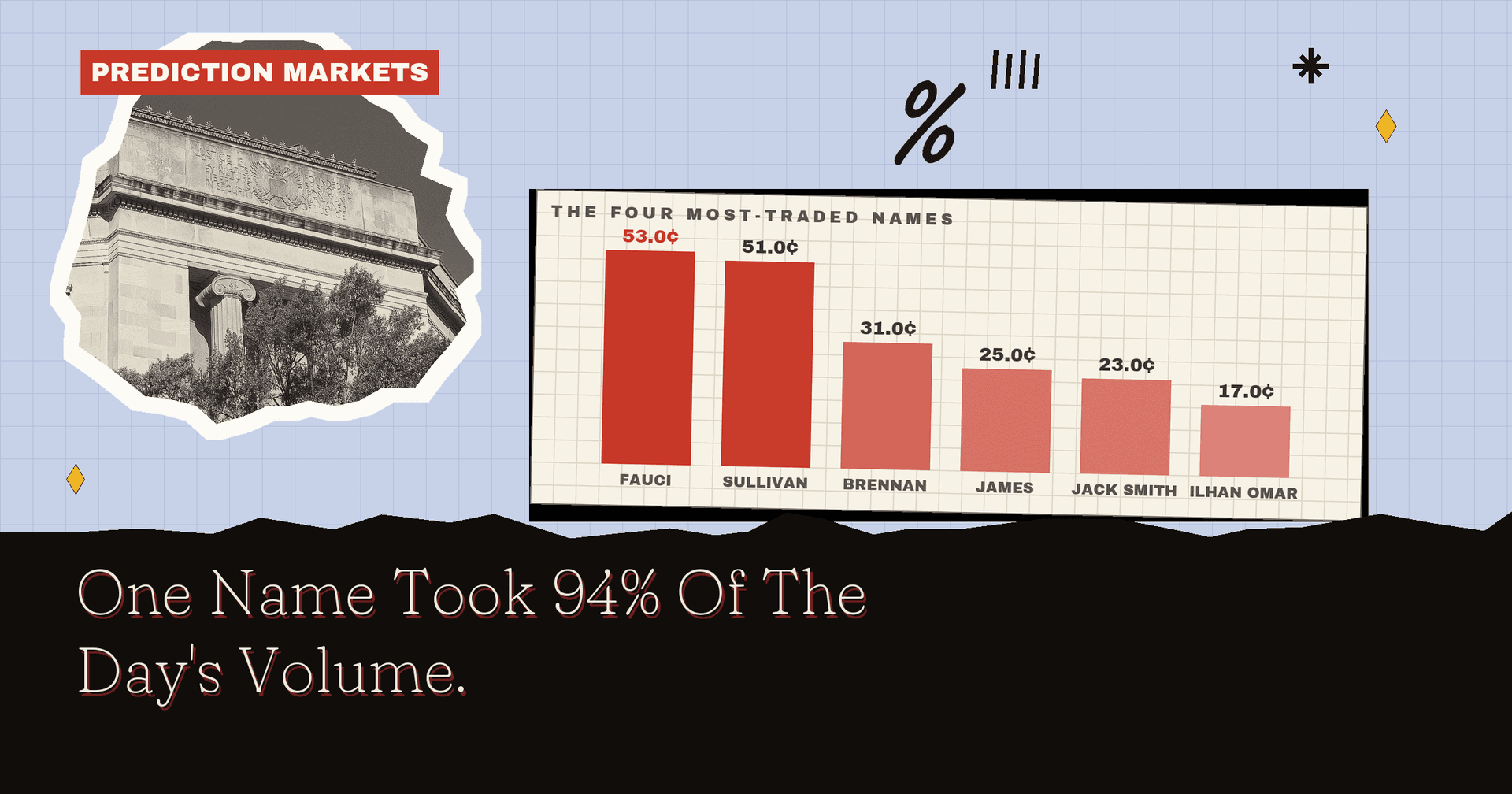
One name on Kalshi's "Who will be charged with a federal crime in 2026?" board did 94% of the past day's trading, and it is the name you would guess. Anthony Fauci's contract printed a 45¢ bid on Saturday afternoon, ran as high as a 57¢ bid overnight, and sits at 53¢ bid, 57¢ ask on Sunday afternoon. John Brennan drifted from 34¢ to 31¢ on about a hundred contracts. Letitia James slipped a point to 25¢ on 20. Jack Smith held 23¢. When 40 of the 41 names barely trade and one absorbs the whole board's order flow, the market is not repricing a theme. It is repricing a person.
That is a different story from the one this page told a week ago, when the Fauci contract first crossed 50¢ and the rest of the board drifted up alongside it. So the thesis gets sharper: a market price and the legal machinery behind it run on two different clocks, and this week the price clock got a second catalyst the law clock has not digested yet. I'll walk both events, show you the leg-by-leg board against where it sat on August 17, and then lay the Justice Department's decision path against the January 1, 2027 deadline, because the deadline, and a pardon this page should have mentioned the first time, are what decide whether 53¢ is cheap or expensive. The price is a real, tradeable read on sentiment. It is not a verdict, and it is not a prediction of what a grand jury will do.
The Quick Answer
Kalshi's federal-crime market pays out on one thing only: whether a named person is formally charged with a federal crime before January 1, 2027. A Fauci contract at 53¢ means the market implies roughly a 53% chance of that happening. It does not mean he has been charged, and he has not. Two dated events sit behind the move: the Senate Homeland Security and Governmental Affairs Committee's 8-5 vote on August 6 to hold him in contempt, which the committee says it referred straight to the Justice Department, and the August 18 guilty plea of David Morens, a former senior adviser in NIAID's Office of the Director during Fauci's tenure, on a conspiracy charge tied to concealing COVID-related records. The full board, the week-over-week comparison, the settlement rule, and what the DOJ decision timeline means for the 2026 deadline are below.
Stay ahead of the markets.
Daily insights and expert picks on Kalshi, Polymarket, and what's moving markets.
Free forever. Unsubscribe anytime.
What The Market Is Actually Pricing
The Kalshi federal crime market is a single board, ticker KXFEDERALCHARGE-27JAN01, with a separate yes/no contract for each of 41 named people. Kalshi is a CFTC-regulated event-contract exchange, and these are event contracts: each one settles at $1.00 if that person is charged with a federal crime during 2026 and $0.00 if they are not, so a cent price reads directly as an implied probability. A 23¢ contract is the market saying "a bit better than one-in-five." If cent-priced contracts are new to you, our Kalshi odds explainer breaks down the mechanics.
The settlement rule matters more here than on most boards, so here it is from Kalshi's own market rules: the contract resolves yes if a criminal complaint, information, or indictment is filed against the person in an appropriate court after the market's issuance and before January 1, 2027. Being named a target, getting subpoenaed, civil suits, and administrative actions do not count. Charges that are filed and then dismissed before the deadline still count. Hold onto that last sentence, because it means a contempt-of-Congress charge, a misdemeanor carrying up to a year, would settle this contract yes the day it is filed, regardless of whether it survives a motion to dismiss.
Here is the top of the board as of Sunday afternoon, August 23, 2026, next to where each contract sat when this page first published on Monday, August 17:
| Contract | Aug 23 (bid / ask) | Aug 17 | Change | 24h volume |
|---|---|---|---|---|
| Anthony Fauci | 53¢ / 57¢ | 52¢ / 54¢ | +1¢ on the week, +8¢ in 24h | 12,546 |
| Dan J. Sullivan | 51¢ / 52¢ | not listed yet | — | 425 |
| John Brennan | 31¢ / 32¢ | 34¢ | -3¢ | 101 |
| Letitia James | 25¢ / 26¢ | 26¢ | -1¢ | 20 |
| Jack Smith | 23¢ / 24¢ | below the leaders | — | 76 |
| Ilhan Omar | 17¢ / 20¢ | 21¢ | -4¢ | 24 |
| Peter Strzok | 17¢ / 18¢ | not tracked here | — | 0 |
| Lisa Cook | 16¢ / 17¢ | not tracked here | — | 0 |
The row that matters is the last column. Of roughly 13,400 contracts that changed hands across all 41 names in the past 24 hours, about 12,550 were Fauci, 94% of the board's entire day on one contract. The next-busiest name, the brand-new Sullivan listing I'll come back to, did 425, and Brennan did 101. A week ago I wrote that three out of every four contracts were piling into Fauci and that the rest of the board was drifting up with him. Both halves of that sentence are now stale: the share is higher, and the siblings stopped drifting up. Brennan, James, and Omar each gave back a point or three on almost no volume while Fauci held. The market spent the week deciding that whatever is happening to Fauci is happening to Fauci alone.
Hottest Prediction Markets Right Now
- 2028 Democratic presidential nominee · $190M traded
- 2027 Pro Football Champion · $69M traded
- 2028 U.S. Presidential Election winner? · $62M traded
- 2028 Republican presidential nominee · $59M traded
- Pro Baseball Champion · $59M traded
- Bitcoin price at the end of 2026 · $32M traded
Every market above links to our full AI model verdict; browse them all on the OddsShopper prediction markets hub, and see how every settled call actually scored on the full graded scoreboard.
How The Week Actually Traded
The "45¢ to 53¢ in 24 hours" headline undersells how choppy this contract has been, and the chop is part of the read. Kalshi's daily candles for the Fauci leg, by Eastern-time session, since this page first published:
| Session (ET) | Open | Close | High | Low | Volume |
|---|---|---|---|---|---|
| Mon Aug 17 | 52¢ | 51¢ | 63¢ | 49¢ | 7,896 |
| Tue Aug 18 | 50¢ | 54¢ | 70¢ | 48¢ | 16,123 |
| Wed Aug 19 | 54¢ | 48¢ | 60¢ | 45¢ | 9,020 |
| Thu Aug 20 | 48¢ | 58¢ | 60¢ | 44¢ | 8,229 |
| Fri Aug 21 | 55¢ | 46¢ | 57¢ | 44¢ | 9,856 |
| Sat Aug 22 | 46¢ | 53¢ | 55¢ | 45¢ | 5,955 |
| Sun Aug 23 (through 1 p.m.) | 53¢ | 53¢ | 65¢ | 50¢ | 6,842 |
Read the close column top to bottom: 51, 54, 48, 58, 46, 53. That is not a contract marching higher. It is a contract that cannot decide whether it belongs in the high 40s or the high 50s, and its daily close has crossed 50¢ four times in six completed sessions. The highs tell the same story from the other side: 63¢, 70¢, 60¢ prints on thin volume that got sold back within hours every time. Tuesday, the day of the Morens plea, is the busiest row and the highest print of the week, 16,123 contracts and a 70¢ tick, and it still closed at 54¢.
Sunday's move came in pieces. The bid sat at 45¢ through Saturday afternoon. Around 7 p.m. ET Saturday, roughly 3,850 contracts lifted it to 51¢. Then, between 1 and 2 a.m. ET Sunday, about 6,200 contracts traded in a single hour and pushed the bid to 57¢ with the ask at 61¢. A 65¢ print around 6 a.m. on 224 contracts was the high, and by early afternoon the contract had faded back to 53¢ bid, 57¢ ask. So the "45¢ to 53¢" move is true, but the path ran through 57¢ first and came back.
The honest description of the Fauci contract, then, is a coin flip with a 4¢ spread that spikes on every headline and gives most of the spike back. Open interest sits at about 202,000 contracts and lifetime volume on this leg alone is 326,000, so it is liquid by the standards of a political board, but the 4¢ bid-ask gap at 53/57 is wider than the 2¢ it carried last week. A wider spread on a contract that keeps whipsawing is the market telling you it is less sure, not more.
Why The Price Moved: Two Catalysts, Both On The Record
The catalyst chain is a matter of public record, and it is worth stating in plain terms with the sources attached, because this is a board that prices named people.
August 6: the contempt vote. The Senate Homeland Security and Governmental Affairs Committee, chaired by Rand Paul, voted 8-5 on a party-line basis to hold Fauci in contempt of Congress after he invoked his Fifth Amendment right against self-incrimination at a hearing, 111 times by Paul's count, per CBS News. Paul said the committee would bypass the customary Senate floor vote and send the resolution directly to the Justice Department ("We will send it to the Department of Justice tomorrow so there's no delay"), and a congressional aide later confirmed to CBS that the referral had been sent. The resolution directs the president of the Senate, Vice President JD Vance, to certify it to the U.S. Attorney for the District of Columbia, Jeanine Pirro. Fauci's attorney David Schertler called the vote "a crude political stunt intended to punish Dr. Fauci for exercising his constitutional rights." That vote is what pushed the contract from the high 30s through 50¢ in mid-August.
August 18: the Morens plea. Dr. David Morens, a former senior adviser in the National Institute of Allergy and Infectious Diseases' Office of the Director during Fauci's tenure as director, pleaded guilty in federal court in Maryland to one count of conspiracy to commit offenses against and to defraud the United States, per CBS News and the U.S. Attorney's Office for the District of Maryland. He admitted to agreeing with co-conspirators to route emails about COVID-19, its origins, and NIH's terminated bat-coronavirus research grant through his personal Gmail account rather than his official NIH email, to keep them out of reach of public-records requests. He was indicted in April 2026. Sentencing is set for November 12, and he faces up to five years in prison. CBS reports that court filings describe Morens sharing back-channel information with an unidentified senior NIAID official who appears to be Fauci, and that Fauci has said Morens was not his adviser on policy matters and that many of Morens' actions violated agency policy. Fauci was not charged with anything in connection with the Morens case.
Put those two facts side by side and the week's trading makes sense. The plea is not a charge against Fauci and does not name him as a co-conspirator. What it does is put a guilty plea from a senior adviser in his old front office, on a records-concealment conspiracy, into the public record 12 days after a contempt referral landed at the same Justice Department. Traders read that as the temperature rising around one person. They did not read it as anything about Brennan, James, or Smith, which is why those contracts went nowhere on no volume. A candidate-specific catalyst produces a candidate-specific move, and that is the cleanest evidence on this board that the order flow is reacting to dated news events rather than to a general mood about the board.
A Worked Example: What 53/57 Actually Costs You
The yes side is 53¢ bid, 57¢ ask, and the two numbers matter separately. (The payout structure itself is covered in how prediction markets work; our beginner's guide to Kalshi walks through the exchange.) A yes contract pays $1.00 if he is charged before the deadline, so buying at the 57¢ ask means you are paying for a 57% chance, and you would need to sell at 57¢ or better just to exit flat before fees. The no side is the mirror image: no is 43¢ bid, 47¢ ask, so buying no costs 47¢ and pays $1.00 if no charge is filed in 2026, and selling yes at the 53¢ bid is economically the same trade as buying no at 47¢.
That 4¢ spread is the toll for having an opinion, and on this contract it is steep relative to the edge anyone can claim. If you believe the true chance of a charge before January 1 is 35%, the yes side at 57¢ is badly overpriced and no at 47¢ is cheap. If you believe it is 65%, yes at 57¢ is the bargain. The market is saying neither: it is saying 53 to 57, and it has said 44 and 70 within the same week. For what it is worth, I do not have a number I would trade at here with conviction, and the reason is in the next two sections: the decision that settles this contract belongs to one office with no deadline, and the legal questions around it are contested by people who do this for a living. A contract whose answer depends on discretion inside a fixed window should be priced with a wide band, and it is.
From A Referral To An Actual Charge, Against The Deadline
This is the part the price cannot see, and it is why I keep coming back to the two-clocks idea. For the Fauci contract to settle yes, a charging document has to be filed before January 1, 2027, which leaves 130 days in 2026 from this update. On the contempt path, the chain runs:
- A properly certified referral reaches the Justice Department. The committee says the referral has been sent. Whether it is properly certified is contested. Paul skipped the full Senate route, where the move would likely fall short of the 60 votes needed to advance most legislation, and government-investigations attorney Ross Garber told PBS News that "it is likely a court would reject a prosecution where neither the full Senate nor Vance signed off on the contempt finding." A committee transmittal reaching DOJ and a certification under the contempt statute are two different things, and the public record so far supports the first, not the second. Under the Kalshi rule, a charge that is later thrown out still settles yes, so this is a problem for a prosecutor's appetite, not for the contract's settlement.
- The U.S. Attorney decides whether to pursue it. Pirro's office would be the one to decide whether to present a contempt case. The contempt statute describes it as the U.S. Attorney's "duty" to bring a certified contempt before a grand jury; the Justice Department has held for decades that it keeps prosecutorial discretion anyway, and that disagreement has never been squarely resolved. Either way, there is no clock forcing a decision by any date. This is the step the market is really pricing.
- A grand jury returns an indictment, or the office files an information. Either is a charge under the rules. Only then does the contract resolve yes.
Contempt is not the only road to yes, and the pardon is the reason. Before leaving office, President Biden issued Fauci a preemptive pardon covering January 1, 2014 through January 19, 2025, including his time on the White House Coronavirus Task Force and COVID-19 Response Team, per PBS. That pardon does not cover anything Fauci said under oath in 2026. Michael Gerhardt, a University of North Carolina law professor, told PBS that Fauci could still invoke the Fifth because of potential perjury exposure from his 2026 testimony, and that is also a second, separate federal charging path that would settle this contract yes. What would not settle it: the subpoenas the attorneys general of Florida, West Virginia, and Louisiana have said they are issuing. Those are state matters, and this market is federal only.
Step two is still the whole ballgame, and it cuts both ways for the price. The referral is sitting at DOJ, the same department just took a guilty plea out of Fauci's old shop on a records case, and a misdemeanor information is a low bar to clear procedurally. That is the argument for why 53¢ might be light. Against it: a contempt case over a Fifth Amendment assertion is one the department would have to choose to bring against a pardoned defendant, with a certification question hanging over it, and 130 days is not a long window for a charging decision on a high-profile target. Every week that passes without a reported decision shortens the runway, and a contract that needs a dated event inside a fixed window should bleed value as the window closes. The chop in the candle table is what that tension looks like in real time: headlines pull it up, the calendar pulls it down.
Where The Price Can Sit Far From The Law
The entire premise of the referral is Fauci invoking the Fifth 111 times. Whether he was entitled to is the live legal fight, and it runs in both directions. Republicans on the committee argue the pardon extinguished the privilege: Sen. Josh Hawley cited the 1896 Supreme Court case Brown v. Walker for the rule that a pardoned witness "cannot longer set up his privilege," per PBS. If that reading wins, the invocation was improper and the contempt case gets stronger. Gerhardt's reading is that Fauci "is under no obligation to answer questions even though he has a pardon," because perjury exposure and state prosecutions are outside its scope, and Mark Osler, a pardon scholar at the University of St. Thomas, called the situation unusual and said it may have to be resolved in court. A market can be 53% confident a charge lands while the people who litigate this for a living say the threshold question is unsettled. One of those moves on headlines and order flow; the other on charging memos, certification fights, and grand-jury calendars.
Treat the market as a fast, liquid, real-money read on how likely traders think a charge is, not a forecast of guilt, a legal opinion, or a timeline you can bank on. Prediction markets are often well-calibrated on questions with clean, public settlement triggers, but this one hinges on discretionary decisions by named officials, which is precisely the kind of question where a confident-looking price and the underlying reality can pull apart. We dig into that calibration gap in are prediction markets accurate and in why a forecast is not a price.
The Rest Of The Board
Fauci is the headline, but the board is built so that it stays relevant no matter which name moves next. John Brennan sits at 31¢, Letitia James at 25¢, Jack Smith at 23¢, with Peter Strzok and Ilhan Omar at 17¢ and Lisa Cook at 16¢. What they share this week is silence: combined, those six names did about 220 contracts in 24 hours, less than 2% of what Fauci did, and the price drift among them was all downward.
The James contract is the one whose 25¢ carries the most history. She was indicted in federal court in Virginia in October 2025 on bank-fraud and false-statement counts, a judge dismissed that indictment on November 24, 2025 on the ground that the interim U.S. Attorney who brought it was unlawfully appointed, and two separate Virginia grand juries then declined to re-indict her in December. Read against the Kalshi rules, that history cuts a specific way: the original indictment predates this market's November 25, 2025 issuance and would not count, and the rules say a reinstated old charge does not count either. Only a new charging document filed in 2026 settles her contract yes. So 25¢ is the market's price on a fourth attempt succeeding where three did not, which is a very different question from the one Fauci's 53¢ is asking.
One new row deserves a flag precisely because its price looks like a headline and is not one. A contract labeled "Dan J. Sullivan," listed on August 19, sits at 51¢ bid, 52¢ ask, the second-highest price on the board, and no, not the sitting Alaska senator. It is the retired Petersburg schoolteacher of the same name who ran in Alaska's August 18 nonpartisan top-four Senate primary, and was running third at about 2.4% of the vote in the early count, which under Alaska's top-four system puts him on track for November's ranked-choice general alongside Sen. Dan S. Sullivan and Mary Peltola. NBC News reports that a federal grand jury has issued subpoenas to witnesses linked to his campaign, in a probe into whether the candidacy was a scheme to confuse voters and pull votes from the incumbent. He has not been charged, and he has denied in a court filing and in interviews that his candidacy was meant to confuse voters. The contract has traded 434 lifetime contracts, 425 of them in the past day, against Fauci's 326,000. A 51¢ price on a few hundred contracts is a handful of traders' opinion, not a market's. I would not read anything into it until the volume says otherwise, and that contrast is a useful reminder of what the Fauci number actually has behind it.
If a different name catches its own dated, public event next week, the volume can rotate to that contract the same way it stacked onto Fauci. Watching which contract the order flow chooses is often more informative than the level of any single price, because the flow is where a repricing shows up first.
In Summary
Kalshi's federal-crime market prices whether a named person is charged with a federal crime in 2026, and on Sunday one name took 94% of the board's volume while the rest barely traded. Anthony Fauci's contract went from a 45¢ bid to 53¢ bid, 57¢ ask, by way of 57¢, on the back of two dated events: the August 6 committee vote that referred a contempt citation to the Justice Department, and the August 18 guilty plea of David Morens, a former senior adviser in NIAID's director's office during Fauci's tenure. Read the price as what it is, a liquid, real-money estimate of a probability whose daily close has crossed 50¢ four times in six sessions, and keep it separate from the legal process, which still needs a charging decision by one U.S. Attorney's office, under a pardon and a certification question the experts call unsettled, inside the 130 days left in 2026. What changes the read from here is not another headline about the hearing. It is one of three filings: a charging document out of Pirro's office, a reported declination, or a court ruling on whether the pardon stripped the privilege. Until one of those lands, every week of silence is a small vote for the no side, and the candle table will keep looking like it does now.
OddsShopper's tools focus on sports markets, not political ones like this, so there's no edge for us to sell you here. If you want the markets where our models do the work, our free expert picks are the honest place to start.
Prices quoted are live Kalshi market prices as of Sunday, August 23, 2026, and will keep moving. Trading involves risk; contracts can go to zero.
More on this: Connor Hellebuyck Trade Odds: Who's Trending After Goalie's Suspension? · Will There Be A 2027 MLB Season? Some Owners Expect None · Why Jack Reed (D) Will Win the Rhode Island Senate Race · Why N'Kiyla Thomas (D) Will Win the Oklahoma Senate Race · What Will Trump Say At The RNC? The Bet Moved Up A Night