Every Solana price prediction for 2026 I have read this month hands you a number. Kalshi's "above $150 in 2026" contract hands you a price, and it has gone from a 17¢ quote to a 31¢ ask since I first pulled this board on August 4, while Solana has not touched $150 once. As of September 13, 2026, SOL trades near $100 on Coinbase, up from $74 at launch, and the bid on that rung sits at 25¢. Read that as the market saying a quarter to a little under a third that SOL prints a new 2026 high above $150 before New Year's. The price-blind AI panel we ran at launch said 8%. What the rally did to that gap, rung by rung, and what it did not do, is the story of this page.
The Quick Answer
Kalshi's "How high will Solana get in 2026?" board is a ladder of yes-or-no contracts, one per price level from $150 up to $300, and each one pays out only if Solana touches that level at some point before the year ends. At the August 4 launch, SOL sat near $74 and the market gave the "above $150" rung about a 17% chance; our AI panel, priced blind, said 8%. As of September 13, 2026, Solana trades near $100 and the $150 rung has repriced to a 25¢ bid / 31¢ ask. The panel's August 4 numbers stand as the dated record we grade in public, not a live re-score. The full rung-by-rung board, every model's number, and where the money has moved away from the models are below.
📩 Get the settled verdict. We grade every call on this board in public once 2026 closes. Want the scorecard, plus a re-scored ladder if Solana makes a run this fall? Grab it from the email box at the bottom of this page. No pick is a prediction of fact.
New to event contracts on crypto? Start with our plain-English guide to Kalshi's crypto price markets before you read a single cent as an edge.
Prices on this page refresh during active news waves; every quote below carries an "as of" stamp so you can see when it was last read.
Stay ahead of the markets.
Daily insights and expert picks on Kalshi, Polymarket, and what's moving markets.
Free forever. Unsubscribe anytime.
The Market
| Venue | Kalshi, a CFTC-regulated event-contracts exchange (18+; availability varies by state, see where Kalshi is legal) |
| Event Ticker | KXSOLMAXY-27JAN01 |
| The Contract | A ladder of "Above $X" markets. Each rung resolves YES if Solana's spot price, per the market's settlement rules, is above the stated level at any point in the window running from January 1, 2026 through January 1, 2027 at 12:00am ET |
| Settlement Source | The CF Solana-Dollar Real-Time Index (SOLUSD_RTI, a per-minute average named in each market's own rules), not a single exchange print |
| Why It Is A "Max" Market | Because YES only needs the level to be touched once, the live question is really: will Solana set a new 2026 high above each rung in the days that remain? |
| Closes | On resolution; the window ends January 1, 2027, 12:00am ET |
Verify it yourself: the live ladder, its exact rungs, and the current YES prices sit on Kalshi's Solana markets under event ticker KXSOLMAXY-27JAN01, and Solana's live spot price is on any major tracker such as Coinbase. Only the settlement index's print inside the 2026 window counts.
The Board
Here is the ladder in phone-friendly form, with two dates side by side. The first two price columns are the live Kalshi book as of September 13, 2026: the ask is what it costs to buy YES right now, the bid is what a seller can get. The third price column is the same rung at the August 4 launch. The last column, "AI panel blend," is the equal-weight mean of the three models after a revision round, scored on August 4 and frozen there.
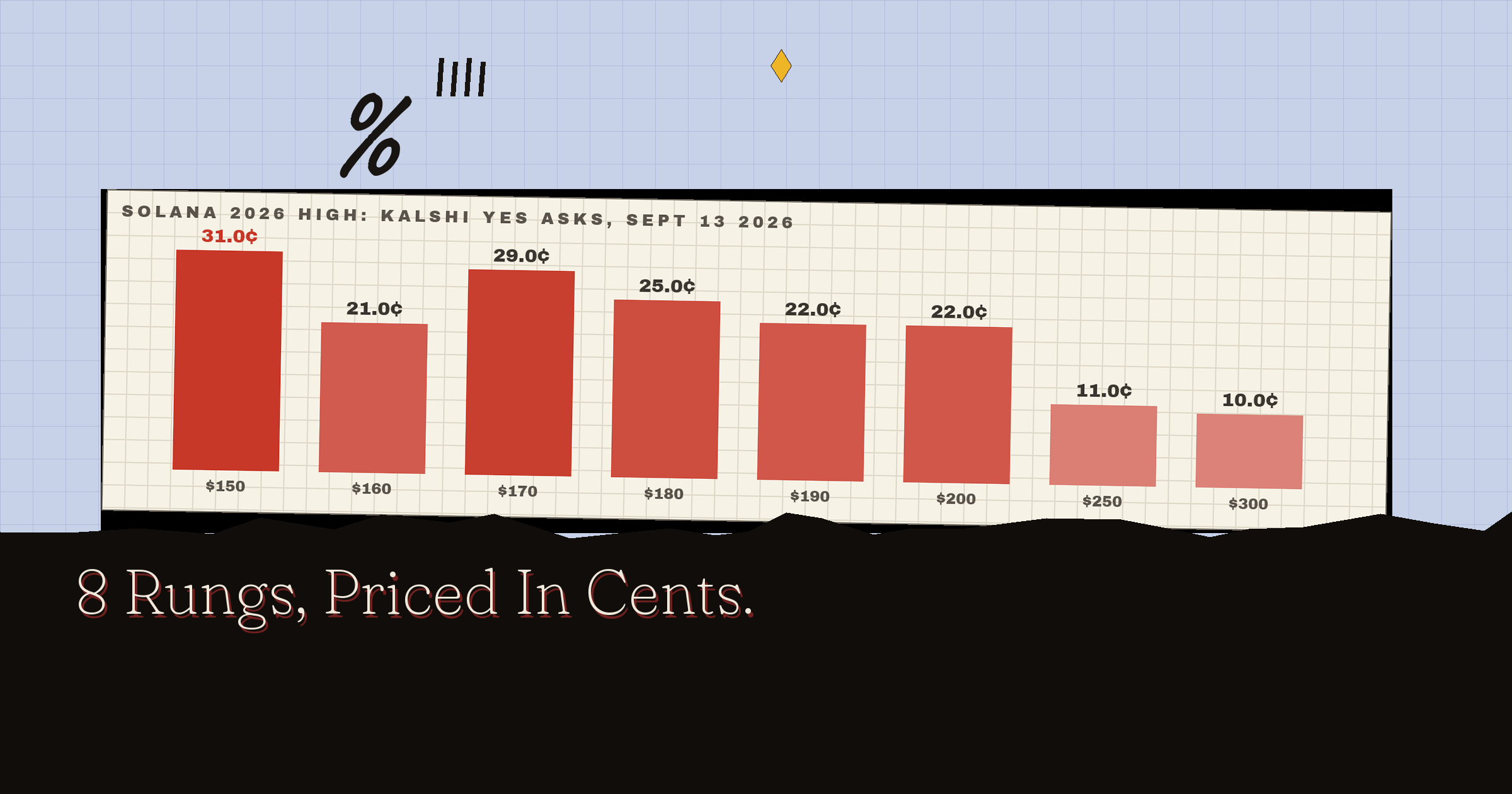
The ladder's YES asks as of September 13, 2026. The August 4 launch column in the table is the frozen record the scoreboard grades.
| Will Solana's 2026 High Top… | Kalshi YES ask (Sept 13) | Kalshi YES bid (Sept 13) | Kalshi YES (Aug 4 launch) | AI panel blend (Aug 4) |
|---|---|---|---|---|
| $150 | 31¢ | 25¢ | 17¢ | 8% |
| $160 | 21¢ | 14¢ | 12¢ | 6% |
| $170 | 29¢ | 10¢ | 11¢ | 5% |
| $180 | 25¢ | 10¢ | 7¢ | 4% |
| $190 | 22¢ | 12¢ | 5¢ | 3% |
| $200 | 22¢ | 8¢ | 6¢ | 2% |
| $250 | 11¢ | 8¢ | 4¢ | 1% |
| $300 | 10¢ | 6¢ | 3¢ | 1% |
The row I keep coming back to is the top one. The move above happened without Solana getting anywhere near $150. Its best print since launch was about $110.65 on August 27, per Coinbase's daily candles. The market did not reprice because the level got touched. It repriced because the distance shrank and the tape got loud.
Now read the rest of the ask column and notice it is not even in order. Someone is offering $160 YES at 21¢ while the best offer on $170 is 29¢, a higher price for a harder outcome. Nobody is claiming $170 is likelier than $160. Kalshi's own 24-hour volume figures, pulled with the prices, back that up. The $150 and $160 rungs each traded a couple dozen contracts. The $190 rung traded about 275, and five of the eight rungs traded nothing at all. On a book like that the ask is one resting order, not a consensus. The August 4 column had the same wrinkle in miniature: the $190 rung sat a cent under the $200 rung. Treat the cents as a spread, not a laser. On this ladder, the spread is wide.
How the ladder moved. Solana closed August 4 near $74. It ran to that $110.65 high on August 27, then drifted back to about $100 by September 13. Two things changed underneath the board. The distance to $150 fell from a 103% climb to roughly a 49% one, with about 110 days left in the window. And volatility woke up. The 30-day realized volatility off Coinbase's daily closes is running near 66% annualized. Almost double the roughly 35% the panel measured off the calm tape in early August. Hold onto that second number. One seat on the panel left the door open for it, and it matters later.
Every Seat's Number
The full panel, rung by rung. These are the round-two numbers, after each model read the others' anonymized reasoning and was free to revise.
| Threshold | Claude Fable | Claude Opus | Claude Sonnet | Blend |
|---|---|---|---|---|
| $150 | 8% | 7% | 8% | 8% |
| $160 | 6% | 5% | 6% | 6% |
| $170 | 5% | 4% | 5% | 5% |
| $180 | 5% | 3% | 4% | 4% |
| $190 | 4% | 3% | 3% | 3% |
| $200 | 3% | 2% | 2% | 2% |
| $250 | 2% | 1% | 1% | 1% |
| $300 | 1% | <1% | 1% | 1% |
Model estimates generated August 4, 2026, 18:02 UTC, from a price-blind data card: each model saw the live 2026 price path but never the market's prices. This run reached three of the eight seats we normally poll; ChatGPT, Gemini, GLM 5.2, Kimi K3, and DeepSeek were unreachable on this run (an expired session, a missing local client, and provider rate-limits), and their absence is disclosed here rather than hidden. These are model estimates, not predictions of fact and not financial or trading advice. Models are frequently wrong, and the market price reflects real traders' money.
The seat table is the dated record, and the rally is the first real test of it. Every seat sat below the market on every rung on August 4, and the market has since walked further away from them. That does not settle who was right. A YES contract only pays if Solana actually prints the level, and $150 has not printed. It does mean the panel's bearish lean is now being stress-tested by the tape instead of by the other models.
Where The Panel Splits From The Money
On every rung the AI blend sat below the Kalshi quote at launch. That was the whole disagreement, and it was a coherent one: the market priced in slightly more hope of a second-half recovery than the models were willing to grant. The widest gap was the headline rung, 17% from the market against 8% from the panel. Both were pricing the same hard fact different ways, and Claude Opus put that fact plainly:
SOL at $74 must more than double (103%) in ~149 days to set a new 2026 high clearing even the lowest $150 rung. — Claude Opus
The move above cut that climb roughly in half. The ask on the $150 rung followed it up, which is the market doing exactly what a market should do when the distance changes. What the market did not do is wait for the models to catch up. Nobody has re-scored this panel since August 4, and I am not going to pretend an eight-percent estimate built on a $74 Solana applies to a $100 one.
There is one structural feature that keeps the low rungs off the floor, and Opus named it: the "any point" rule means the price only has to touch a level once, not close there.
The running-max ('any point') feature roughly doubles a terminal-crossing probability and crypto's fat right tail lifts it further. — Claude Opus
Even with that boost, a clean 49% run in under four months is a new bull leg, not a mean-reversion bounce, and the August panel priced the bigger version of that leg as a long shot.
A worked example, in real cents. Say you buy the $150 rung at the 31¢ ask on September 13. If Solana touches $150 before the window closes, the contract pays $1, so you make 69¢ on the trade before fees. If it never touches, you lose the 31¢. That trade only makes sense if you believe the true chance is comfortably above 31%, because Kalshi charges a fee on the way in and the spread costs you again if you need to get out early. The panel's dated number was 8%. There is no re-scored number, so the only honest framing is that 31¢ is the bar you would have to clear, and nothing on this page hands you that. Picking a Solana number is easy. Beating 31 cents is the job. Our guide to Kalshi fees versus sportsbook vig shows what that fee does to a thin-edge trade like this one.
More live boards from the same panel: Bitcoin 100K Odds tracks the flagship's timing ladder, Bitcoin 2026 Price Odds prices the year-end range with the bear case at 56.5¢, Ethereum Price Odds runs the same panel on the second-biggest coin, and our crypto 2026 returns board asks whether any of ten coins finishes the year green.
The Bull Case (Why The Rungs Could Hit)
We just ran the control experiment. Solana added 36% since August 4 with no ETF headline behind it, and the $150 rung's quote added 14 cents at the ask. That tells you roughly what the market thinks a catalyst-free grind is worth, and how much of this ladder is still priced on the catalyst nobody has seen yet. The case for the rungs is the catalyst showing up, and underneath that, a case for volatility doing what volatility does. Solana is the asset that traded under $10 in the wreckage of late 2022 and printed near $293 by January 2025, and the panel did not ignore that history. Claude Sonnet is the clearest example of a model refusing to let a calm tape talk it into a zero:
crypto return distributions are fat-tailed and SOL has posted 2-4x moves in comparable windows during past cycles (e.g., 2023-24 rallies), so a catalyst-driven repricing (ETF/staking flows, broad crypto risk-on, L1 narrative rotation) can't be dismissed the way pure GBM would. — Claude Sonnet
Every model named the same trigger for that scenario. A confirmed spot Solana ETF with strong early inflows, or a broad crypto risk-on driven by aggressive Federal Reserve easing, is the single input most likely to reprice the lower rungs upward fast. Claude Opus was blunt about the size of that lever:
The single biggest ladder-mover: confirmed spot Solana ETF approval with strong early inflows — that alone could re-rate the whole ladder up 2-3x. — Claude Opus
The August rally is not that lever. It came without a confirmed ETF headline and it stalled at $110.65, which is why the headline rung's quote added 14 cents at the ask rather than tripling. The mid-ladder asks jumped harder, but on a handful of trades. The bull case still needs the catalyst, and the catalyst has not shown up.
If you want to track the crypto-wide version of that thesis, our Bitcoin price prediction for 2026 and Ethereum price prediction for 2026 boards price the same "new high this year" question for the two largest coins, and all three tend to move together when the whole complex runs.
The Bear Case (Why They Probably Do Not)
The bear case was the base case in August, and it was mostly arithmetic. Claude Fable laid out why the whole ladder decays:
SOL at $74 needs 103% in ~149 days just to clear the lowest rung; depressed vol and below-MA momentum make every rung a tail outcome. — Claude Fable
The tape at the time backed that up. On August 4, Solana traded below both its 20-day and 50-day moving averages, its 7-day change was roughly flat, and it had printed a 2026 low of $60 as recently as June, so the down-regime was still fresh. Part of that has flipped. As of September 13 the price sits well above its 50-day average, near $88, and just under its 20-day average, near $102. The "below-MA momentum" half of Fable's sentence is half gone: above the 50-day, still a hair under the 20-day. The distance half is not, and the calendar is shorter.
The higher rungs compound the problem. The $300 rung does not just need a recovery, it needs a new all-time high on top of one. Claude Sonnet flagged exactly why that rung sits at the floor:
$300 sits above the all-time high ($293), requiring a fresh record with zero 2026 precedent, hence the lowest probability. — Claude Sonnet
That is why the market and the models both floored the top of the ladder in August, and why the $300 ask is still only 10¢ after a 36% rally in the spot price. It asks Solana to roughly triple off the current price and print a level it has never traded, by New Year's Eve.
Dark Horses The Panel Won't Dismiss
The steep decay does not mean the tail is dead. Two threads keep the upper rungs off zero:
- A Confirmed Cycle Low. Solana's June bottom near $60 is the kind of level from which crypto's violent V-shaped recoveries have historically launched. Claude Fable weighted that path directly, assigning real weight to a "bull-catalyst scenario (rate cuts, ETF inflow wave, broad crypto risk-on)" even while calling the recent tape bearish. A durable bottom plus a catalyst is the entire path to the middle of the ladder, and the June low has now held for three months.
- A Vol Regime Nobody Was Pricing. This is the thread from the board section. Claude Fable would not let a quiet tape set the ceiling, noting that "SOL historically runs 60-100% annualized in trending markets" versus the roughly 35% it measured on August 4. Six weeks later, realized volatility is near 66% annualized, squarely inside the range Fable named. That was a historical range, not a forecast, so nobody gets a medal for it. It is still a big part of the mechanism behind the cents the ask column added, and the reason the tails were never floored. Neither thread is the base case. But a market that now prices "above $250" at an 11¢ ask is telling you those tails carry real, if small, weight, and the panel never argued with that.
The Convergence Round
We run these panels twice. After the first pass, each model reads the others' anonymized ladders and may revise. The revisions here were small but honest, and they moved toward each other. Claude Opus opened as the least bearish seat on the headline rung at 9% and trimmed to 7% after seeing the pack, while Fable and Sonnet held near 8%. Nobody abandoned their read to conform; the result is a tighter, better-defended blend that lands at 8% on the "above $150" rung, a full nine points under the market's 17 at launch, and further under it now.
How To Read This Board Like A Sharp
A prediction-market price is a probability with a dollar sign in front of it. A 25¢ bid and a 31¢ ask on the $150 rung is the market's shorthand for a high-20s chance. Kalshi charges no vig inside the price the way a sportsbook line does, but on a rung this thin the six-cent spread is the vig, so the midpoint, not the ask, is the probability read. If turning cents into probabilities is not yet second nature, our guide to what a Kalshi price actually means walks through it.
On a ladder this thin, the second skill matters as much as the first. The gap between the 25¢ bid and the 31¢ ask on the top rung is six cents of pure friction, and paying it on both sides of a trade eats most of the edge anyone could plausibly have. Resting your own bid inside that spread instead of lifting the ask is the whole game here, and our piece on making a price instead of paying one covers how that works on Kalshi.
The move a sharp makes next is not to bet the market's number, it is to compare it against an independent estimate and act only when the two diverge. On this ladder the divergence is not hiding, but read it carefully. The panel's August number was scored on a $74 Solana, and the ask it keeps getting compared to is quoted on a $100 one. That is a dated estimate next to a live price, not an edge, and until the panel is re-run it stays that way. What is live is the book telling on itself: the inverted $160 and $170 offers above are a ladder where one resting order sets the price. That is the second opinion this page can honestly give you today. It is not a pick. If you would rather start from someone else's homework than build your own read, OddsShopper's free expert picks show where sharp bettors are finding edges across sports and markets today. The picks there are free. The fuller toolkit behind them is OS Pro, and new users get a free 7-day trial, so the first week costs nothing.
Every number in this piece is publicly graded on our scoreboard once the market settles, so you can check whether the panel or the market read 2026 better. You can follow the running tally on our full graded scoreboard.
To be explicitnothing here is advice to buy or sell anything. Kalshi is a CFTC-regulated event-contracts exchange, you must be 18 or older to use it where it is offered, and Solana's volatility cuts both ways. These are model estimates, not predictions of fact and not financial or trading advice, and the market price reflects real money from traders who may know more than any model does.
- Bitcoin End Of 2026 Price Odds: Live Market Bands
- Gold Price Prediction 2026: Kalshi vs the Viral Chart
- The Forecast Is Not The Price On A Kalshi Weather Market
- How Bitcoin Price Contracts Work On Kalshi
- South Carolina Senate Runoff Odds: Kalshi Beat The AP Call
Hottest Prediction Markets Right Now
- 2028 Democratic presidential nominee · $166M traded
- Rocket Classic Winner · $124M traded
- 2027 Pro Football Champion · $51M traded
- Pro Baseball Champion · $40M traded
- Bitcoin price at the end of 2026 · $30M traded
- 2027 Pro Basketball Champion · $19M traded
Every market above links to our full AI model verdict; browse them all on the OddsShopper prediction markets hub, and see how every settled call actually scored on the full graded scoreboard.
Prices on this page are Kalshi's book. If you also trade on Polymarket, code OS4 gets new users a $20 bonus on a $10 deposit — affiliate link; terms as stated by Polymarket; 18+, availability varies by state.