Last updated: July 25, 2026
In Summary
Learning how to build winning parlays has almost nothing to do with the picks that jump out at you. It is a process, and the process exists to beat the two things that quietly sink most parlays: recency bias (grabbing the first leg that looks good) and paying a worse price than you had to. Open any sportsbook and there are hundreds of options across every game and market, and the overwhelm pushes people to click on vibes and skip shopping the number. This guide walks the build in order: decide the shape of the parlay, choose each leg on value instead of recency, then shop every leg for the best price before you lock it in. Do those three things and a parlay stops being a lottery ticket and starts compounding whatever edge its legs actually have. Below is the full build, with the math laid out.
Watch The Video
Prefer to watch? Here is the full breakdown on the OddsShopper YouTube channel. Watch on YouTube.
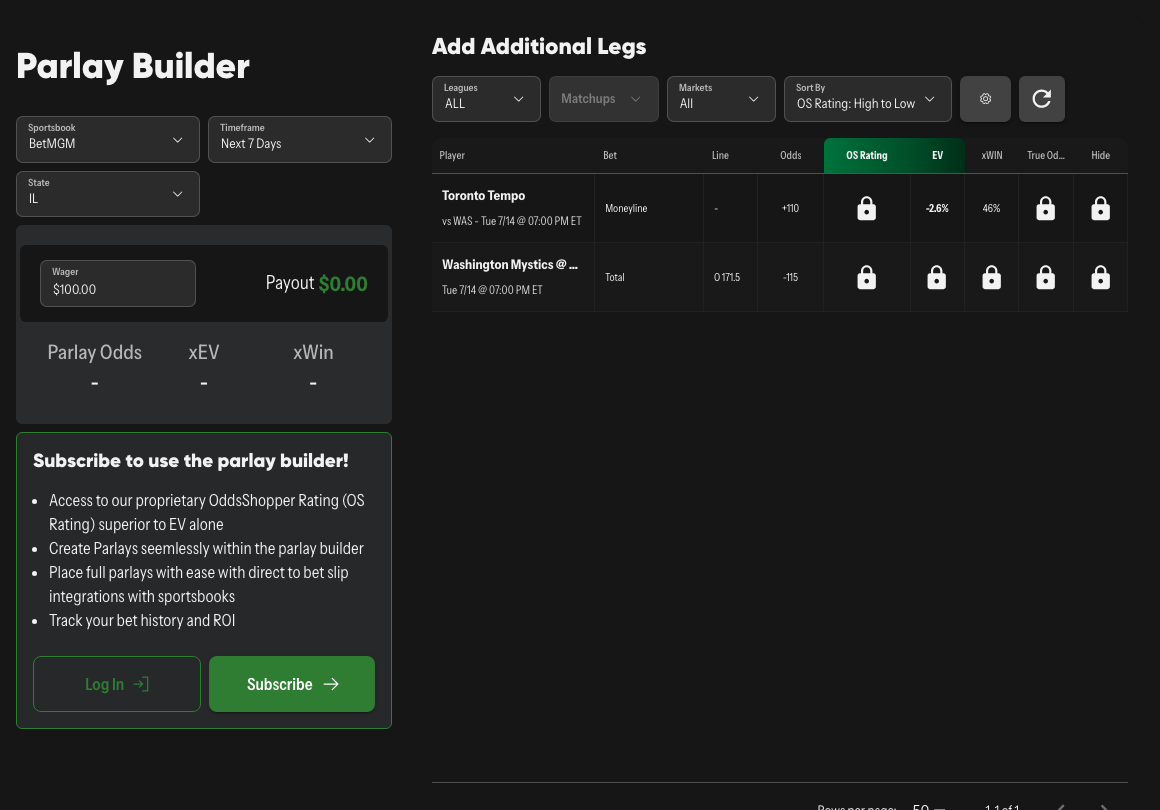
The OddsShopper Parlay Builder.
Why Parlays Feel Like A Guessing Game
Sit down to build a parlay and the first thing you meet is noise. Every game has a moneyline, a spread, and a total; every player has a stack of props; and there are dozens of games on a busy night. That works out to thousands of individual bets competing for a slot on your ticket, and no human sorts through all of it. So what happens instead? You see a leg that looks good, the one you watched hit last week or the star everyone is talking about, and you tap it. Then the next one. Recency bias does the building for you.
The problem is that clicking on the first thing that looks good means you never checked whether the number was any good. You did not compare the leg across books, you did not ask if the price beat the true odds, and you gave up a little value on every selection. Stack five of those together and the leaks compound. This is exactly why parlays earned a sucker-bet reputation: not because combining legs is inherently bad, but because of how most people combine them. The fix is to replace the guessing with a repeatable build.
Step 1: Decide The Shape Of The Parlay
Before you pick a single leg, decide what kind of parlay you are building. Two questions set the shape: how many legs, and how much risk. The two are linked, because every leg you add multiplies the odds and lowers the chance the whole thing cashes.
The clearest way to see the trade-off is the payout on five legs at different price points. These are the combined odds when every leg is priced the same, using standard parlay math (the decimal prices multiply):
| Build Style | Five legs priced around | Combined parlay odds | Profile |
|---|---|---|---|
| All Favorites (Chalk) | -150 each | ~+1,190 (about 12-to-1) | Highest chance to cash |
| Even Mix | -110 each | ~+2,440 (about 24-to-1) | Middle ground |
| All Underdogs | +110 each | ~+3,980 (about 40-to-1) | Lottery-ticket payout |
The row that surprises people is the middle one: five ordinary -110 coin-flips, nothing exotic, already pay better than 24-to-1, which tells you the payout is coming from combining legs, not from chasing longshots. The all-favorites build gives you the best shot at a green ticket for a smaller number; the all-underdogs build is the low-probability, big-payout swing. Neither is "correct." What matters is that you choose the shape on purpose instead of backing into it. Want a real number on any combination before you build it? Our parlay calculator does the multiplication for you.
Keep in mind that more legs mostly buys you variance. A five-legger swings far harder than a three-legger even when every leg is sound, so a longer ticket belongs at a smaller stake. We cover that sizing math in the bankroll management guide.
Step 2: Choose Each Leg On Value, Not Recency Bias
Now the actual legs, and this is where most parlays are won or lost. The rule is simple to say and hard to do by hand: put a leg in your parlay because the price is good, not because the pick feels good.
A parlay does not have a mind of its own. It just multiplies the expected value of its legs. Combine legs that beat their true probability and that edge compounds in your favor across the whole ticket. Combine the juiced, popular longshots most casual bettors grab off recency and the house edge compounds against you. The entire difference between a parlay that is a good bet and one that is a bad one comes down to the legs, not the format.
In practice it looks like this. Say your projection has a player prop landing about 55% of the time, and the book has it at +110, which implies only 47.6%. That leg carries an edge, so it belongs in the parlay. Now the leg recency hands you: the star everyone is hammering, bid up to -140 (implied 58.3%) when the honest chance is closer to 52%. It feels like the safe pick, but you are paying above fair for it, so it drags the whole ticket. Same two spots on your slip, opposite value. One you add; the other you pass.
So the standard for adding a leg is not "do I like it" but "is it priced in my favor." A four-leg ticket where all four legs beat their fair odds is a better bet than a two-legger with one coin-flip leg thrown in for the payout. And if you cannot find legs that clear that bar on a given night, the build is over. Having action is not a strategy; betting only where the number is in your favor is. For the deeper version of this half of the game, including closing line value as the proof your legs were priced right, see our full parlay betting strategy guide.
Step 3: Shop Every Leg For The Best Price
You have the shape and you have legs you like on value. Do not lock it in yet. The same parlay is priced differently at every book, and the gaps are bigger than people expect, so the last step before you bet is to shop the whole ticket.
Here is why it is not optional. The price you take sets your break-even rate, the share of these bets you would need to win just to come out even. For a positive-odds bet, break-even % = 100 ÷ (odds + 100). The same combination priced at +580 at one book only needs to hit about 14.7% of the time to break even; the identical legs at +369 somewhere else need 21.3%. Same picks, but the worse price quietly raises the bar every one of your legs has to clear. Over a season of parlays, that difference is the whole ballgame, which is the point our strategy guide drives home with a full 100-bet example.
The catch is speed. Re-entering a five-leg parlay across five apps before the lines move is a grind, and by the time you finish the number has changed. This is where an odds-comparison tool earns its keep: OddsShopper scans 100+ sportsbooks at once, so taking the best available number on the whole ticket becomes a glance instead of a chore. None of this out-handicaps anyone; you are simply refusing to take a worse price on a bet you were already going to make.
New to OddsShopper? It scans 100+ sportsbooks in real time and flags the legs priced in your favor, then shows which book gives the best number on the exact parlay you are building. You can try OS Pro free for 7 days, and code BUILDWIN20 takes 20% off if you subscribe.
Let A Parlay Builder Do The Legwork
Running all three steps by hand across every game, market, and book is the labor-intensive part, and it is exactly what a build tool is for. The OddsShopper parlay builder does the legwork you would otherwise do manually: it scans the full board, surfaces the legs that beat their fair odds with their projected win percentage and expected ROI attached, and lets you assemble and edit the ticket from there. You still choose the legs and set the shape you decided on in Step 1; the tool just removes the impossible task of eyeballing thousands of options and quietly hands you the value most bettors leave on the table.
That closes the loop. The overwhelm at a sportsbook is real, and clicking on recency is what the noise pushes you toward. A disciplined build, shape first, value legs second, best price last, is how you fight back, and letting the tool surface the value is how you do it in a minute instead of an hour. If you would rather see how sharp bettors are attacking today's card, our free expert picks show the best bets of the day. And to combine legs within a single game, the same logic applies with one extra wrinkle we cover in the same-game parlay strategy guide.
Frequently Asked Questions
How do you build a winning parlay? Build it as a process, not a hunch. Decide the shape first (how many legs and how much risk), then choose each leg because it is priced better than its true odds rather than because it feels good, then shop the finished ticket across books so you take the best price. The parlay multiplies the value of its legs, so good value legs at a good price are the entire build.
How many legs should a parlay have? There is no magic count. Every added leg multiplies the odds but lowers your hit rate and adds variance, so more legs is not automatically better. What matters is that every leg is priced in your favor; a tight three- or four-legger of value legs beats a padded five-legger with a filler pick thrown in for the payout. Size longer parlays smaller.
Are favorite parlays or underdog parlays better? Neither is inherently better; they are different risk shapes. A parlay of favorites has the best chance to cash for a smaller payout, while a parlay of underdogs is a low-probability swing at a big number. Pick the shape on purpose based on the payout you want and the risk you can stomach, and make sure each leg still carries an edge before it goes on the ticket.
Why does the same parlay pay different odds at different books? Each sportsbook prices a parlay with its own margin and its own read on the legs, so the identical combination can pay noticeably more at one book than another. Taking the worse number raises the win rate you would need just to break even, which is why shopping every leg across books is free expected value before you ever lock the bet in.
More on this: Why Did My Sportsbook Limit My Account? What It Means · Correlated Parlays On Kalshi: The Team-To-Advance Plus Striker-To-Score Stack · College Football Parlays: Why Most Lose, Build Smarter · How To Build A Same Game Parlay: An NBA SGP Walkthrough · How To Combine Same Game Parlays On FanDuel (SGP+)
The Bottom Line
A winning parlay is not a hot pick you got lucky on; it is the output of a build you can repeat. Set the shape so you know what you are actually betting, fill it with legs that are priced in your favor instead of the ones recency bias hands you, and take the best number on the whole ticket. That is the difference between feeding the sportsbook and making it work for your bet. Let the parlay builder do the sorting, take the best price on every leg, and code BUILDWIN20 takes 20% off OS Pro. Bet 21+ where legal, and only what you can afford.