Search "sports betting strategy that works" and you get a thousand systems that all quietly do the same thing: bet your gut and hope. None of those is a strategy. The approaches that can actually move a bankroll over a season are boring, repeatable, and public, and they come down to just four. Each one is a different answer to a single question: how do you get a price that beats the true odds of the game?
The four systems reward different things. One rewards volume and speed. One rewards the work you put into a game the book got lazy on. One skips predicting winners entirely. One simply hands you a head start. By the end you will know which of the four fits your time, your bankroll, and how much homework you actually want to do, and we will name the one most people should start with in the final section.
TL;DR: The Four Strategies At A Glance
- Top-Down (Market-Based): Read the market, not the game. Compare a sharp consensus price to every other book and bet the soft numbers. Lowest effort, highest volume, no handicapping required — the durable core for most bettors.
- Bottom-Up (Origination): Build your own line from stats, projections, and simulations, then bet where it disagrees with the book. Highest ceiling, highest effort. Or borrow an originator's work through the Tails marketplace.
- Arbitrage: Back both sides at two books that disagree enough to lock a small, low-variance profit. Great for a young bankroll, but books limit successful arbers fast.
- Boosts And Promos: Cash in welcome bonuses and profit boosts to grow a new bankroll — but only when the boosted price actually beats the true odds. Where most people should start.
- The Common Thread: three of the four come down to one task — comparing an offered price to the true (no-vig) price. That is exactly the work the OddsShopper betting tools automate.
The Four Sports Betting Strategies That Actually Work
Before we go deep, the whole map fits on one screen. Everything below is an expansion of this table.
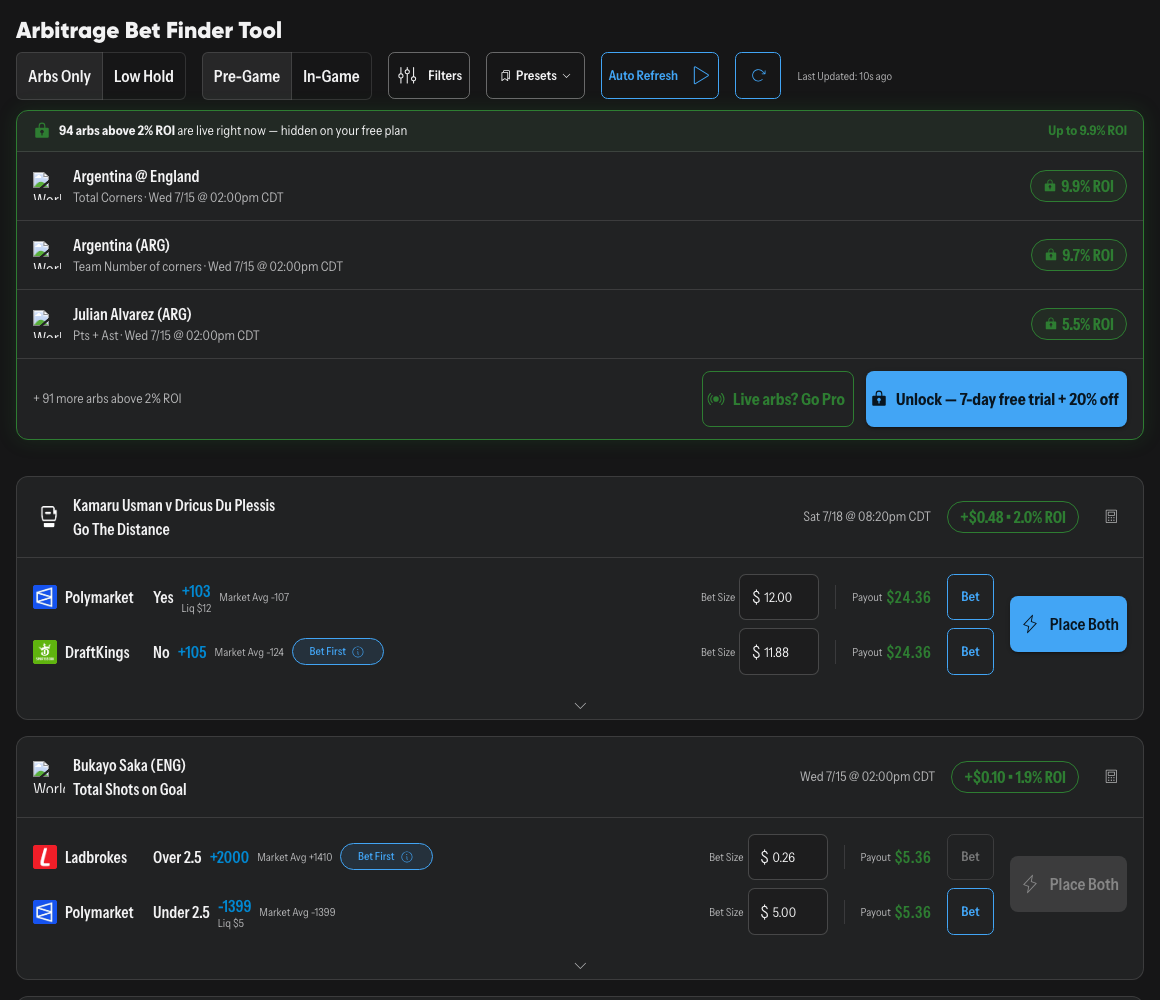
The OddsShopper Arbitrage Tool.
| Strategy | What it is | Where the edge comes from | Effort | Best for |
|---|---|---|---|---|
| Top-Down (Market-Based) | Read the market, not the game | A sharp consensus price vs. a soft book's number | Low | High volume, no sport knowledge needed |
| Bottom-Up (Origination) | Build your own sharper line | Knowing the game better than the book | High | People who love the film and the numbers |
| Arbitrage | Bet both sides at two books | Two books disagreeing enough to lock a return | Medium | Grinders who want low-variance profit |
| Boosts And Promos | Cash in book incentives | The book paying you to sign up and bet | One-time | Anyone starting a new bankroll |
The row we keep coming back to is the first one. It asks the least sport knowledge of the four (no projections, no film, no opinion on who wins) and it still works, because the edge does not live in predicting the game. It lives in the gap between what a sharp book has priced and what a softer book is still offering. That distinction is the thread through this whole guide, so we start there.
Top-Down Betting: Let The Market Find Your +EV Bets
Top-down betting, also called a market-based approach, is the strategy for someone who wants to automate finding profitable bets at real volume. The concept is simple. You aggregate odds from the sharpest sources into a consensus "true" price, then compare that price against every other book in the industry. When a book is slow to move, you pick off the number it left on the table. No personal projections. No take on the matchup. You are betting the market's own inefficiency back at it.
The mechanism behind it is the vig. Every market carries a vig, the built-in cut that makes the two sides add up to more than 100%. Strip the vig out and you get the no-vig, or "fair," price, the market's honest estimate of the real odds. A book offering a longer price than that fair number is handing you positive expected value (+EV): a bet priced better than its true chance of winning. Repeat that discipline, and the math grinds in your favor over time, even though plenty of individual bets lose. Betting a market that is efficiently priced, with no gap to exploit, is not a play at all, so a top-down bettor passes far more often than they fire.
A Quick Worked Example
Say the fair, no-vig price on an underdog is +200, roughly a one-in-three shot. FanDuel 🎁 is posting exactly +200, but DraftKings 🎁 is still up at +230 on that same side. Same bet, bigger payout. Taking the +230 is free expected value, and the reason +230 beats +200 is not "it pays more if it hits." It is that you are getting paid above the real odds. Miss that gap on every bet and you are just taking the best of a bad number.
Doing this by hand across every major sportsbook, checking an NFL moneyline or an MLB total across a dozen books before every bet, is a full-time job, which is exactly what OddsShopper's tools automate. The live odds screen, which lets you shop the number across every major book, compares each book's price on a market in real time so you always take the best number. The no-vig pricing engine strips the vig from each market to its true price, and the tool surfaces every bet on the board ranked by expected ROI (xROI) and expected win % (xWin%); the Sharp Action tool does the same reading of where sharp money sits on the exchanges (more in how to follow sharp money). The full top-down loop, find the fair price, find the soft book, take the gap, happens in seconds instead of tabs. If you want the discipline behind it, how to bet like a pro and how to remove the vig go deeper.
New to OddsShopper?It scans every major sportsbook, strips the vig to the true price, and flags the bets sitting in your favor: the exact top-down job this section just described, done for you automatically. You can try OddsShopper Pro free for 7 days, and code PROVENEDGE20 takes 20% off OS Pro or OS Core if you subscribe.
For the full mechanics of turning +EV into a season-long process, our sports betting strategy guide and how to find +EV bets walk through it step by step.
Bottom-Up Betting: Build A Sharper Line Than The Book
A market-based approach never forms an opinion on the game. Bottom-up betting, also called origination, is the opposite instinct. Here you actually use information to build a line yourself, one you believe is sharper than the number the sportsbook is offering. You take in stats, matchups, projections, and simulations, and you produce your own price for the outcome. If your number and the book's number disagree, you bet the difference.
This is the harder road, and it is honest to say so. What people call "ball knowledge" is the entry-level version of it: you simply need a deeper read on the sport than top-down betting ever asks for. True originators are the small group of sharp bettors who effectively help set the market. Books lean on their early action to find where the number should be, and everyone else bets into the line that results. The payoff is that a genuine originator can beat even the closing price, and closing line value in a liquid, well-bet market is one of the cleanest signals a bet was sharp, because they are pricing the game in a way the market has not caught up to.
The catch is that most bettors cannot build and maintain a real model, and a fragile "angle" that dies the moment the market adjusts is not the same thing as origination. If you love the film and the spreadsheets, build your own line. If you want the result of origination without doing all of it yourself, the practical route is to follow bettors who already do it. The Tails marketplace is where independent handicappers post their own plays and reasoning, so you can ride an originator's work instead of building the model from scratch. Bottom-up is the highest-ceiling strategy on this list. It just costs the most effort, whichever way you get there.
Arbitrage Betting: Bet Both Sides To Lock In The Gap
The first two strategies both chase a better price on one side of a bet. Arbitrage takes that same idea, a book being out of line, and pushes it to the extreme. Instead of betting one side and waiting, you back both sides of the same event, at two different books, in the right proportion, so that once both tickets are placed the winning one covers the loser with a little left over.
It works when two books disagree enough that betting each side still leaves you ahead. Remember the fair price from the top-down section: an arb is really just two books mispricing the same market so badly that their two implied probabilities, added together, come out below 100%, which means at least one side had to be +EV. Here is the illustrative version. Take a game where BetMGM 🎁 has one side at +110 while Caesars has the other side at +105. Stake both in the right proportion, and once the two tickets are locked the winning payout more than covers the losing stake, a small, low-risk profit banked before the game even starts.
The honest caveatarbitrage is real, but it is a stepping stone, not a forever machine. Books limit successful arbers quickly, so treat it as a way to grow a young bankroll and sharpen your habits, not a career. It is low-risk, not risk-free. A canceled leg or a mistimed stake can turn a locked arb into an open one.
Finding arbs by hand means watching every book on every market at once, and the window closes in seconds. OddsShopper's Arbitrage tool surfaces those price gaps across books as they appear, and OS Pro's Live Arbs feed opens up the full real-time set of higher-value arbs that free users do not see. For the full mechanics first, arbitrage betting explained is the deep dive.
Boosts And Promos: The Fastest Way To Grow A New Bankroll
The last strategy leans on the sportsbook's own incentive rather than your read on any game, which is why it is where most people should start. Sportsbooks throw incentives at new and existing customers: welcome bonuses, deposit matches, profit boosts, and free bets. Used well, they are the quickest way to add real money to a bankroll, because the book is effectively paying you to show up.
The honest framing matters here, because this is where beginners get burned. A boost is not a windfall, and it does not turn a bad bet into a good one. A 30% profit boost slapped on a poor number is still a poor bet. The only test that matters is whether the boosted price beats the true odds. Illustrative example: a book offers a 30% profit boost on a play priced at +118, and boosted, that pays roughly +153. If the fair odds on that play are around +118, the boosted +153 is now clearly priced in your favor, so that is a boost worth taking. The same boost on a play that was already -EV usually will not drag it back to profitable, so you skip it.
Promos also have a shelf life, which is the one-and-done part. You cannot farm the same welcome bonus over and over. But early on, cashing the good ones is the highest-return move on this entire list, precisely because it does not depend on you being right about a single game.
Try this the smart way.OddsShopper's Promo Converter and EV Calculator show you which boosts and free bets actually clear +EV against the true odds, so you cash the ones worth cashing and pass the rest. Free for 7 days, then code PROVENEDGE20 for 20% off OS Pro or OS Core.
For the full breakdown of which boosts clear the bar, see odds boosts strategy.
Which Sports Betting Strategy Should You Use?
Here is where to start. These four are not rivals, and the sharpest bettors combine them. But if you are choosing where to start, work backward from effort:
- Start With Boosts And Promos. No model required, quick bankroll growth whenever the boosted price beats the true odds, and it drills the exact habit every other strategy runs on: checking a price against the true one.
- Add Top-Down Next. It is the highest-volume, lowest-knowledge way to bet +EV consistently, and OddsShopper does the heavy lifting. For most people, this is the durable core of a disciplined betting process.
- Layer In Arbitrage while your accounts are fresh, to bank low-variance profit before the limits arrive.
- Grow Into Bottom-Up only if you love the work, or borrow an originator's edge through Tails instead of building a model yourself.
Notice the throughline. Three of the four (top-down, arbitrage, and squeezing real value out of boosts) come down to the same task, comparing an offered price against the true one. That is not a coincidence, and it is why one tool covers three of these strategies at once. The one I keep coming back to for new bettors is boosts first, then top-down as the everyday engine; it is the pairing I would hand a friend starting from scratch. Building it into a real routine (unit sizing, record-keeping, when to fire) is its own skill: bankroll management and our NFL betting strategy guide show how the same four systems play out over a full season in one sport. Pick the system that fits how you want to bet, and let the price decide whether there's a bet.
Frequently Asked Questions
What is the best sports betting strategy that works? There isn't one single best strategy. The four proven approaches (top-down, bottom-up, arbitrage, and promos) each win in different ways. For most bettors, the durable core is top-down, or market-based, betting: consistently taking prices that beat the true odds, at volume, without needing to handicap games.
Does top-down betting really work without knowing the sport? Yes. Top-down betting ignores who you think will win and reads the market instead, betting the gap between a sharp consensus price and a softer book's number. Because the edge is a mispriced number rather than a prediction, you don't need a strong opinion on the game. In practice you also pass far more often than you fire: on an efficiently priced market with no gap, the correct top-down move is no bet at all.
Is arbitrage betting worth it? It can be worth it as a way to grow a young bankroll with low variance, since once both bets are locked at the right prices the winning side covers the loser. Real arbs are usually thin, often in the 1% to 5% range, and the window closes in seconds, so you're grinding small locked returns rather than swinging for a big score. Books also limit successful arbers fast, so treat it as a stepping stone rather than a long-term plan, and remember it's low-risk, not risk-free.
Can betting promos and boosts actually make money? Used correctly, yes. Welcome bonuses and profit boosts add real value to a bankroll. The rule is that a boost only helps when the boosted price beats the true odds: a 30% boost turning a fair +118 into +153 clearly clears that bar, while that same 30% slapped on a heavy -300 favorite usually doesn't move it into +EV. A boost on an already-bad bet is still a bad bet, and you can't repeat one-time offers forever.
The Bottom Line
The sports betting strategies that work aren't secret systems. They're four repeatable ways to get a price better than the true odds, whether you read the market (top-down), build your own line (bottom-up), lock both sides (arbitrage), or cash in the book's own incentives (promos). Three of the four run on the same engine: comparing what a book offers against what the market says is fair.
That is the part OddsShopper automates. It scans every major sportsbook, strips out the vig to reveal the true price, and flags the bets, boosts, and arbs sitting in your favor. Try OddsShopper Pro free for 7 days, and use code PROVENEDGE20 for 20% off OS Pro or OS Core if you subscribe.
More on this: Sports Betting Strategy: How To Bet Smarter In 6 Moves · I Asked Three AIs for Tonight’s Best MNF Props · Positive EV Betting Strategy: Top-Down Vs. Bottom-Up Edges · Underdog Playoff Best Ball Strategy: Draft To Survive · PrizePicks MLB Strategy: Price Every Line Before You Play