Kalshi is not a sportsbook. It is a federally regulated exchange, so you buy a contract from another trader instead of betting into a house that bakes in its margin.
The habit that pays: convert the Kalshi price to an implied probability, add the fee, and compare it to the no-vig number at the books. When the two disagree, that gap is the reason to be here.
Which NFL Markets Kalshi Lists
Kalshi's football menu has grown quickly since the exchange expanded into sports event contracts, and as of August 2026 it stretches well beyond a single bet type.
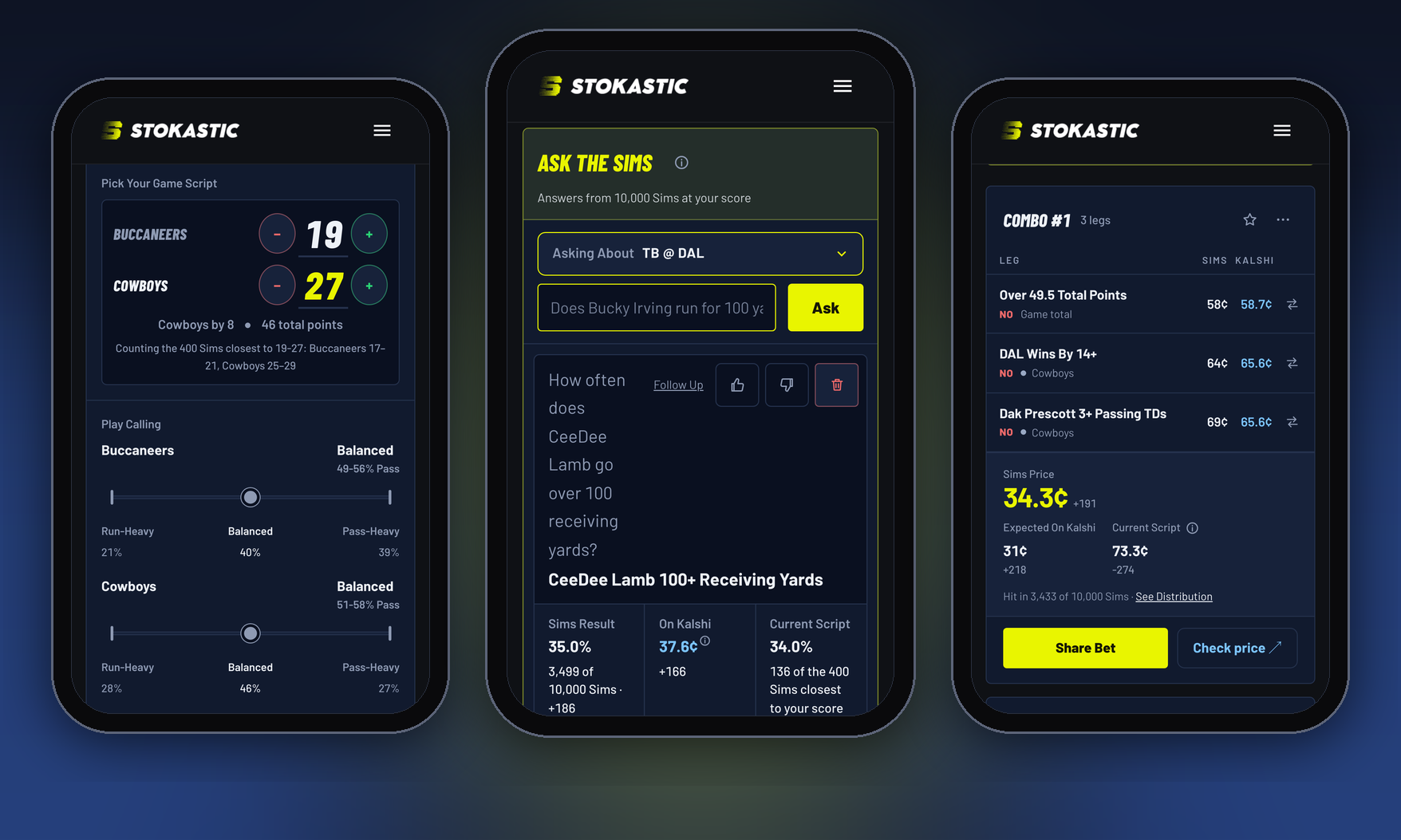 Price the combo before you buy it. The Kalshi Combo Simulator plays this week's game 10,000 times and prices any combo you build next to the price on Kalshi, on your phone, free, no login.
- Game Markets. The core weekly product. Kalshi lists a game-winner market (the exchange's version of a moneyline) and, alongside it, spread- and total-style contracts framed as questions: whether a team wins by more or fewer than a set number of points, or whether the combined score lands over or under a line. Spread-style contracts make NFL key numbers like 3 and 7 matter here the same way they do at a book. The winner market is a single Yes/No contract per game — Yes backs one team, No fades it — and it is the cleanest one to learn the mechanics on, which is why the examples below use it.
- Player Props. Kalshi has self-certified a deep football prop menu — passing, rushing, and receiving yards, touchdowns, receptions, and more, and some props break out by half or by quarter rather than only by full game. Props tend to be the less efficient corner of a market, so they can be worth a look, but only when the liquidity is there and the price survives the fee; our Kalshi NFL props breakdown goes deeper on that menu, and the NFL touchdown cheat sheet tracks live anytime-TD prices every week if scorer props are the ones you actually trade.
- Season Win Totals. Over/under win-total markets for teams across the league, priced as live contracts you can enter or exit any time before the season settles. If you had bought, hypothetically, a team's win total over 10.5 in August and they opened 7-2, you could sell that position for a profit rather than sweat the final weeks. We line these up against the books in Kalshi vs. DraftKings vs. FanDuel on NFL win totals.
- Futures. Division winners, conference champions, and the Super Bowl champion, all trading year-round and repricing on injuries, trades, and results.
The menu keeps expanding, so check what is actually listed for a given week rather than assuming a market exists. And read the fine print: every contract settles by its own written resolution rules, so before you buy, know exactly what counts as a win, how overtime is handled, and what happens to a postponed game. Settlement language has already bitten NFL traders: the Steelers win-total dispute turned on exactly this kind of wording, so treat the rules page as cheap insurance against a "why didn't this pay" surprise.
A Worked NFL Example: Reading A Live Board
Snapshot from the Kalshi board, Week 3 Thursday: Atlanta at Green Bay.
| Side | Kalshi Yes |
|---|---|
| Green Bay Packers | 71¢ |
| Atlanta Falcons | 30¢ |
Green Bay's 71¢ Yes price is the market's implied probability before fees — about 71%. A favorite at that level needs real separation from a sportsbook's no-vig line to clear Kalshi's trading fee before it's worth buying. Check the live board yourself, side by side with this price, before you size anything — a snapshot from one moment is a worked example, not a standing quote.
Reading Cent Prices Vs American Odds
Here is the one translation I promised, and it works on every Kalshi market — winner, spread, total, or prop: the cents are the market's rough implied probability, before fees and spread. A contract that costs 54¢ is the market saying that outcome has about a 54% chance. If it hits, the contract settles at $1.00, so you paid 54 cents to win 46.
This makes every Kalshi price directly comparable to a sportsbook once you convert it to the American odds you already read.
| Kalshi Price | Implied probability | Roughly equal American odds |
|---|---|---|
| 25¢ | 25% | +300 |
| 40¢ | 40% | +150 |
| 50¢ | 50% | +100 (even) |
| 55¢ | 55% | -122 |
| 65¢ | 65% | -186 |
| 80¢ | 80% | -400 |
The row worth sitting with is 55¢. A team trading at 55 cents is a modest favorite at about -122, and that band is where I look first, not on a hunch but because of how vig works. Books often shade the popular side of a game or move the price toward the public money, so that same modest favorite can show up at -135 or -145, a worse number for the same outcome. You can see that shading in real time on the NFL live odds screen, which shops the number across every major book on one row. The wider the book's vig, the more room Kalshi's independent price has to sit under it, which is why mid-range favorites are the first place I check the exchange.
Fees On Kalshi NFL Markets
Kalshi charges a trading fee that peaks on coin-flip contracts near 50¢ and shrinks toward the extremes near 1¢ or 99¢, so a pick'em NFL game is the most expensive place to trade and a heavy favorite or long shot is the cheapest; add it to every price before you compare against a book, because a one-cent gap near the middle of the board is often the fee, not an edge. Full formula, the fee table, and deposit/withdrawal mechanics: Kalshi's fees, explained.
Full board, every NFL series we track: NFL 2026 on Kalshi.
FAQ
Can you bet NFL on Kalshi? Yes. Kalshi lists NFL game markets — game winners (the moneyline equivalent), point spreads, and totals — plus a growing player-prop menu, season win totals, and futures like division and Super Bowl champion, all as event contracts. It is a CFTC-regulated exchange rather than a sportsbook, availability varies by state and changes over time, and this is not legal advice, so confirm what is offered where you live.
How do Kalshi NFL prices work? Every price is in cents, and the cents are the rough implied probability. A team at 60¢ is priced at about a 60% chance; the contract costs 60 cents and settles at $1.00 if it hits.
Are Kalshi's NFL fees worth it? Often, yes. On a liquid market the all-in cost, fee included, tends to beat a sportsbook's vig. The fee scales with the contract price, peaking near 50¢ and shrinking toward the extremes — see Kalshi's fees, explained for the exact formula and deposit mechanics.
Is betting NFL on Kalshi legal? Kalshi operates as a CFTC-regulated event-contract exchange, which is a different legal category from a state-licensed sportsbook. How sports event contracts are classified is contested and varies by jurisdiction and over time. This is not legal advice; confirm current availability where you are, be of legal age, and trade responsibly.
Is Kalshi better than a sportsbook for NFL? Neither is always better. I check both on every game rather than committing to one venue, because the two prices disagree far too often to marry either one.
More on this: NFL 2026 on Kalshi: 49 Live Boards, 10 Days To Kickoff · Kalshi Vs FanDuel NFL: Who Pays More On $100, Every Game · Kalshi vs DraftKings: Every NFL Opener Is Cheaper On Kalshi · Kalshi NFL Props: Spreads, Totals and Quarter Markets · 49ers vs Rams: Someone Bet Six Figures At Midnight
The One-Screen Summary: Convert, Net, Then Compare
The edge I keep coming back to is not "Kalshi versus the books." It is your all-in price versus the market's no-vig estimate. Start with the de-vigged number, add Kalshi's fee and spread to the contract price, and only trade when the gap that is left is big enough to survive a bad fill. My own rule: near 50¢, where the fee bites hardest, a one-cent difference is not an edge, so I want real cushion before I treat the exchange price as the better bet. Do that every week and Kalshi stops looking exotic and starts working like one more sharp price on your screen.
If you gamble, do so responsibly and only where you are of legal age.
De-vig every NFL book to its no-vig price with the OddsShopper odds tools, then use the Arbitrage tool to catch the book-to-book gaps worth acting on. That same no-vig baseline is what tells you the weeks a Kalshi contract, all-in, is the better number.