Every NFL bettor learns the same lesson eventually, usually the expensive way. You can be right about the side and still lose money over a season, because the price you paid was worse than the price you deserved. ProphetX NFL betting inverts that problem. Instead of accepting the price a bookmaker prints, you post the price you are willing to take and wait for another trader to meet it. This guide covers what the exchange actually is, why federal regulation is the reason it reaches states with no sportsbook at all, how making and taking odds works on an NFL market, and the workflow that tells you which price is worth posting. One market, a team at -3, will carry the whole argument by the time we finish with it.
The Quick Answer
ProphetX is a CFTC-regulated, peer-to-peer sports prediction exchange where you trade NFL markets — moneylines, spreads, totals and player markets, per ProphetX's own site — at a price you name yourself instead of accepting a book's number, with a 2% fee ProphetX advertises on winnings only. It is live in 49 states — every one but Nevada — as of August 26, 2026. The mechanics of making versus taking a price, a worked example on a -3 spread, and the de-vig workflow that tells you exactly which number to post are all below.
Stay ahead of the markets.
Daily insights and expert picks on Kalshi, Polymarket, and what's moving markets.
Free forever. Unsubscribe anytime.
What ProphetX Is, And Why It Reaches 49 States
Federal registration is the reason a bettor in Austin or Sacramento can trade an NFL spread at all, and the reason the number on the screen is a counterparty's price rather than a book's ask. ProphetX operates as a peer-to-peer sports prediction exchange under federal commodities regulation, not state gambling licenses, and that distinction sounds like paperwork right up until it decides both where you can trade and what the numbers actually mean. (Our full ProphetX review grades the platform as a whole — states, fees, safety; this page is about what the model means for NFL betting specifically.)
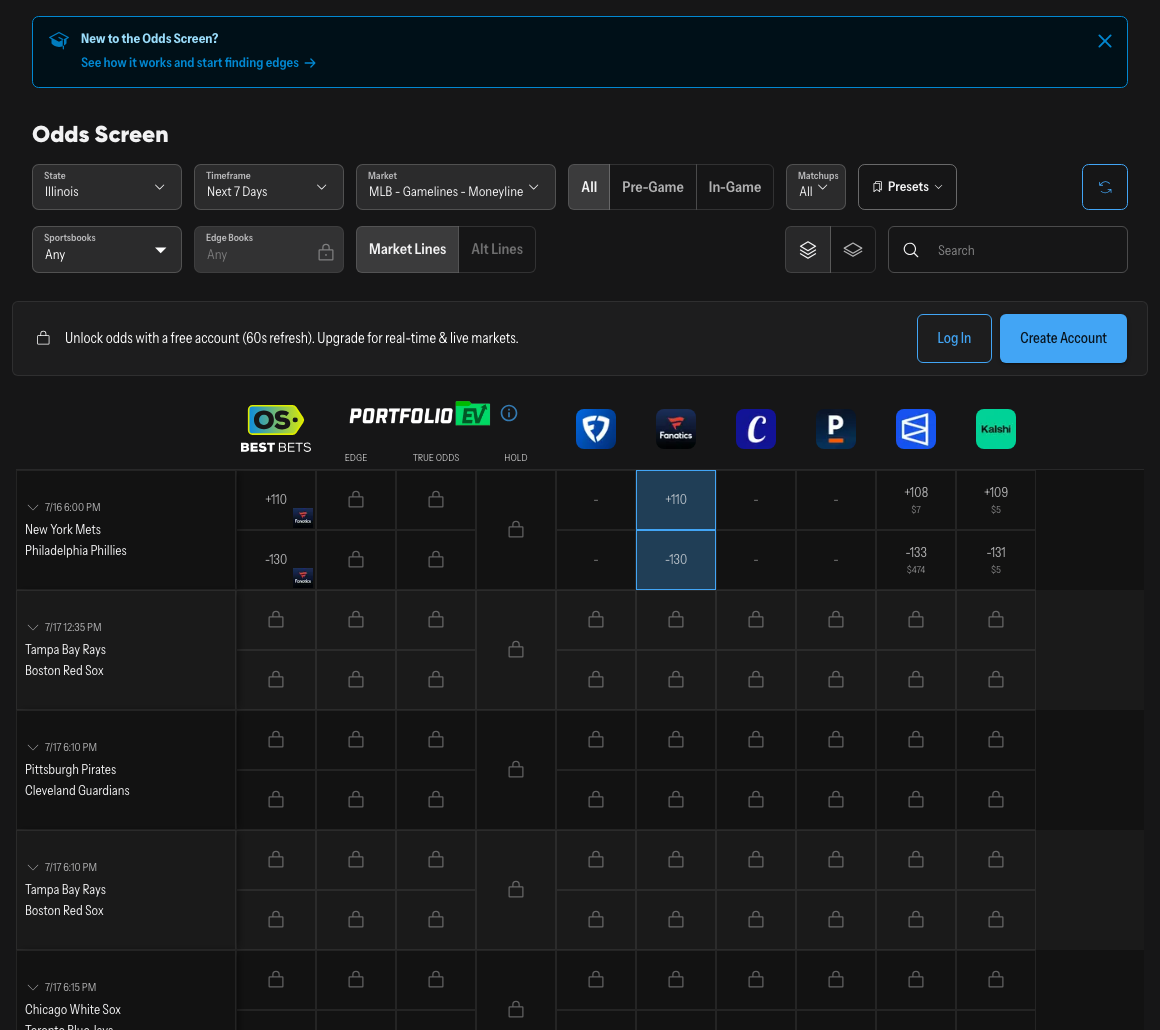
The OddsShopper Odds Screen — part of the Core toolkit the free week trial unlocks.
A sportsbook prints a number, folds its margin into it, and takes the other side of your action. ProphetX runs an order book instead, matching you against a trader who disagrees with you, and earning a commission rather than profiting when you lose. The company has been public about the design. Co-founder Jake Benzaquen told Sportico in June 2026: "We won't be trading against our customers. We never have." It is a statement about conduct, and the one that matters: the house is not taking the other side of your read. As a registered clearing organization ProphetX still stands between the two sides of every matched trade, but that is plumbing, not a position against you.
Be precise about who is actually across the table, though. Peer-to-peer does not mean every fill comes from a fellow bettor. On any order book of this kind, professional liquidity providers generally sit alongside retail traders, which is what keeps prices tight enough to be worth shopping in the first place. The part that matters survives the nuance: the house itself is not your counterparty.
If the structure sounds familiar, it should. ProphetX runs the same federally regulated event-contract model Kalshi and Polymarket US built their sports markets on, and it now sits in that family rather than alongside state-licensed books. One distinction matters for an NFL bettor, though: Kalshi lists elections, economics and culture alongside its sports board, and the wider Polymarket brand is best known for its politics markets. ProphetX, by contrast, lists sports and nothing else: built sports-native from the start. Our Kalshi vs. sportsbooks breakdown for NFL runs that same comparison on the exchange that got here first, and it is worth reading beside this one before you pick a platform. And if the choice you are actually weighing is between the two make-your-own-price exchanges, our ProphetX vs. Novig comparison settles that matchup head to head.
ProphetX's federal-registration model, rather than a state-by-state sportsbook licensing rollout, is the basis for its nationwide access. ProphetX announced CFTC approval on June 11, 2026, after a Derivatives Clearing Organization registration dated June 10 and a Designated Contract Market designation dated June 11, and launched across the country on June 18, 2026. The result is coverage no book can match: 49 states, with Nevada the only holdout, including California and Texas — re-confirmed against ProphetX's own site as of August 26, 2026, which still lists Nevada as the lone exclusion. That reach is not settled law. State and court treatment of sports-event contracts remains actively contested, several states have moved against exchange-style sports contracts generally, and our state-by-state guide to prediction market legality tracks where the fight stands.
Check before you fund.Coverage and eligibility rules move, and prediction markets are an actively contested space. Confirm ProphetX operates where you live and that you meet its age and eligibility requirements before you deposit. None of this is legal advice, just a nudge to verify rather than assume.
Why The NFL Is The Market Where The Price Wins
Now the promise from the top comes due, because the NFL is not an arbitrary sport to run this experiment on. Nothing else in American betting trades this heavily, which means nothing else is priced this efficiently. Whatever clever read you have on a Week 3 game, the market has almost certainly already absorbed it. The side is rarely where your edge lives.
The number is. NFL scoring clusters on key numbers in a way no other major sport does, because of how touchdowns and field goals stack. Per that breakdown, roughly 15% of NFL games (about one in seven) are decided by exactly 3 points, and close to 9% (about one in 11) land on exactly 7, with 10, 6 and 4 forming the second tier behind them. No other margin comes near those two bars, which is why getting -2.5 instead of -3 is not an ordinary half-point. The 3 sits on the fattest part of that curve, and crossing it is worth far more than a half-point anywhere else on the board.
| NFL Margin Of Victory | Roughly how often | Why it moves the price |
|---|---|---|
| 3 Points | ~15% (about 1 in 7) | The single fattest bar — the number books charge the most to cross |
| 7 Points | ~9% (about 1 in 11) | Second most common; the other key number worth buying toward |
| 10 / 6 / 4 Points | the second tier | Smaller clusters that still decide where a half-point earns its cost |
Read the table as one fact with a tail: the gap between that top row and everything else is the whole reason the price on a 3 behaves differently from the price on, say, a 5. The margin that decides one in seven games is not a number you cross casually. The full distribution, tier by tier, lives on that same key-numbers page. Books know this, which is why they charge for it. Buying a half-point off 3 costs you real juice, and the standing advice among sharp NFL bettors is to buy only when the half-point actually crosses 3 or 7 and only at cheap prices, because the alternate lines are raked aggressively. A standard -110/-110 NFL market carries about a 4.76% overround, roughly a 4.5% hold for the book, and that margin is invisible: it is baked into both sides before you ever click.
A sportsbook lets you say yes or no to its price. It will sell you a better one, at a markup it sets. An exchange lets you name the price you are willing to pay on the markets it lists. Those are structurally different relationships with the most price-sensitive board in sports, and the gap between them is why a bettor who already shops lines should care about ProphetX at all. Our ProphetX vs. sportsbooks breakdown prices out that structural difference market by market, if you want the full version of the argument.
One clarification before the example, because it is the thing most people get wrong about exchanges. Naming your price does not mean inventing your own spread. If ProphetX lists a team at -3, you are not conjuring a -2.5 contract out of nothing; you are setting the odds you will accept on a contract the exchange actually lists. Where an alternate number like -2.5 is listed, you can name your price on that too, instead of paying a book's markup for the same half-point. The lever is the price. The menu is still the menu.
This is also where the key-number table pays off. At a sportsbook, the half-point and the markup come bundled: crossing the 3 means paying whatever the book charges for its alternate line. On an exchange the two come apart. You cannot move the main number, but where an alternate line is listed, you are bidding against another trader for that half-point instead of paying a set markup for it. The 3 is still the most valuable real estate on the NFL board; the difference is who sets the rent.
Making Vs. Taking An NFL Price
Every play on an order book is either a take or a make, and ProphetX supports both. (Our step-by-step guide to betting on ProphetX walks the actual order ticket; here we stay on the decision itself.)
- Taking means you trade at the current market price: you accept a number already posted and the system fills you at the best available price. It is the closest thing here to placing a normal bet — you get the -3 you wanted at the price the board is asking, the difference being that the ask came from a trader, not a book's built-in vig.
- Making means you set your own price and wait for another participant to match it. Your order sits on the book until a trader decides your number is worth taking against them.
| Take the current price | Set your own price | |
|---|---|---|
| What You Do | Accept a number already on the book | Post the number you want |
| Speed | Matched right away, if liquidity is there | Waits until a counterparty takes it |
| The Price | Whatever the market is offering | The exact price you name |
| Best When | The posted price already beats your fair number | Your read says fair is better than what is posted |
| When It Goes Wrong (NFL) | You paid the spread on a number that was already moving your way | Wednesday's injury report fills your stale order for the trader who read it first |
| NFL Fit | Fine when the board has already come to you | The reason to be here at all |
That last row is the one I keep coming back to. Taking a price is convenient, and when the posted number already beats your fair estimate, convenience is the correct answer. Making a price is what converts a read into a position at a number you chose, without paying a book's markup to get there.
Your economics change too, though not as cleanly as the marketing suggests. On a sportsbook you always pay someone's margin, hidden in the line. On an exchange the platform's cut is at least visible: ProphetX advertises 2% on winnings only (still the number on its own site as of August 26, 2026), so a losing position costs nothing beyond the stake. The marketing stops there; the full cost picture does not. Commission is the visible cost, not the whole cost. A taker still pays the bid/ask spread, and a market maker's edge can sit inside the price you just accepted. Compare the full effective price, not the fee line. Fee schedules change, so confirm the current one before you lean on it.
A Worked Example: Naming Your Price On A -3 NFL Market
Make it concrete, and keep the two questions separate: which side you want, and what price makes it worth taking. The exchange only helps with the second.
Say ProphetX lists a team at -3 and the best available price to take it is -110. You do the de-vig work below and your no-vig read says the fair price on that side is about -102. That gap is the entire opportunity. Paying -110 for something worth -102 is how a season quietly bleeds out: you are right about the side and still behind, because you overpaid on every card, all season.
ProphetX's own board hands you one more reference before you act, and it is the cleanest one on your screen. ProphetX's book has two sides too, and the gap between the best bid and the best ask on your contract is the spread you are being asked to cross to trade right now. The midpoint of those two numbers is the market's own working estimate of fair. When that midpoint disagrees with the fair you derived from the sportsbooks, the disagreement itself is the trade — and reading it costs you nothing but a glance.
So you do not take -110. Before you pick your own number, though, run the commission through the math, because it moves the target. With 2% coming off winnings, a fill at your own fair -102 functions closer to -104 and leaves you about a point underwater, and even +100 falls a hair short. Break-even sits just past even money, so +101 is the first whole price that clears fair and the fee. So you post +102, or hold out for +105 and a real margin, and you wait. If another trader takes the other side, your play is matched and live at the price you named. A fill can also be partial: someone takes a slice of your order, you are live for that amount, and the rest keeps resting. If nobody takes it at all, no trade executes — and, as on any order book, expect the stake behind an open order to stay committed until you cancel it. (Every figure here is illustrative, not a live price.)
| Your Choice | What happens | The honest read |
|---|---|---|
| Take -110 Now | Matched right away, position live | Certain, and you have paid 8 cents over fair before the fee touches your wins |
| Post +105 And Wait | Matched only if a counterparty accepts +105 | The price that beats fair with the commission paid. May never fill, precisely because it is good for you |
| Post +105, Partially Filled | Live for the matched slice, the rest keeps resting | Your real position is smaller than you planned. Size and cancel accordingly |
| Post +105, Never Filled | Order sits until you cancel it, no play | No P&L, no edge captured, and your stake was tied up the whole time |
Nobody warns you about the waiting outcome. You have no live position until the order is matched, but the stake behind it is committed the whole time, and the order can still become live if someone fills it before you cancel. Call that capital doing no work, and call it the real cost of making your own market. Worse, the better your price, the less anyone wants it: an order that is a bargain for you is a donation for them. A number that fills instantly is often a number you should have questioned.
Now flip the read and watch the honest version of this. If your no-vig work says fair on that -3 side is closer to -140, the posted -110 already beats your fair number by a wide margin, and the right move is to take the current price right now before it moves. And if your read says the favorite is weaker than the board, the value was never on this side at all: it is on the dog at +3, and the play is to post your price over there instead of getting clever about a number you do not believe in.
That is the discipline. Once you know fair, the exchange stops being a place to name a number you like the look of, and becomes a place to hold out for the only number worth having.
Cancel stale orders.A resting order carries no live position, but it does not go away when the world changes. If an injury drops or the line moves, your unmatched order can still get picked off at yesterday's price by a trader who saw the news first. Pull your open orders before injury waves, big line moves, and kickoff.
What You Can Trade Before Week 1
Because this is late August, the honest answer is that the NFL board is filling in but still thin compared to what it becomes in September. The preseason is done: the exhibition slate wrapped on August 29, and per the league's published 2026 schedule, the season opens 10 days from now on Wednesday, September 9, with the Seahawks hosting the Patriots and the first full Sunday landing September 13. That means real NFL game markets are arriving, priced off practice reports instead of film. ProphetX's markets span the ones you already bet: its own site, as of August 26, 2026, describes a board running from moneylines and spreads to totals and player markets, and industry coverage reports NFL futures trading there too. What is actually posted on a given day is a narrower menu than the full catalog, so check the app rather than planning around a market that may not be up yet.
The thin board cuts both ways, and the tradeoff is sharper than it first looks. A season win total or a division-winner contract, if one is listed, is priced off training-camp reports and a roster that has not played a meaningful snap since January, which makes it far less efficient than a Week 10 spread. Inefficiency is exactly where naming your own price has room to work. The catch is on the other side of the same coin: fewer traders are watching in August than in season, so the counterparty who would take your number may simply not be there. Your good price and an unfilled order are the same event.
Picture a win total posted at 9.5, with the over priced at -115. In September that number has been chewed on by the whole market. This far out it has not, so your read is likelier to be different from the board's, and likelier to sit unmatched for days. Post it anyway on a stake you would not miss, and treat the fill itself as information. (Illustrative, not a live price.)
The practical read: use the 10 days before kickoff to build three specific habits, all on minimum-size orders. Keep the test stakes small and fixed until you know how often your posted prices fill and how fast stale ones get picked off. Post an order away from the current price and watch how far from the market you have to sit before anyone takes it, because that tells you what the real spread on this exchange is better than any fee page will. Size every make order as if only part of it will fill, because on an order book it often will: a partial fill is a position too, just a smaller one than you planned. And cancel stale orders until pulling them is muscle memory, especially before news lands, because the NFL calendar is a series of scheduled ambushes: depth-chart moves and preseason injuries this month, injury reports on Wednesday through Friday once the season starts, inactives 90 minutes before kickoff. Each one repriced the market while your stale order sat there looking generous. You do not want to learn what "matched" means at 12:58 on a Sunday.
The Workflow: De-Vig First, Then Name Your Price
An exchange only rewards you if you bring a real opinion to it, and this is where our side of the workflow earns its place. Naming your price means nothing unless the price you name is smarter than the one already on the board. Which means the work happens before you open the order ticket, and it happens somewhere else.
Think of it as line shopping, taken one step further. Pull a game up on the OddsShopper live NFL odds screen — shop the number across every major book and read the shape of the market, not just the best price. Say five of the 20-plus books on the screen — DraftKings, FanDuel, BetMGM, Caesars and the rest — sit at -110 on the favorite, two at -108, one dangles -104, and the best price on the other side is +100 (illustrative again). Pair the two best prices, -104 and +100, and the two-way market implies just over 50% on the favorite once the overround comes out: fair of roughly -102, not the -110 the crowd is charging. That is the number you carry to the exchange — and the stray -104 was never the bet, just the tell. The screen's spread of prices is your raw material: the range the market thinks is defensible, which is the range your posted price has to beat. Our live NFL odds hub covers how to read each market on it.
Next, strip the vig out of the line. It is the step that produces the actual number you post as your own price, because a price with a 4% to 5% hold baked into it is not an estimate of anything, it is a book's ask. The no-vig figure that falls out the other side is your fair price, and the whole make-or-take decision reduces to comparing it to what ProphetX has posted. Run that comparison through the EV Calculator and it will tell you which of the two moves to make: if the posted price already beats fair, take it; if it does not, the no-vig number you brought to it is the price you post and wait on. That whole loop, from the odds screen through the de-vig step to the EV math, is the OddsShopper toolkit — and you can run it free for 7 days first. The free week trial covers the Core toolkit — the pre-game odds screen, Portfolio EV, and pre-game arbitrage among them — and after the week, code PROPHETX20 takes 20% off Pro or Core. Practice pricing fair numbers for a few days before you ever post one on an exchange.
Return to that -110 and watch the math do the work. The odds screen shows how much margin each book is charging on the game. Pull it out, and you learn whether fair on that side is -102, in which case -110 is an overpay and you post your own price, or -140, in which case -110 is the bargain and hesitating costs you the fill. Same market, same side, opposite actions, and the only thing that changed is that you did the de-vig first. Traders who work several platforms at once run this comparison across the gaps between them, which is the idea behind prediction market arbitrage, and the reasoning is identical whether you are reading Kalshi, ProphetX, or a book. Our step-by-step Kalshi guide walks the same loop on the other major exchange, and our prediction markets vs. sports betting breakdown covers the fuller contrast.
One more input worth pricing properly. If you are holding a sportsbook free bet, the free bet converter tells you what a stake-not-returned bonus is actually worth in real, withdrawable cash — always less than face value. Exchange promo credit is a different instrument, and ProphetX's own terms govern how its $20 behaves, so check those before assuming the same math; the habit of pricing a bonus instead of taking it at face value is the part that transfers. None of this is new thinking for anyone who already shops lines. The exchange just lets you act on the gap at your own price instead of the house's.
The ProphetX New-User Offer: Trade $50, Get $75
Signing up through our link attaches the current new-user offer. Here it is at a glance.
| Detail | What to know |
|---|---|
| Headline Offer | Trade $50, Get $75 in promo credit for new users — still the live offer on ProphetX's site as of August 26, 2026 |
| What Activates It | Sign up through our link with code ODDS2, then make a first qualifying trade of $50 or more |
| Timing | Credited within 24 hours of that first qualifying trade, subject to the offer's terms |
| Rollover | None — ProphetX's own offer page says the credit carries no rollover requirement |
| Who Qualifies | New accounts only, 18+, in a state where ProphetX operates |
| The Honest Read | a welcome offer, not a promised return. Confirm live terms on ProphetX, since offers change |
Give the honest read a beat before you click. This is a welcome offer with its own terms attached, not free money, so treat it as a cheap reason to learn the mechanic rather than a reason to force plays you would otherwise skip. ProphetX updates its offers periodically, and the terms on their site are always the final word — including any use-by window on the promo credit itself, so check for one before you count the $20 as banked.
One practitioner note: an unmatched order is not a completed trade, and ProphetX's terms decide what actually starts the offer clock — so fund the account, park a moonshot make order, and your $10 may just sit there with nothing qualifying. Read the terms before you size your first order. The sane first trade is a small take at a price you would have accepted anyway: it qualifies you within minutes, and it doubles as your first live read on how wide the exchange's real spread runs.
More on this: NFL 2026 on Kalshi: 49 Live Boards, 10 Days To Kickoff · Don't Buy Denver +2.5; Take These Three Instead · Can Five AI Models Beat The Market On Kalshi Player Props? · Kalshi vs DraftKings: Every NFL Opener Is Cheaper On Kalshi · How To Bet NFL Futures On Kalshi (And Get Paid To Wait)
Make The NFL Loop Mechanical
The reason to learn an exchange is not novelty; it is that the NFL leaves you so few other edges. So make the loop mechanical. Shop the game across the books, strip the vig to get your fair number, run the 2% winnings fee through it to see what actually clears, and only then decide: if ProphetX's posted price already beats that number, take it, and if it does not, post yours and wait. Pull whatever is still resting when Wednesday's injury report lands. Everything above comes back to those eight cents between -110 and -102: a book keeps them, and an exchange lets you ask for them, on the days someone is willing to give them up. Find the fair price first. Then go name yours.
Ready to try it?Sign up for ProphetX with code ODDS2 then make a first qualifying trade of $50 or more to get the Trade $50, Get $75 new-user offer. Subject to terms; credited within 24 hours.
We may earn a commission if you sign up for ProphetX through our link. That relationship does not change the offer or what we say about the platform. Eligibility and location requirements apply. Not available in every state. Trading on an exchange involves risk, including the possible loss of the funds you put up. The new-user offer is subject to ProphetX's terms and is not a promised return. Confirm the current offer and full terms on ProphetX before you sign up. Regulatory, availability, fee, and offer details were re-verified against ProphetX's site on August 26, 2026 and are not legal advice. If you or someone you know has a gambling problem, call or text 1-800-GAMBLER.