How To Bet NBA On DraftKings (Beginner's Guide)
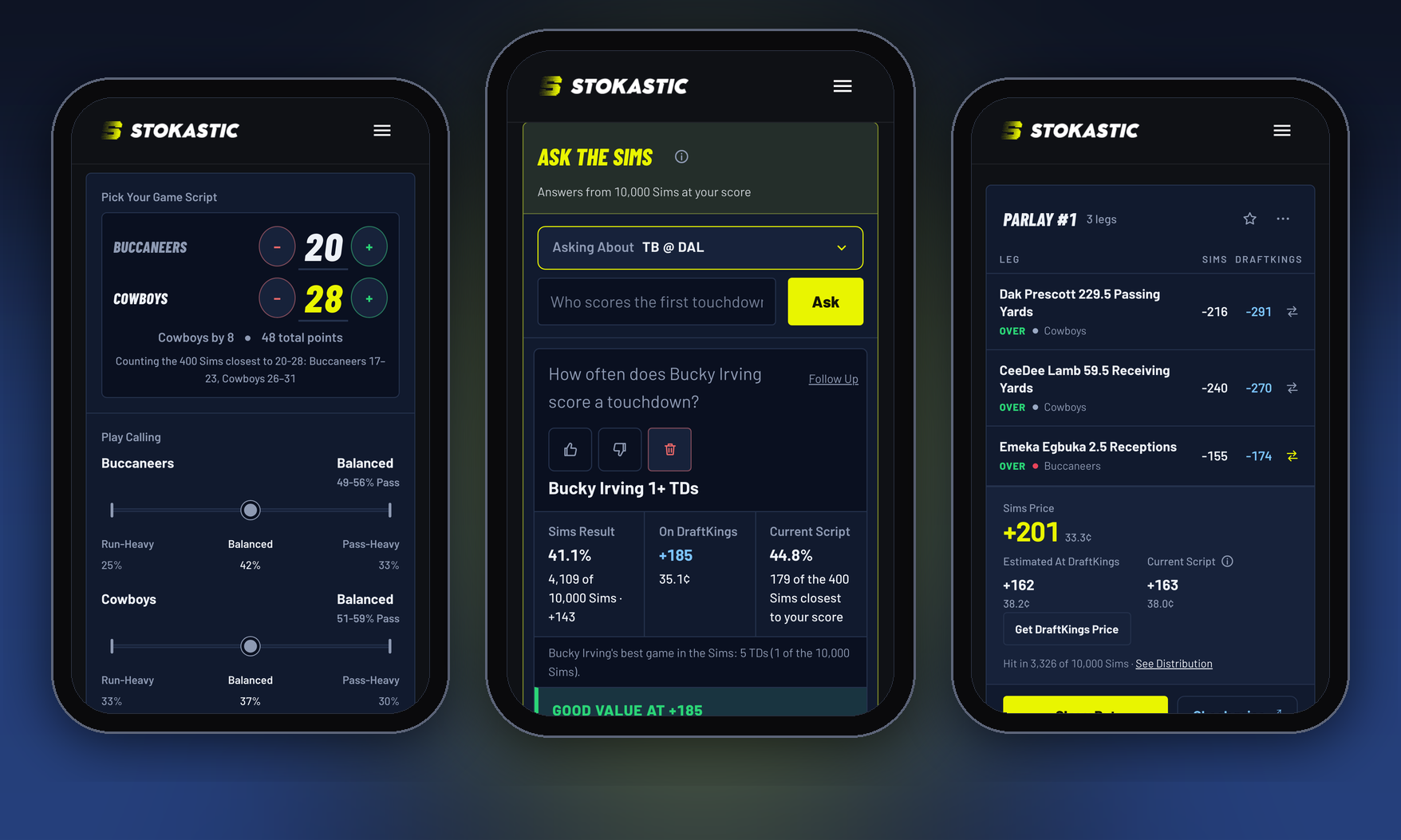 See what the parlay is worth before you place it. The DraftKings Parlay Simulator plays the game 10,000 times and prices any parlay you build next to the DraftKings odds, on your phone, free, no login.
In Summary
DraftKings makes it easy to fire your first NBA bet, which is exactly why a new bettor can lose money fast without ever knowing why. This guide covers the three core basketball markets (spread, moneyline, and total), how to read the prices attached to them, where props, parlays, live betting, and NBA futures fit, and which promos carry real value. Along the way you will meet the one number the app never puts on your screen, the one that decides whether the bet you just placed was worth making. Learning how to bet basketball on DraftKings takes about ten minutes. Learning what a bet is worth is the rest of the job, and it is what separates a beginner who slowly builds from one who slowly bleeds.
Watch The Video
Prefer to watch the walkthrough first? Here is the full breakdown on the OddsShopper YouTube channel. Watch on YouTube.
Getting Set Up And Finding Your Way Around
Signing up and depositing takes a couple of minutes, and like every book, DraftKings runs a welcome offer that hands new accounts bonus bets after a first qualifying wager. Claim it. A welcome offer is real value at any new sportsbook, though eligibility, wagering, and expiry terms always apply, so read them before you opt in. Terms and amounts change, so check the book's current offer and how to claim it before you deposit rather than trusting a number from an old video.
One thing to hold onto while you claim it: bonus bets are only worth what the price you spend them on is worth, which is the same idea the rest of this guide is built on. Once you are in, learn the layout before you bet a dime. Four tabs do almost all the work:
- Home is your hub for sports, promos, and everything else.
- In-Game is where you bet games that are already underway, live, from the first quarter to the fourth.
- My Bets is where every wager you have placed lives, open and settled.
- Rewards is the one most beginners ignore, and it is worth your attention. DraftKings runs one of the stronger loyalty programs in the space. You earn Crowns automatically on every wager, then redeem them once they pile up for site credit and other rewards in the DraftKings store.
The Three Core NBA Markets: Spread, Moneyline, And Total
Tap into an NBA game and you will see a wall of numbers. Most of them come down to three markets. Here is what each one means in plain terms.
| Market | What you are betting | How it works on an NBA game |
|---|---|---|
| Point Spread | A team to cover a margin | The favorite must win by more than the spread; the underdog can lose by less than it or win outright. |
| Moneyline | A team to win, straight up | Just pick the winner. The price sets the payout. |
| Total | The combined points, over or under | Bet whether both teams' points land over or under a posted number. |
The middle row is the one beginners reach for first, and there is a good reason to think twice about it. We will come back to that once the prices make sense.
The point spread exists because most matchups are not evenly matched, so the book sets a margin to level them out and let you bet either side without picking the outright winner. Say the 76ers are -5 against the Pacers at +5. Lay the Sixers at -5 and they have to win by 6 or more to cover. It does not matter whether they win by 6 or by 60; the bet pays the same. Take the Pacers at +5 and they cover by losing by 4 or fewer, or winning the game outright. Your payout is the same regardless of the exact margin. Once the spread makes sense in those terms, everything fancier gets easier.
One wrinkle to know early: the push. When the Sixers win by exactly 5 on a -5 spread, neither side wins, the bet is voided, and your stake is returned to your account.
The push ruleif the margin lands exactly on the spread, no one wins. The bet is void and your stake comes back. The half-point in the next market exists to prevent this.
The total is the most straightforward of the three. You are simply betting the combined score to go over or under a posted number. With a Sixers-Pacers total of 240.5, the over needs 241 points or more and the under wins on 240 or fewer. That half-point is called the hook, and it matters: a total ending in .5 cannot push, so every bet is a clean win or loss. It does not matter how the points get there. A 130-111 final is still 241 points to an over bettor.
The moneyline is just the winner, but the price is where beginners trip. Minus numbers are the favorite, the more likely result; plus numbers are the underdog, the less likely one.
A Worked Example: How To Read NBA Odds On The Sixers-Pacers
Numbers are easier with one in front of you. Say the Sixers are -198 on the moneyline and the Pacers are +164 (illustrative prices from the video, not tonight's board).
- Sixers -198. The minus sign marks the favorite. The number is what you stake to win $100, so a -198 line means betting $198 to win $100. Push the favorite to -400 and you would need $400 to win $100; the more negative the number, the more you risk for the same return.
- Pacers +164. The plus sign marks the underdog. The number is what a $100 stake wins you, so $100 returns $164 in profit if they pull the upset.
That is the entire language of American odds. You never have to bet exactly $100; the price just expresses the rate. Those prices also imply a win probability: a -198 favorite implies roughly a 66% chance to win before you strip the vig out, and a +164 underdog about 38%. If turning odds into probabilities still feels fuzzy, our how to read betting odds guide walks through the math step by step.
This answers the beginner question from the table above: why bet the Sixers -5 instead of just taking them on the moneyline? Because a heavy moneyline favorite forces you to risk a lot to win a little, while the spread offers a more even price in exchange for the team needing to win by a margin. Read the price, not just the side you like.
The Number DraftKings Never Shows You
Add those two implied probabilities together: 66% plus 38% is 104%. A game has exactly one winner, so the real total has to be 100%. That extra slice is the vig, the book's built-in commission, and it is priced into every NBA market on the app.
It is easiest to see on a total, where both sides usually sit at the same price.
Read that fourth row again, because it reframes everything above it. Strip the vig out and the market's honest read is a coin flip. Bet a coin flip at -110 and you risk $110 to win $100, so over time you hand back about 4.5 cents of every dollar you stake. That is the toll on the game line, and it is why "I won more bets than I lost" and "I made money" are not the same sentence. Our how to remove the vig guide shows the de-vig math on any price you are looking at.
The takeaway is not that the vig is unfair, it is that the vig is negotiable. Every regulated book sets its own hold on the same NBA game, so the price you pay depends on where you place the bet.
Beyond The Game Lines: Alt Lines, NBA Props, And Futures
Tap the game itself and DraftKings opens a much larger menu. A few areas worth knowing:
- Game Lines And Alternate Numbers. You can move the spread or the total off the standard line. Want the Sixers to win by 8 instead of 5? Adjust it and the payout grows, since a less likely outcome pays more, often flipping minus money to plus money. Our advice for a beginner: leave the alternate lines alone until you know what a good price looks like on the standard ones.
- Player Props. This is where DraftKings NBA betting gets deep: standard points, alternate points, three-pointers, and combos like points-rebounds-assists or rebounds plus assists. Props behave like small totals, but the odds swing harder and the hold runs wider. Say a points prop is hung at -130 over and +100 under, and run the same math: 56.5% plus 50% is 106.5%, or roughly a 6.1% hold, against the 4.5% you pay on the game line. Same de-vig arithmetic, noticeably steeper toll, which is why price discipline matters more here than anywhere else on the app. Start with our how to bet NBA points props guide before you build a card of them.
- Futures And Awards. Scroll all the way right across the app's bet menu and you will find season-long markets: MVP, the Finals winner, and the in-season tournament (now branded the NBA Cup). These tie up your stake for weeks or months, so treat them as a small slice of your action.
Parlays, Teasers, And Same-Game Parlays
A parlay combines two or more bets into one wager for a bigger payout. Each pick inside it is a leg, and every leg has to hit. Miss one leg of a five-leg parlay and the whole thing loses, which is why the bigger payout comes with much bigger risk. Teasers work similarly while letting you shift the spread or total in your favor across legs in exchange for a lower payout, though they are mostly a football product and you will see them far less on the NBA tab. (For the structured way to combine parlays so a single miss does not sink everything, see our how to bet round robins guide.)
A same-game parlay (SGP) combines multiple bets from one game, say a team's moneyline with a star's points prop, into a single wager at longer odds. Remember that 4.5% hold on a single total? You pay a cut on every leg you add, and on an SGP the book prices the correlation between those legs on top of it, which is precisely why sportsbooks promote SGPs so hard. They can be fun, but treat them as entertainment money, not the core of your slip. Our same-game parlay strategy guide covers when one is actually worth it.
Live (In-Game) NBA Betting
The In-Game tab lets you bet a game already in progress, and basketball suits it well because live NBA totals reprice off two things that move fast: possessions and free throws. Know what actually drives them and you know where the traps are.
- An Early-Quarter Under Is Usually A Shooting-Variance Bet, Not A Pace Read. A team shooting 60% in the first quarter drags the live total up, but shooting regresses and pace mostly does not. If the possession count has not changed, the model behind the number has barely moved and you are betting on shots to stop falling.
- Late-Game Intentional Fouling Is The Live Under's Killer. A trailing team fouling to stop the clock manufactures possessions and free throws in the last two minutes, and a total that looked comfortably under can gain 10 to 15 points in 90 seconds of game time.
- A Blowout Cuts The Other Way. Starters sit the fourth, the benches trade misses, and the live over dies quietly. Check the margin before you take a number built on full minutes.
The rule does not change in-game, it just gets harder to follow. Live prices carry a wider hold than pre-game ones and books hold your ticket for a beat before accepting it, so the number you tap is not always the number you get. Our NBA live betting strategy guide goes deeper on timing those spots.
DraftKings Promos, Boosts, And Rewards
DraftKings hands out real value, and some of it is worth claiming:
- Profit Boosts And Odds Boosts. A profit boost raises how much you win on a specific bet; an odds boost sweetens the price on a game, player, or sport. Both add value. But a boost does not automatically make a bet good, and it does not require the bet to already be good. The only question that matters is whether the boosted price beats the true, de-vigged odds. A big boost can flip a marginal play into a real one, and a small boost will not rescue a bad number. Run the math first. Our odds boosts strategy guide shows how to tell the difference.
- Bonus Bets. Promos pay in bonus bets, and a bonus bet is not worth its face value, because the stake is not returned when it wins. A $25 bonus bet is worth a fraction of $25 in real money, and how big that fraction is depends on the price you put it on. The free bet converter does that conversion for you and shows the price that squeezes the most cash out of one.
- Crowns And Rewards. You earn Crowns automatically on every wager, then redeem them for site credit and other rewards in the store. They accrue as you play, so claim them.
Worth rememberinga promo or boost is added value, not a guarantee. Bonus bets do their best work on longer-priced or +EV plays where the value compounds, not burned on a heavy favorite.
Shop The Number Before You Bet
Every NBA bet on DraftKings has a true price hiding under the vig, the fair number a sharp market would set. DraftKings prices its line around that number, so does every other book, and none of them land in the same place. When DraftKings is offering a worse price than the rest of the market, you are handing back money on a bet you would make anyway.
Say that same Pacers moneyline sits at +164 on DraftKings while another regulated book has it at +172. Illustrative numbers, but the size of the gap is ordinary: a few cents of price on a mainstream NBA moneyline. Same wager, better payout, $100 returns $172 instead of $164. That eight-cent gap is worth roughly 3% of your stake, on the same order as the entire 4.5% hold we just calculated, and it is available on a bet you were making anyway. With NBA games almost every night, it compounds into real money across a season.
Two habits, and that is the whole disciplinenever place a bet you have not compared somewhere else first, and track where the number goes after you bet it. Consistently beating the closing line is the best early evidence you are picking good sides. Our closing line value explained guide covers how line movement turns into a scorecard.
This is exactly what OddsShopper does for you. Its line shopping feed scans every major sportsbook available in your state, 20-plus books on most NBA markets, and for any basketball bet the tool surfaces which book has the best number and how that price stacks up against the true, de-vigged odds. The Portfolio EV view flags whether a bet grades +EV, priced in your favor versus the fair number, before you tap confirm, and the Odds Boost Evaluator shows whether a DraftKings boost actually clears +EV or just looks like it does. Pull up the NBA live odds screen and you can see the spread, moneyline, and total for every game lined up book by book. If the term +EV is new, our how to find EV bets guide is the next thing to read.
New to OddsShopper?It scans every major sportsbook in seconds and flags the NBA bets priced in your favor, so you can confirm DraftKings is giving you a fair number before you bet, and find a better one when it is not. Try it free for 7 days, and code NBABETEDGE20 takes 20% off OS Pro if you subscribe.
The One Thing To Remember
Betting NBA for beginners comes down to one idea: DraftKings will teach you how to place a bet, and it will never tell you what that bet was worth. Everything in this guide is in service of closing that gap. Read the spread and the total, not just the moneyline. Mind the price on every prop, where the hold runs widest. Claim the promos and Crowns that carry real value, treat pre-made boosts and SGPs with a clear head, and size your bets to your bankroll rather than your confidence (start with our bankroll management guide if that part is new). Then shop every number against the market so you are betting +EV instead of blind.
When you are ready for the layer above this one, our how to win at NBA betting guide picks up where the basics end, and for the full app walkthrough across every sport, see our how to bet on DraftKings guide. It is 21+ and legal only where regulated, so bet responsibly.
Frequently Asked Questions
How do I bet NBA on DraftKings as a beginner? Open the app, tap an NBA game, and read the three core markets: the point spread (the favorite must win by more than the number, the underdog covers by losing by less or winning), the moneyline (just pick the winner, the price sets the payout), and the total (over or under the combined points). Add a side to your bet slip, enter your stake, check the price, and place it. Mind the odds on every bet and shop the number before you confirm.
What does the point spread mean in NBA betting? The spread is a margin the book sets to even out a mismatch. If a team is -5, they have to win by 6 or more to cover; their opponent at +5 covers by losing by 4 or fewer or winning outright. If the favorite wins by exactly 5, it is a push and your stake is returned. You win the same amount no matter how big the covered margin is.
How do I read DraftKings NBA odds? A minus number is what you stake to win $100 (a -198 favorite means $198 to win $100). A plus number is what a $100 stake wins you (a +164 underdog means $100 wins $164). Totals and spreads use the same scale, while props swing more, so always check the price, not just the side.
What is the vig on a DraftKings NBA bet? The vig is the book's commission, baked into the price rather than charged separately. When both sides of an NBA total sit at -110, each implies a 52.4% chance, which adds to 104.8% instead of 100%. That overage is roughly a 4.5% hold. De-vigging strips it out to reveal the market's true probability, which is the number your bet actually has to beat.
What is the hook in a total? The hook is the half-point at the end of a number, like a total of 240.5. Because the combined score can never land on a half-point, a total with a hook cannot push. The over needs 241 or more and the under wins on 240 or fewer, with no possibility of a tie.
Are DraftKings odds boosts worth it for the NBA? Sometimes. A boost adds value, but it does not automatically make a bet good, and the bet does not have to be good already. What matters is whether the boosted price beats the true odds. A large boost can turn a marginal bet into a play, while a small one will not save a bad number. Run any boost through an odds boost evaluator before you take it.
DraftKings is easy to bet the NBA on and easy to lose on. The gap is mostly which prices you take. OddsShopper compares every major sportsbook, surfaces the best number on any basketball bet, and tells you whether it is actually +EV against the de-vigged odds, plus an Odds Boost Evaluator so pre-made boosts cannot fool you. Try it free for 7 days; code NBABETEDGE20 is 20% off OS Pro after that. Must be 21+ to wager. If you or someone you know has a gambling problem, call or text 1-800-GAMBLER.
More on this: NFL Win Totals 2026: Kalshi Vs DraftKings Vs FanDuel · NBA Championship 2027 Odds: Live Title Prices By Team · NBA Next Team Odds: Every Star's Landing-Spot Market, Scored · How To Bet NBA Assists Props: A Strategy Guide · How To Bet NBA Points Props: A Strategy Guide