Kalshi Player Props: How To Bet On Players On Kalshi (Cross-Sport Guide)
Most people find Kalshi through the game markets and never notice the exchange also lists player props, priced not as a line with juice but as a yes/no question in cents. Here's what's actually live on the board this week, straight off the exchange.
Real listed markets, stamped Friday, September 11, 2026, 11:48 AM ET:
| Player | Game | Market | Kalshi Yes (bid/ask) |
|---|---|---|---|
| Ja'Marr Chase | Buccaneers @ Bengals, Sun 9/13 | 7+ receptions | 55¢ / 58¢ |
| Trey McBride | Cardinals @ Chargers, Sun 9/13 | 6+ receptions | 54¢ / 58¢ |
| Trey McBride | Cardinals @ Chargers, Sun 9/13 | 60+ receiving yards | 38¢ / 48¢ |
| Jahmyr Gibbs | Saints @ Lions, Sun 9/13 | 70+ rushing yards | 61¢ / 66¢ |
| De'Von Achane | Dolphins @ Raiders, Sun 9/13 | 70+ rushing yards | 49¢ / 50¢ |
| Patrick Mahomes | Broncos @ Chiefs, Mon 9/14 | 2+ passing touchdowns | 43¢ / 46¢ |
Anytime-touchdown props get their own live board on our NFL anytime TD cheat sheet; this page covers the rest of the menu, from receptions to passing yards, and how to read and price it.
Why A Kalshi Player Prop Is A Yes/No Question, Not A Line
Start with the wrapper, because it changes everything downstream. A sportsbook builds a player prop as a line and two prices. It sets a number, say 6.5 receptions, and then quotes each side with juice: Over 6.5 at -130, Under 6.5 at +110. You are betting whether the real result clears the book's number, and the juice is how the book gets paid on both sides.
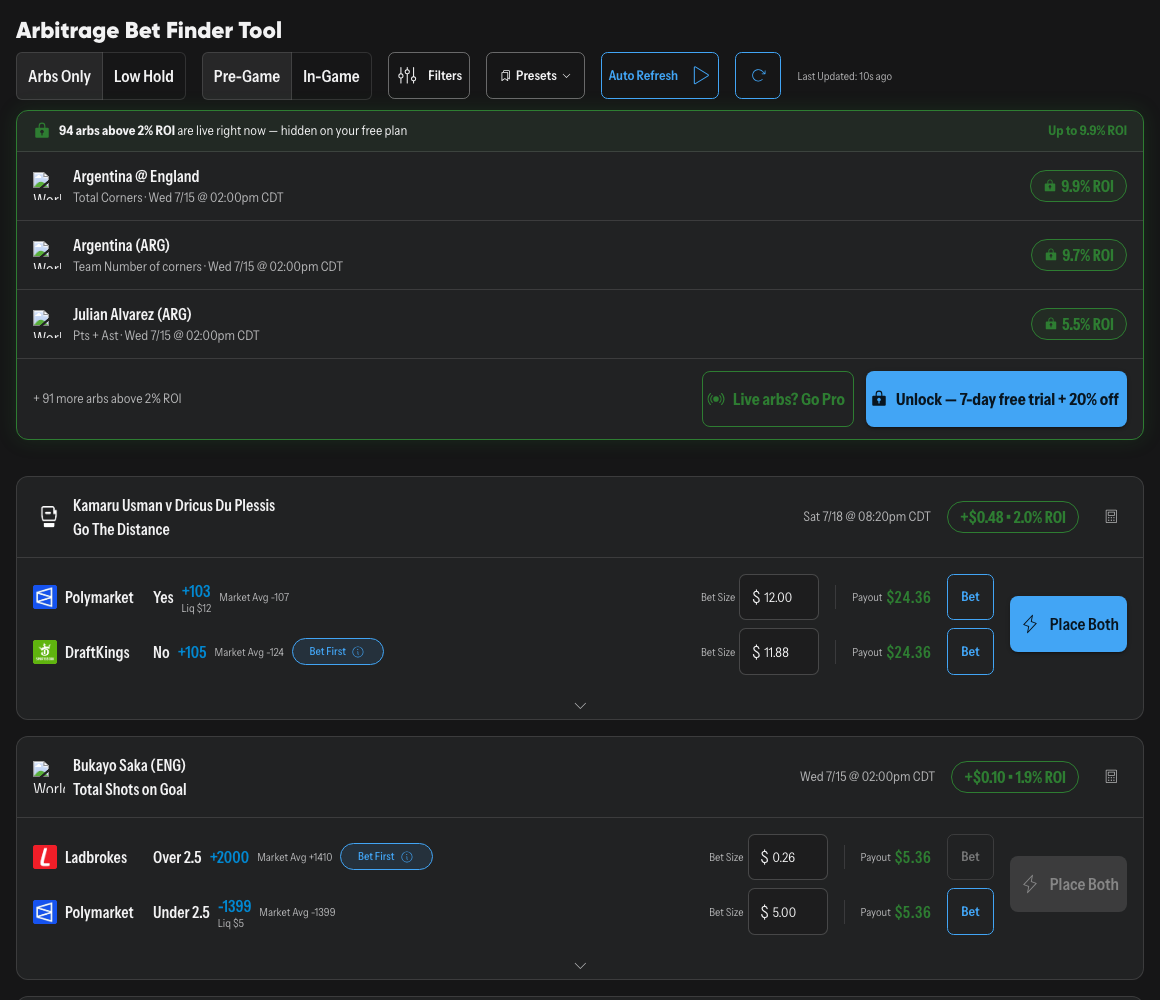
The OddsShopper Arbitrage Tool.
Kalshi does not post a line. It posts a precisely worded question with a fixed threshold and lets the market price the answer. The same receptions bet becomes a contract like "Will [Player] record 7 or more receptions?" trading at, say, 58 cents for Yes. If the player gets there, the contract resolves Yes and settles at $1.00; if not, it resolves No and settles at $0.00 — which means the 58-cent price is the market's read that the event is about 58% likely. There is no separate "under" line to juice; the No side is simply the mirror, trading near 42 cents, because Yes and No have to add up to roughly a dollar.
Two things fall out of that immediately, and both matter before you risk a cent. First, the threshold is exact and it is not always the book's number. A book's "Over 6.5" clears at 7, so a Kalshi "7 or more" contract is the same bet, but always read the contract wording rather than assuming it matches the line you saw elsewhere. Second, the cent price is already a probability, the same clean read our Kalshi odds guide walks through in full, and that is exactly what makes the exchange price so easy to compare to a de-vigged book number later. Hold that; it is the promise this guide pays off at the end.
Here is the same prop, side by side in both formats:
| Sportsbook player prop | Kalshi player prop | |
|---|---|---|
| Shape | A line plus two prices (Over 6.5 receptions, -130 / +110) | A yes/no question with a fixed threshold ("7 or more receptions?") |
| How It's Priced | American odds with juice on both sides | A single cent price, 1 to 99, that reads as a probability |
| The Cost You Pay | The book's two-sided hold, baked into the line | The bid-ask spread plus a separate trading fee |
| What "Over" Looks Like | Bet the Over at the posted juice | Buy Yes at the ask price |
| To Compare, You Must | De-vig the line to a fair probability first | Add the fee to the cent price for your true break-even |
The Kalshi Player-Prop Menu, Across Sports
The Kalshi props menu is wider than the "who wins" markets most people associate with the exchange, and it spans sports. The player markets bettors actually shop break down like this:
- Football — passing yards, rushing yards, receiving yards, receptions, and touchdown markets, each phrased as a yes/no threshold. Some break out further, into halves or quarters rather than full-game totals, and defensive props surface on the deeper boards.
- Basketball — the same structure carries across points, rebounds, assists, and three-pointers.
Depth is not even across Kalshi player markets, and that is the part that actually governs whether a price is worth trading. NFL and NBA carry the deepest order books, meaning the most contracts, the tightest spreads, and the most volume behind a quoted price, while smaller sports and more exotic player thresholds can be thin or absent entirely. Thin markets are where the exchange's spread cost bites hardest, which is the whole subject of our Kalshi liquidity guide; a headline price on a market nobody is trading is not a price you can actually get filled at in size. The practical read before you trust any posted prop: check the depth sitting at the ask and how far the price jumps to fill your intended size. If a one- or two-contract order moves the market, the headline probability is not a number you can actually bet, no matter how attractive it looks.
One honest caveat governs everything in this sectionavailability varies by week and by state, so check the live board rather than trusting a menu from an article. Player-prop listings expand around marquee slates and thin out otherwise, contracts get added and retired, and what is offered depends on where you are. Treat the categories above as the shape of the menu, not a guarantee that a specific player's specific threshold is posted right now.
How Exchange Prop Pricing Works: Spread And Fees, Not Vig
Here is where the callback earns its place. A sportsbook charged you through two-sided juice: the Over at -130 and the Under at +110 don't sum to a fair 100%, and that gap is the book's hold. Kalshi does not bake a hold into a line, because there is no line. Instead the cost of trading a player prop on the exchange comes from two other places, and you pay them differently.
The first is the bid-ask spread. Kalshi is an exchange: you are trading against other participants, not against a house. You buy Yes at the current ask and, if you want out early, sell at the current bid, and the gap between those two is a real cost you eat on the way in and the way out. On a deep NFL or NBA prop that spread can be a cent or two; on a thin market it can be wide enough to erase your edge before the event even starts.
The second is Kalshi's trading fee, charged on top of the price rather than hidden inside it. The fee scales with how close the contract is to a coin flip, largest near 50 cents and smallest out at the extremes, and our Kalshi fees guide carries the exact formula. The practical consequence is the one that trips up newcomers: the fee raises your true break-even above the sticker price. A contract that reads as 58 cents does not break even at 58% once the fee is layered on; it needs a little more than that to profit. So the honest cost comparison is not "exchange versus book vig" in the abstract. It is spread-plus-fee on Kalshi against the de-vigged book price on the same player, which is exactly the comparison worth building next.
Worked Example: Comparing A Kalshi Prop To A Sportsbook Prop
Numbers here are illustrative — plug in the live prices you actually see — but the mechanism is exactly how the comparison works.
Say you like a receiving prop. A sportsbook posts Player X Over 6.5 receptions at -130, with the Under 6.5 at +110. Convert each price to an implied probability: -130 is about 56.5%, and +110 is 47.6%. Add them and you get roughly 104.1%. That extra ~4 points is not a probability; it is the book's hold, the margin baked into the two-sided price. To read the book's true estimate you have to strip that hold out. De-vig the pair and the Over's fair probability lands near 54%, which in American odds is about -119 (a modest favorite).
Now walk over to Kalshi. The matching contract is "Will Player X record 7 or more receptions?", the same bet, because clearing 6.5 means landing on 7. Suppose Yes is trading at 58 cents. That is a raw 58% read, but remember the fee: near a coin-flip price it adds a bit to your break-even, so call the effective cost something like 60%. Set the two honest numbers next to each other and the decision is mechanical from here:
| The Same Receptions Bet (Illustrative) | Sticker price | Honest cost |
|---|---|---|
| Sportsbook Over 6.5 At -130 | ~56.5% implied | ~54% fair after the de-vig |
| Kalshi "7 Or More?" Yes At 58¢ | 58% | ~60% effective after the fee |
54% fair at the book versus about 60% effective on Kalshi. On this event, at these prices, the book is the cheaper venue for the Over, and there is no exchange edge to take.
Flip one number and the answer flips with it. If that same Kalshi Yes were sitting at 51 cents instead of 58, its fee-adjusted cost would land under the book's 54% fair line, and now the exchange is the cheaper way to back the same outcome. That is the entire game with player props on Kalshi: not "which price looks lower," but which price is lower after you have de-vigged the book and fee-adjusted the contract. Do that math on both sides, or let a tool do it for you.
Where To Compare: No-Vig Fair Odds Vs A Kalshi Contract
Everything above hinges on one step people skip: de-vigging the sportsbook prop before you compare it to anything. Eyeballing -130 against 58 cents is meaningless, because -130 is a probability plus the book's margin and 58 cents is a clean probability. You have to make them the same kind of number first.
That is what the no-vig fair-odds pricing on the OddsShopper odds screen does. For a supported two-way prop, it takes both sides of the book's line, removes the hold baked into that price, and estimates the book's true implied probability — turning "-130 with a ~4% hold" into "about 54% fair" without you doing the arithmetic by hand. From there the comparison is the clean side-by-side the worked example walked through. The same screen runs line shopping across every major sportsbook to find the best prop price in the first place, an EV calculator prices any number as a probability, and the arbitrage finder surfaces cross-book arbitrage and the no-vig fair price on each side. Note the tools price the sportsbook side; they do not ingest Kalshi contracts, so you take that de-vigged book number and hold it against the Kalshi cent price yourself. If you would rather start from someone else's homework, our free expert picks today show the same discipline applied to live markets, and prediction-market strategy for Kalshi goes deeper on trading the exchange side. And when the de-vigged book number and the exchange price disagree by enough, the same comparison graduates into prediction-market arbitrage — backing both sides of the gap instead of picking one.
See the real price on both sides.OddsShopper Pro prices sportsbook props at no-vig fair odds, so you can hold a book's true probability next to a Kalshi contract's cent price and see which venue is truly cheaper on the same player. Use code KALSHIPROPS20 for 20% off your first payment.
For the book side of the ledger, our guides to player props betting and NFL player props cover the sportsbook version of these same markets — worth reading alongside this one, since the whole point is comparing the two. And if you are still new to the exchange itself, start with the how to bet sports on Kalshi hub, or compare venues in Kalshi vs Polymarket.
Prefer to trade the same class of markets on Polymarket?The Polymarket US App is a separate CFTC-regulated venue, and its event contracts price in cents the same way. Our link carries offer code OS3 — a $50 trading bonus after a $10 deposit and your first qualifying trade (credits once the trade is placed) for new users: claim it here. It is a trading bonus you use to take positions, not instant withdrawable cash. State availability is its own map and can change, so confirm in the app before you sign up; full terms are in our Polymarket sign-up bonus guide.
18+ Only. Restrictions and eligibility requirements apply. Not available in all jurisdictions. Trading is risky. 100% loss can occur. See polymarket.com/tos for more information. The Polymarket US App serves as an independent software provider and affiliate of Polymarket US and Polymarket Clearing, the CFTC-regulated exchange and clearing organization. OddsShopper is a Polymarket partner and we may earn a commission if you sign up through our link.
More on this: NFL Comeback Player Odds: Kalshi Sleeps on Daniel Jones · PFA Player Of The Year 2026 Odds: Kalshi's Big Fernandes Bet · NFL Comeback Player Of The Year Odds: The Missing Favorite · Offensive Player of the Year Odds: Kalshi's Saquon Discount · NFL Defensive Player of the Year Odds: The Full 2026 Field
Before You Trade: State Rules And Eligibility
Kalshi's availability is not the same map as a sportsbook's, and that map is being redrawn in court in real time. As a CFTC-designated exchange, Kalshi operates in 40-plus states, including some where sportsbooks are not legal at all — because the mechanism at work is federal preemption, not state gambling law. In an April 2026 ruling, a federal appeals court (the Third Circuit) sided with Kalshi on Commodity Exchange Act preemption, holding the CFTC likely has exclusive jurisdiction over sports event contracts; that decision blocked New Jersey from enforcing its gambling law against the exchange and keeps contracts live in that circuit while the case heads toward possible en banc or Supreme Court review. Other states have pushed the opposite way, and the picture is split: while the Third Circuit blocked New Jersey's enforcement, courts elsewhere have let state regulators keep contesting Kalshi's sports contracts, and states such as Arizona, Maryland, Nevada, and Ohio have been among those restricting or contesting sports contracts as of our July 2026 check. The point is not the exact roster on any given week; it is that this list is split and shifts on court rulings, sometimes fast. Because prediction-market legality is a separate question from sportsbook legality, do not assume your state's sports-betting status tells you anything here. Check Kalshi's own eligibility tool on the day you fund an account, and see are prediction markets legal for the wider picture.
Minnesota, specifically.A Minnesota law effective August 1, 2026 makes it a felony to create, operate, host, or advertise a prediction-market platform in the state. It targets platforms and operators, not individual traders, and it is under active litigation — but the practical result for a Minnesota resident is that these markets are expected to stop being offered there. We do not encourage anyone in Minnesota to trade these contracts. Get current local guidance rather than relying on this paragraph.
This is written for a legal-age audience, and none of it is financial, tax, or legal advice. Prediction-market contracts carry fees and liquidity risk, and prices can move against you.